Why it represents the country
The European bison has never been named Belarus's national animal by law, but it is the animal most widely treated as a symbol of the country. The National Library of Belarus lists the bison, together with the stork, the cornflower, flax and clover, among the symbols of the country, and calls it the visiting card of Belarus's rich and diverse fauna. In 2019 the library also installed a sculpture called Zubr, which it describes as a symbol of Belarus.
The European bison also appears in regional heraldry. The coat of arms and flag of the Brest Region, approved by presidential decree No. 446 on 14 September 2004, show a yellow bison on a red stylized tower, set on a blue field.
The European bison's place in the country's culture goes back centuries. A Latin poem devoted to the animal, A Song about the Appearance, Savagery and Hunting of the Bison, was printed in Kraków in 1523; the National Library of Belarus honours its author, Mikola Husousky (Nicolaus Hussovianus), as a poet and humanist. Today Belovezhskaya Pushcha, one of the European bison's last refuges in the wild, is the heart of the bison's story in Belarus.
About the animal
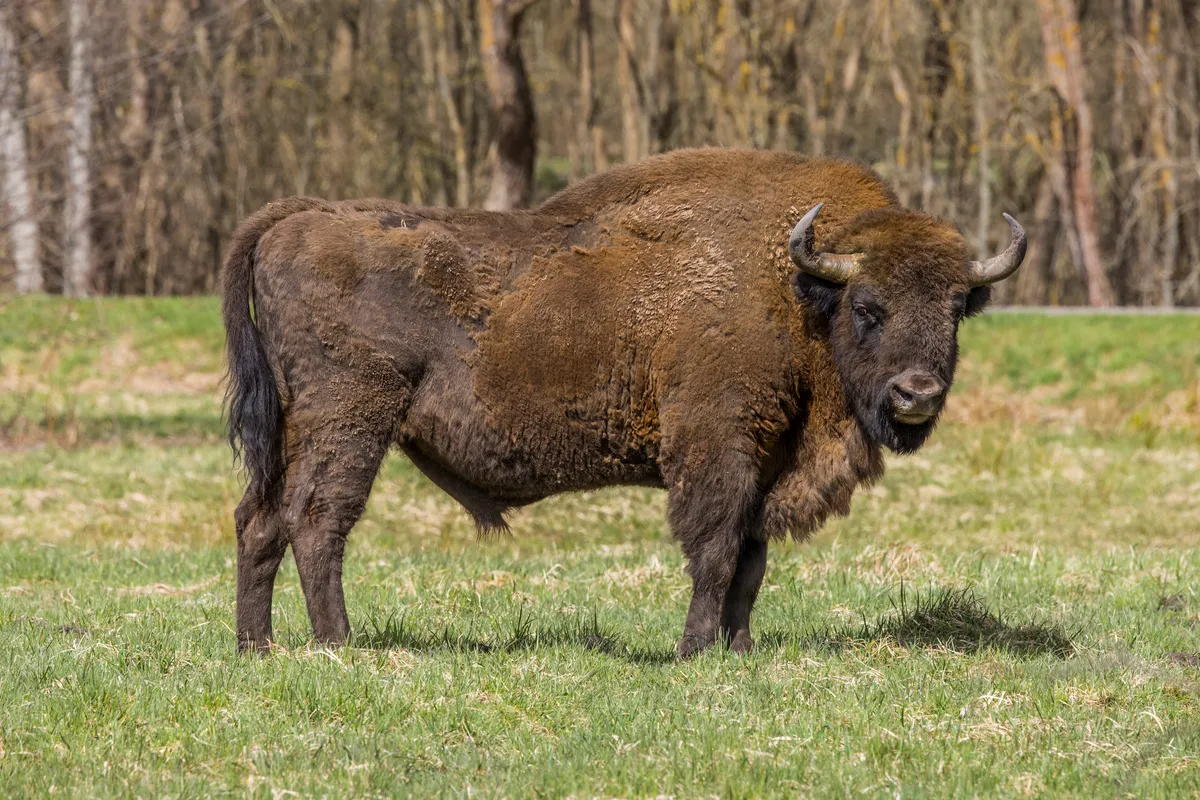
The European bison is one of the largest land mammals in Europe. According to the Belovezhskaya Pushcha National Park, adult males measure 255 to 305 centimeters in body length, stand 170 to 195 centimeters tall at the chest and weigh 600 to 850 kilograms, sometimes close to a tonne. Females are somewhat smaller, at 400 to 600 kilograms. The coat is less shaggy than that of the American bison and ranges from golden brown to dark brown, and the hump is more developed in males.
European bison usually live in broad-leaved or mixed forests that form a patchwork with open areas such as meadows and clearings, and deciduous forest suits them best. About 90% of their diet is grasses, sedges and herbs, and the rest comes from trees. They are active by day, alternating feeding with rest and chewing the cud.
European bison live in groups. Mixed herds of cows, young animals aged 2 to 3, calves and adult bulls average 8 to 13 animals, while bulls often form small groups of about 2. In free-ranging herds the rut runs from July to October, pregnancy lasts about 264 days, and a cow usually gives birth to a single calf. In the wild, European bison typically live 14 to 24 years.
Conservation
The European bison is listed as Near Threatened on the IUCN Red List as a species; it was moved there from Vulnerable in December 2020. In the early 20th century it survived only in captivity, and every European bison alive today descends from just 12 founder animals. After reintroductions that began in the 1950s, the number of wild bison grew from around 1,800 in 2003 to over 6,200 in 2019. Still, most of the 47 free-ranging herds are isolated, only 8 are large enough to be genetically viable in the long term, and the species remains dependent on ongoing conservation measures.
In Belovezhskaya Pushcha, the number of bison peaked at 1,898 in 1857. Competition with other hoofed animals, cattle grazing and poaching during the First World War caused a collapse, and in 1919 the last bison living in the wild there was killed; only 52 bison survived in zoos in Western Europe. In 1946 the first 5 bison, bought in Poland, were brought to the Belarusian part of the forest, and in 1953 bison were released into the wild again. When the herd grew beyond the area's recommended optimum of 250 animals, some were moved to other parts of Belarus: between 1994 and 2005, 95 bison captured in Belovezhskaya Pushcha founded new free-living populations, and the country's total grew from 347 in 1994 to 1,156 in 2012.
According to the latest edition of the European bison pedigree book, there were 12,209 European bison worldwide as of 31 December 2024, and 2,927 of them, or 24.0%, lived in Belarus. On 1 January 2026, the Belarusian part of Belovezhskaya Pushcha alone held 784 bison, 58 more than a year earlier.
Fun facts
- In 1857, Belovezhskaya Pushcha held 1,898 European bison, the highest number ever recorded there.
- A whole Latin poem about the European bison was printed in Kraków in 1523.
- Every European bison alive today descends from just 12 founder animals.
Frequently asked questions
What is the national animal of Belarus?
The national animal of Belarus is the European bison (a widely recognized national symbol, not set by law). The European bison, or zubr, is one of the largest land mammals in Europe and appears on the coat of arms and flag of the Brest Region.
Which country has the European bison as its national animal?
The European bison is the national animal of Belarus. The European bison is also known as wisent or zubr.
Why is the European bison the national animal of Belarus?
The European bison is not named in any law, but the National Library of Belarus lists it among the symbols of the country, and it appears on the Brest Region's coat of arms and flag. Belovezhskaya Pushcha, where bison were brought back in 1946, makes the animal a living emblem of Belarusian nature.
Is the European bison endangered?
The European bison is listed as Near Threatened on the IUCN Red List as a species, after being moved up from Vulnerable in December 2020. Its wild numbers grew from around 1,800 in 2003 to over 6,200 in 2019, but it still depends on ongoing conservation measures.
Where does the European bison live?
Broad-leaved and mixed forests with meadows and clearings; in Belarus, Belovezhskaya Pushcha and other protected forests.
Sources
- National Library of Belarus. Do not Miss the Wonderful Moments! (exhibition, 21 February 2020).
- National Library of Belarus. Book Bison settles in the National Library (5 November 2019).
- National Library of Belarus. Mikola Husousky (Nicolaus Hussovianus).
- Flags of the World (FOTW). Brest Region (Belarus).
- National Park Belovezhskaya Pushcha. Fauna.
- European Bison Conservation Newsletter (P. Kozlo, 2013). Analysis of reintroduction and formation of European bison populations in Belarus.
- Reform.news. Belarus Is Home to 24% of the World's European Bison Population (17 November 2025).
- Reform.news. Belarusian Part of Belovezhskaya Pushcha Counts 784 Bison (26 March 2026).
- IUCN. European bison recovering, 31 species declared Extinct – IUCN Red List (10 December 2020).
- Animal Diversity Web (University of Michigan). Bison bonasus.
- Conservation status: IUCN Red List of Threatened Species.