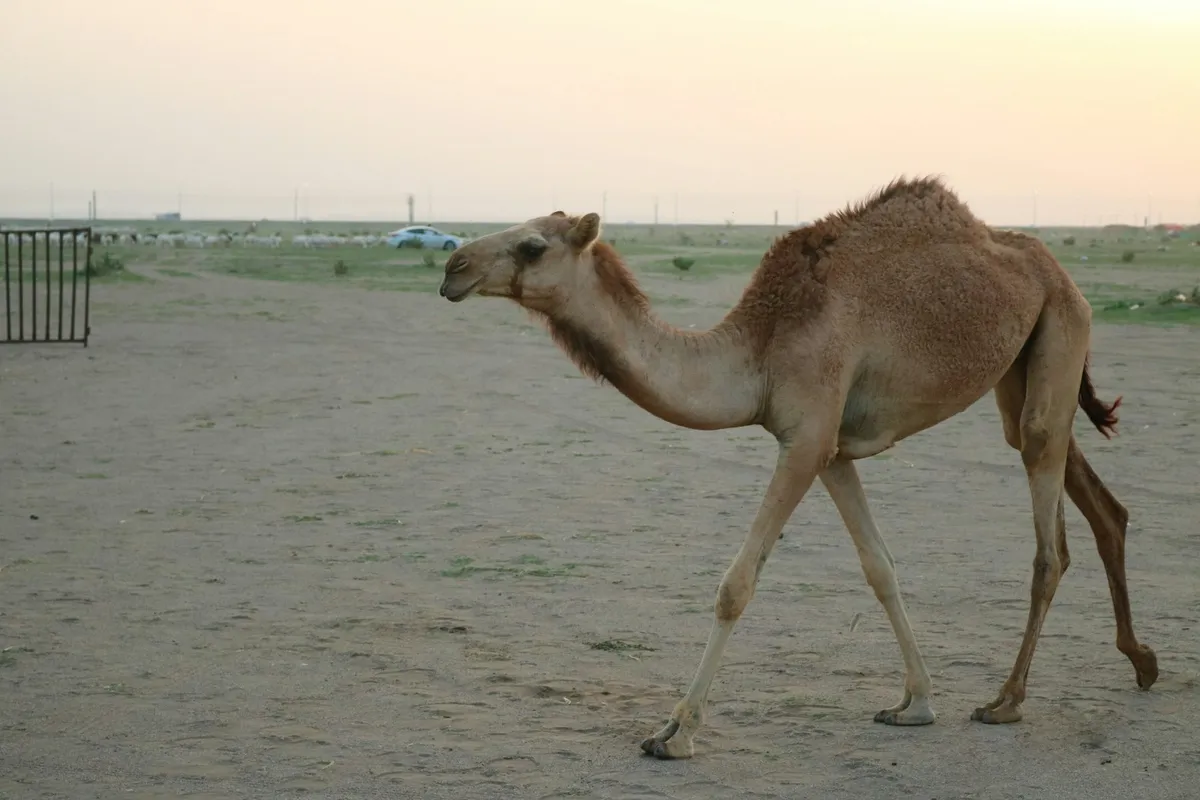
Why it represents the country
The dromedary camel is described as Saudi Arabia's national animal by regional media such as Arab News and Middle East Eye, which note that the choice comes as no surprise for a country of vast deserts. No law naming a national animal has been found, but the camel's place in Saudi life is deep: it is often called al-halal and al-mal, words linked to livelihood and wealth.
The camel received national recognition when the Saudi Council of Ministers, chaired by King Salman, declared 2024 the Year of the Camel. The Ministry of Culture led a year of events, from exhibitions and educational programmes to a camel parade in Paris, and the designation coincided with the United Nations' International Year of Camelids.
The dromedary camel has shaped Arabian history for thousands of years. Thousands of rock engravings and drawings in Saudi Arabia's mountains show camels on trade, pilgrimage and travel routes, and a life-size camel carved into rock in the Al-Jouf region may be one of the earliest of its kind. Saudipedia notes that King Abdulaziz, the Kingdom's founder, relied on camels during his journeys to unify the country.
About the animal
The dromedary is the camel with a single hump. Adults are about 2.2 to 3.4 meters long and stand roughly 1.6 to 2 meters at the shoulder, and most weigh between 400 and 600 kilograms, with males about 10 percent heavier than females.
The dromedary's hump stores fat, not water. When food is scarce, the camel lives off this fat and the hump shrinks and droops. A camel can go a week or more without drinking and then drink up to 145 liters in one session. It can survive losing more than 30 percent of its body water, while most mammals die at about 15 percent, and its body temperature can swing from about 34 to 41.7 degrees Celsius during the day, so it sweats less and saves water.
The dromedary is well protected against sand. It has a double row of long eyelashes, a thin extra eyelid that sweeps across each eye, and nostrils it can close during sandstorms. Its broad, padded feet spread its weight on soft sand, and it can walk about 32 kilometers a day while carrying loads.
A female dromedary usually gives birth to a single calf after a pregnancy of about 15 months. Dromedaries can live 40 to 50 years, mainly in captivity. They are herbivores that browse on thorny plants, dry grasses and saltbush.
Conservation
The dromedary camel is a domestic animal and has not been assessed on the IUCN Red List. Evidence of camel domestication goes back about 4,000 years, to a small island off the coast of Abu Dhabi, and tribes in northern Arabia began riding camels about 3,100 years ago. Truly wild dromedaries disappeared about 2,000 years ago, and today the species exists only as a domesticated animal.
Saudi Arabia is home to around 2.2 million camels, according to government figures released in 2024. The Ministry of Environment, Water and Agriculture has announced plans to issue official camel passports to improve oversight of ownership and regulate the sale, transport and trade of camels. The Camel Club, set up by royal decree in 2017, works to preserve the camel as part of the Kingdom's heritage.
The dromedary camel's cultural heritage is also protected. In 2022, Alheda'a, the oral tradition herders use to call their camels to water, pasture and milking, was inscribed on UNESCO's Representative List of the Intangible Cultural Heritage of Humanity in a joint nomination by Saudi Arabia, Oman and the United Arab Emirates.
Fun facts
- A dromedary camel can drink up to 145 liters of water in a single drinking session.
- Saudi Arabia's first organized camel race was held in 1963.
- In 2022, the herders' camel-calling tradition Alheda'a was added to UNESCO's list of intangible cultural heritage, shared by Saudi Arabia, Oman and the United Arab Emirates.
Frequently asked questions
What is the national animal of Saudi Arabia?
The national animal of Saudi Arabia is the dromedary camel (a widely recognized national symbol, not set by law). The dromedary is the one-humped Arabian camel, a domestic desert animal that Saudi Arabia celebrated with a national Year of the Camel in 2024.
Which country has the dromedary camel as its national animal?
The dromedary camel is the national animal of Saudi Arabia. The dromedary camel is also known as Arabian camel or one-humped camel.
Why is the dromedary camel the national animal of Saudi Arabia?
The dromedary camel is seen as Saudi Arabia's national animal because camels carried people and goods across the Arabian deserts for thousands of years and remain central to Saudi heritage. No law naming it has been found, but the Council of Ministers declared 2024 the Year of the Camel to honor its place in the Kingdom's culture.
Where does the dromedary camel live?
Hot, dry deserts and semi-deserts, where it lives only as a domestic animal; in Saudi Arabia, herds are kept across the Kingdom's desert regions.
Sources
- Arab News. Cute carnivores and beautiful birds: Six national animals from across the Arab world (27 June 2018).
- Middle East Eye. Seven national animals from the Middle East and what they represent (5 May 2022).
- Onmanorama (with IANS). Saudi Arabia designates 2024 as the year of desert's gentle giant (12 January 2024).
- Gulf News. Saudi Arabia designates 2024 as Year of Camels.
- Arab News. As the Year of the Camel ends, Saudi Arabia celebrates 'timeless companion' to Arabs (31 December 2024).
- Arab News. Camels on the global stage as Saudi Arabia celebrates a national symbol (23 June 2022).
- Saudipedia. What Is the Significance of Camels in Saudi Culture?.
- Saudipedia. Year of the Camel 2024.
- Gulf News. Saudi Arabia to issue passports for millions of camels.
- UNESCO Intangible Cultural Heritage. Alheda'a, oral traditions of calling camel flocks (inscribed 2022).
- Animal Diversity Web (University of Michigan). Camelus dromedarius.
- San Diego Zoo Wildlife Alliance. Camel.
- Conservation status: IUCN Red List of Threatened Species.