Why it represents the country
The Andean condor is the bird that crowns Bolivia's coat of arms, shown about to take flight above the shield. Supreme Decree No. 241 of 5 August 2009, which sets the rules for Bolivia's state symbols, describes the condor as the representative bird of Bolivia and says it stands for the search for horizons without limits.
The Andean condor received its own law in Bolivia in 2023. Law No. 1525 of 9 November 2023, the comprehensive law for the protection and conservation of the Andean condor, Kuntur Mallku, declares the bird a symbol and natural and cultural heritage of the Plurinational State of Bolivia, and sets 4 February of every year as Andean Condor Day.
The condor, known in Bolivia as the mallku, has deep spiritual and cultural meaning in the Andean world view. A llama also appears on Bolivia's coat of arms, where it stands for the richness of the country's typical fauna, and some sources call the llama Bolivia's national animal; however, the condor is the only wild species on the national crest and the only animal named a national symbol by law.
About the animal
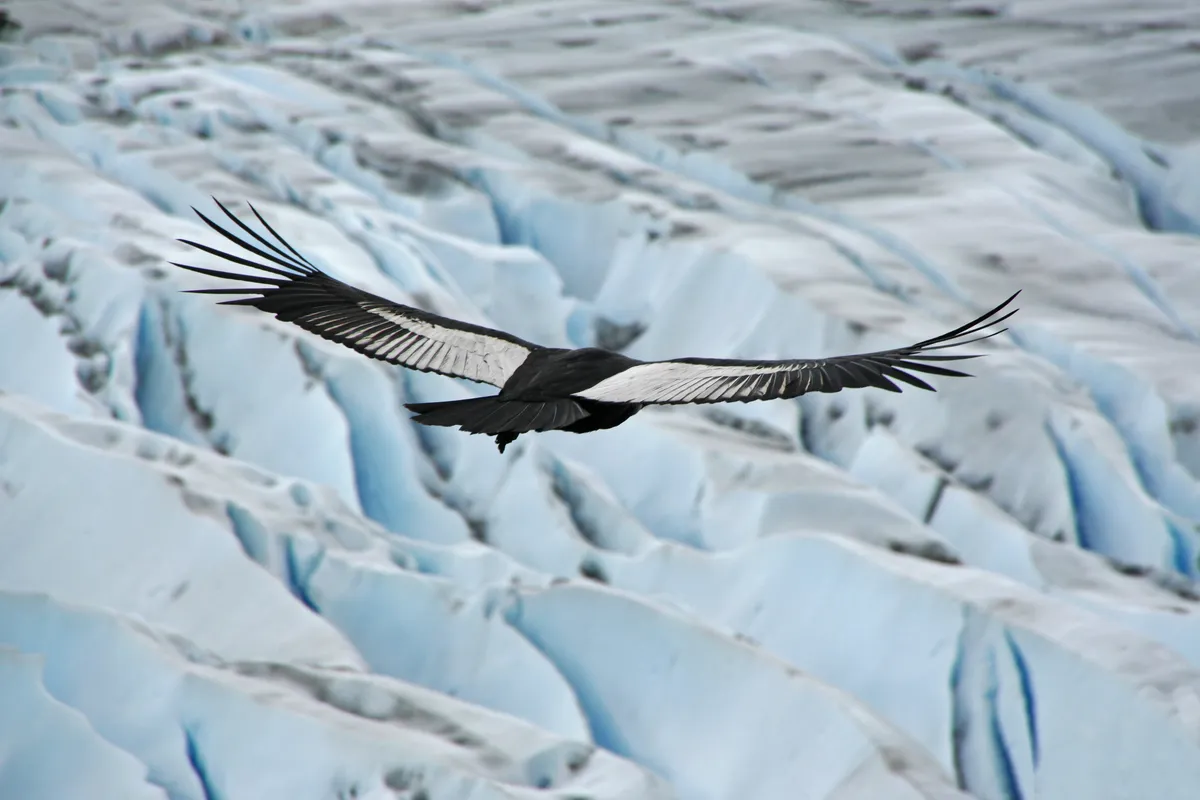
The Andean condor is a huge black vulture with a ruff of white feathers around the neck and a bare head. Adults are roughly 0.9 to 1.3 meters long, weigh up to about 15 kilograms and have a wingspan of up to 3.2 meters, the longest of any bird of prey. Males are larger than females and carry a fleshy comb on the head, while females have no comb and red eyes. Young condors are grayish brown and lack the white ruff.
The condor is a master of soaring. It rides rising air and may flap its wings only about once an hour; one bird was seen flying more than 160 kilometers without flapping at all. Condors can soar as high as 5,500 meters.
The Andean condor is mainly a scavenger that feeds on dead animals, and it can eat more than 6.8 kilograms of meat at one time. By clearing away carcasses, it helps keep high Andean ecosystems healthy.
Condors breed very slowly. The female lays a single egg on bare ground in a rock cavity or cave, without building a nest, and the parents take turns incubating it for about 50 to 60 days. The chick leaves the nest at around six months, but its parents keep caring for it for about a year and a half, so a pair usually raises only one chick every other year. Condors can live into their late 50s or 60s.
Conservation
The Andean condor is listed as Vulnerable on the IUCN Red List, having been moved up from Near Threatened in 2020. BirdLife International says only around 7,000 adults are left across the species' range, and that poisoning is the top threat, followed by illegal hunting, wildlife trade, competition from feral dogs and collisions with energy infrastructure.
Bolivia remains one of the species' strongholds. Biologist Diego Méndez, drawing on a 2014 survey of the Bolivian Andes, estimated about 1,388 condors in the country, roughly 20% of the world's population. Poisoned bait is the biggest danger there: carcasses laced with poison meant for predators that attack livestock can kill many condors at once, because condors feed in groups. In February 2021, 34 condors were found dead from poisoning in a ravine near Tarija, the worst such case recorded in Bolivia.
Law No. 1525 of 2023 permanently bans hunting, harassing or capturing the Andean condor, protects its habitat, and puts the Ministry of Environment and Water in charge of an action plan for the species. It also added prison terms of 4 to 8 years for poisoning wildlife. Researchers in Bolivia follow condors with satellite transmitters to learn where they feed and roost, and the Wildlife Conservation Society has worked with communities in the Apolobamba mountains on ways to reduce conflicts with livestock.
Fun facts
- Bolivia celebrates Andean Condor Day every year on 4 February.
- An Andean condor may flap its wings only about once an hour while soaring.
- A condor fitted with a satellite transmitter in Bolivia was tracked crossing the border into Peru.
Other national symbols of Bolivia
- National flower
Kantuta and patujú (two national flowers) Heliconia rostrata (patujú) Officially designated
Presidential Decree No. 22482 of 27 April 1990 named the tricolor kantuta and the patujú as Bolivia's national flowers, and Supreme Decree No. 241 of 2009 regulates both as state symbols.
Frequently asked questions
What is the national bird of Bolivia?
The national bird of Bolivia is the Andean condor (officially designated). The Andean condor is a giant scavenging vulture of the high Andes that crowns Bolivia's coat of arms with its wings raised for flight.
Which country has the Andean condor as its national bird?
The Andean condor is the national bird of Bolivia. The same species is also the national bird of Chile, Colombia and Ecuador.
Why is the Andean condor the national bird of Bolivia?
The Andean condor crowns Bolivia's coat of arms, and Supreme Decree No. 241 of 2009 calls it the representative bird of Bolivia. Law No. 1525 of 9 November 2023 then declared it a symbol and natural and cultural heritage of the country.
Is the Andean condor endangered?
The Andean condor is listed as Vulnerable on the IUCN Red List, having been moved up from Near Threatened in 2020. Poisoning is its main threat, and in February 2021, 34 condors died from poisoned bait near Tarija.
Where does the Andean condor live?
High Andean mountains, cliffs and valleys; in Bolivia, along the Andes from the Apolobamba mountains in the north to Tarija in the south.
Sources
- Lexivox (text of Bolivian law; official source is the Gaceta Oficial de Bolivia). Ley Nº 1525, 9 de noviembre de 2023: Ley Integral de Protección y Conservación del Cóndor Andino, Kuntur Mallku (Vultur gryphus).
- Lexivox (text of Bolivian decree). Decreto Supremo Nº 241, 5 de agosto de 2009: Símbolos del Estado Plurinacional de Bolivia.
- Lexivox (text of Bolivian decree). Decreto Presidencial Nº 22482, 27 de abril de 1990 (national flowers).
- Wildlife Conservation Society (WCS) Bolivia. Andean condor.
- Mongabay Latam. Amenaza latente: 34 cóndores mueren envenenados en Bolivia (25 Feb 2021).
- Correo del Sur. El mallku está en peligro (Sep 2021).
- Los Tiempos. ¿Tendrá larga vida en Bolivia el Rey de los Andes? (2 Apr 2018).
- eju.tv. Bolivia fortalece la protección del Cóndor Andino (4 Feb 2026).
- BirdLife International. Red List update: the plight of the condor (16 Feb 2021).
- The Peregrine Fund. Andean Condor.
- San Diego Zoo Wildlife Alliance. Andean condor.
- Lexivox: Decreto Presidencial Nº 22482, 27 de abril de 1990 ('Conságrase como flores nacionales de Bolivia a la «Khantuta Tricolor» y «Patujú Bandera»').
- Lexivox: Decreto Supremo Nº 241, 5 de agosto de 2009, Arts. 38–40 (Kantuta and Patujú).
- Conservation status: IUCN Red List of Threatened Species.