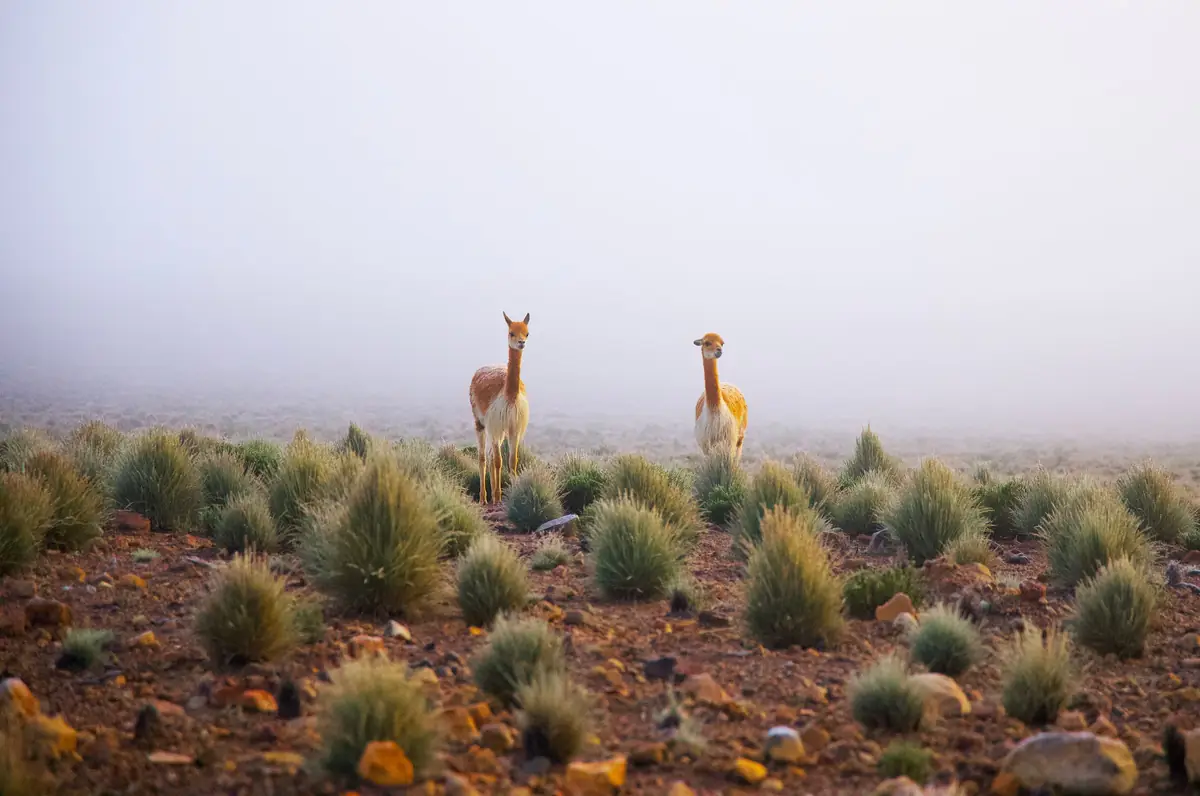
Why it represents the country
The vicuña appears on the coat of arms of Peru. On 25 February 1825 the Constituent Congress passed a law that set new national symbols, including a new coat of arms. Its shield is divided into three parts, each standing for a kind of natural wealth. The vicuña represents the animal kingdom, a cinchona tree represents plants, and a horn spilling coins represents minerals.
The vicuña was a fitting choice. It lives wild in the high Andes of Peru, and its wool has been prized for centuries. In the Inca Empire, vicuña wool was so precious that only the emperor was allowed to wear it.
Peru is home to many of the world's vicuñas, and the animal remains a source of pride for Andean communities that help look after the wild herds.
About the animal
The vicuña is the smallest member of the camel family, which also includes llamas, alpacas and guanacos. It is slender and graceful, with long legs and a long neck, and adults weigh roughly 35 to 65 kilograms. Its back is light cinnamon brown and its underside is white. Unusually for a hoofed mammal, its lower front teeth keep growing throughout its life, a bit like a rodent's, which helps it crop tough grasses close to the ground. Its thick, soft and extremely fine coat keeps it warm through freezing nights at high altitude.
Vicuñas live on the dry, open grasslands of the central Andes, usually between about 3,000 and 5,000 meters above sea level, in Peru, Bolivia, Argentina and Chile. They graze mostly on low grasses and some shrubs. Because they need to drink, they stay within reach of streams, springs and other water.
A family group usually has one adult male, several females and their young. The male defends a territory where the group feeds and sleeps, and he chases away other males. Young males leave to join bachelor groups. A family territory is small, on average about 17 hectares. Vicuñas are tidy animals: they leave their droppings on shared dung piles in fixed places.
Mating takes place from about January to April, and after a pregnancy of about 11 months the female gives birth to a single young. The young vicuña stays with its mother for around eight months. Vicuñas can live for about 15 to 20 years.
Conservation
The vicuña is listed as Least Concern on the IUCN Red List, but it once came close to disappearing. For centuries vicuñas were hunted for their wool, and by the 1970s only a few thousand were left, perhaps about 6,000.
Recovery came from strict protection. In the 1960s Peru created a reserve for vicuñas at Pampa Galeras and trained wardens to guard the herds, and in 1969 Andean countries signed a convention in La Paz to protect the species. Since then the population has grown to around 350,000 animals.
Today vicuña wool is harvested without killing the animals. In a traditional roundup called a chaccu, people from local communities herd wild vicuñas into enclosures, shear them and then set them free. The income from the fine fiber gives communities a reason to protect the herds. Poaching is still a risk, so guarding the herds remains important.
Fun facts
- Vicuña fiber is only about 12 micrometers thick, one of the finest animal fibers in the world.
- In the Inca Empire, only the emperor was allowed to wear clothes made of vicuña wool.
- Vicuñas use shared dung piles, leaving their droppings in the same places again and again.
National bird of Peru: Andean cock-of-the-rock
Andean cock-of-the-rock Rupicola peruvianus Officially designated
Also known as: tunki
Peru declared the Andean cock-of-the-rock its national bird by Supreme Resolution No. 983 of 11 December 1941.
The Andean cock-of-the-rock lives in the cloud forests of the Andes at middle elevations and nests on large rocks or cliff faces. Males are brilliant crimson or orange with black wings, broad silvery wing feathers and a puffy, rounded crest, while females are a duller brown. At dawn the males gather at display sites, where they squeal like piglets and jump and dance to attract females.
Other national symbols of Peru
- National flower
Cantuta Cantua buxifolia National symbol
The cantuta, a sacred flower of the Incas, is popularly known as Peru's national flower, as Peru's Ministry of the Environment notes.
Frequently asked questions
What is the national animal of Peru?
The national animal of Peru is the vicuña (a widely recognized national symbol, not set by law). It is a slender wild relative of the llama and the smallest member of the camel family, with extremely fine wool, living in the dry, open grasslands of the high Andes.
Which country has the vicuña as its national animal?
The vicuña is the national animal of Peru.
Why is the vicuña the national animal of Peru?
The vicuña stands for the animal kingdom on Peru's coat of arms, set by a law of the Constituent Congress on 25 February 1825; the shield's three parts show the country's natural wealth, with a cinchona tree for plants and a horn spilling coins for minerals. It lives wild in Peru's high Andes, and its wool was so prized in the Inca Empire that only the emperor was allowed to wear it.
Is the vicuña endangered?
The vicuña is listed as Least Concern on the IUCN Red List, although by the 1970s hunting for its wool had left perhaps only about 6,000. Strict protection since then has helped the population grow to around 350,000 animals.
Where does the vicuña live?
Dry, open grasslands of the high Andes, about 3,000 to 5,000 meters up.
What is the national bird of Peru?
The national bird of Peru is the Andean cock-of-the-rock (officially designated). Peru declared the Andean cock-of-the-rock its national bird by Supreme Resolution No. 983 of 11 December 1941. The Andean cock-of-the-rock is also known as tunki.
Sources
- Animal Diversity Web, University of Michigan. Vicugna vicugna: vicuña.
- IUCN Red List of Threatened Species. Vicugna vicugna (assessment 2018).
- SERNANP (gob.pe) – Conoce más sobre el gallito de las rocas, ave nacional del Perú.
- Cornell Lab of Ornithology, eBird: Andean Cock-of-the-rock (Rupicola peruvianus).
- Ministerio del Ambiente (gob.pe) – ¿Sabes cuál es la flor nacional del Perú?.
- Conservation status: IUCN Red List of Threatened Species.