Why it represents the country
The Andean condor has appeared on Ecuador's coat of arms since the 1830s, when condors were shown perched on the mountains of the shield. A decree of 6 November 1845 placed a condor with outspread wings on top of the shield, and the current coat of arms, adopted on 31 October 1900 and published in the Registro Oficial on 5 December 1900, keeps it there. Ecuadorian sources say the condor stands for power, greatness and pride, as well as energy and effort.
No law naming a national animal or national bird has been found in Ecuador, but the Andean condor is widely treated as the country's emblematic bird. The CIA World Factbook lists the Andean condor as Ecuador's national symbol, and Ecuadorian conservationists have compared its place in the country to that of the bald eagle in the United States.
The Andean condor also has its own day in Ecuador: every 7 July is celebrated as National Andean Condor Day, to raise awareness of the need to protect the species. In 2009, Ecuador's Ministry of Environment made a national conservation strategy for the condor official.
About the animal
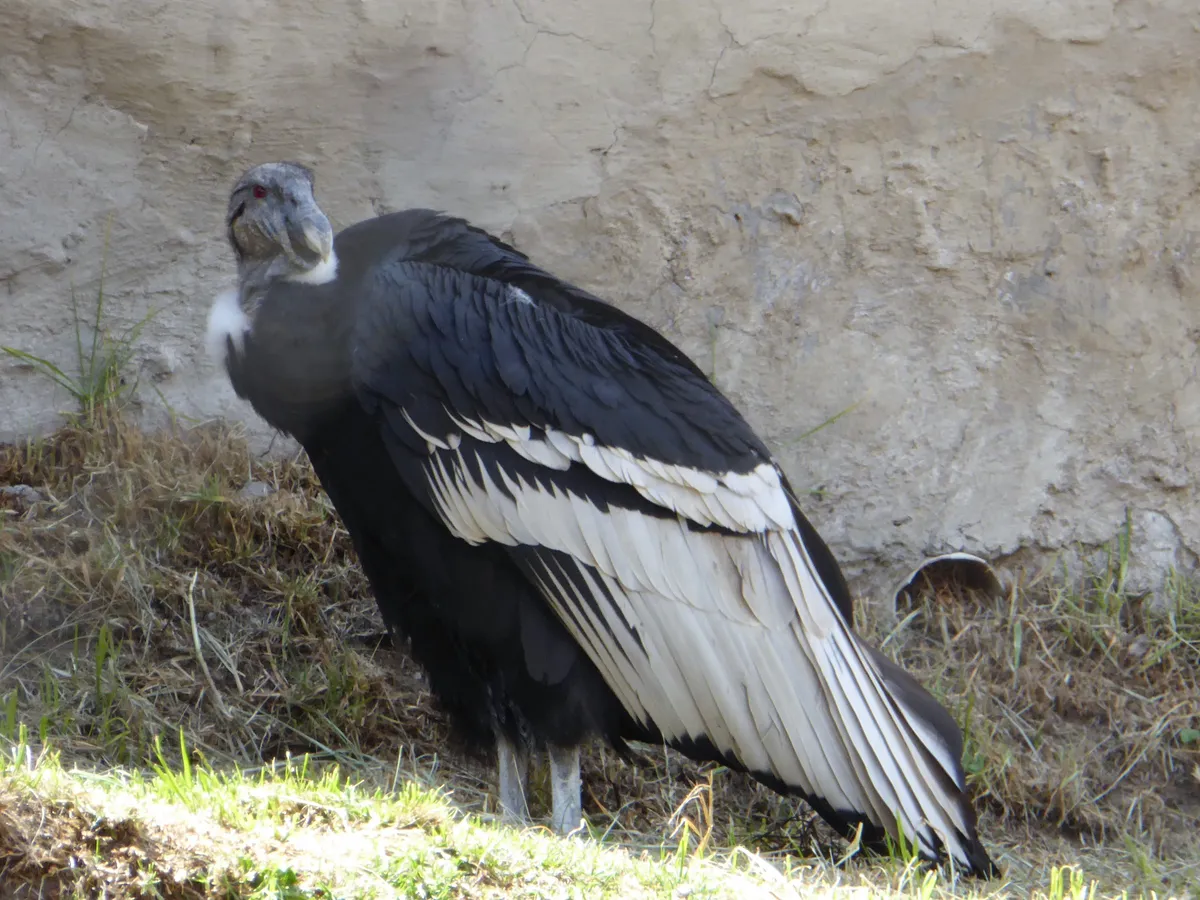
The Andean condor is a huge black vulture with a ruff of white feathers around the neck and broad white patches on the wings. Adults are roughly 0.9 to 1.3 meters long, weigh up to about 15 kilograms and have a wingspan of up to 3.2 meters. Males are usually larger than females; they carry a fleshy comb on the head and have brown eyes, while females have no comb and red eyes.
The condor is a master of soaring. It glides from one rising column of warm air to the next and may flap its wings only about once an hour; one bird was recorded flying more than 160 kilometers without flapping at all. Condors can soar as high as 5,500 meters.
The Andean condor is a scavenger that feeds mainly on the carcasses of large animals such as deer, cattle and sheep, and it can eat more than 6.8 kilograms of meat at one time. By cleaning up dead animals, condors help limit the spread of disease.
Condors breed very slowly. A pair usually raises just one chick every other year: the female lays a single egg on a cliff ledge or in a rocky cave, without building a nest, and the egg is incubated for about 50 to 60 days. The chick leaves the nest at around six months, but its parents keep caring for it for about a year and a half. Condors start breeding at about six to eight years old and can live into their late 50s or 60s.
Conservation
The Andean condor is listed as Vulnerable on the IUCN Red List, having been moved to that category in the 2020 update as numbers fell across the Andes. Poisoning, persecution, illegal hunting and habitat loss are among the main threats. In Ecuador the situation is even more serious: the national Red Book of birds classes the condor as Critically Endangered.
Ecuador's first national condor census, held on 29 and 30 September 2015, involved 163 observers watching 70 roosting sites. They counted 93 condors, for an estimated population of 94 to 102 birds. A second national census in 2018 counted 150 condors; researchers say the better result came mainly from a greater sampling effort, and a third national census was being prepared in 2025. Poisoning remains a serious danger: some ranchers lace carcasses with poison meant for foxes or stray dogs, and 20 condors were poisoned in 2018 and 2019.
Ecuador's condor conservation brings together the Ministry of Environment, the national Andean condor working group and organizations such as Fundación Cóndor Andino, The Peregrine Fund and Fundación Jocotoco. In early 2014, conservationists led by Fundación Jocotoco protected Hacienda Antisanilla, a 2,800-hectare property next to the Antisana Ecological Reserve where up to 30 condors nest and roost, at the time more than half of Ecuador's condors. In 2018 the ministry put an action plan for the species in place, and satellite trackers now help researchers follow condors across the highlands.
Fun facts
- Ecuador celebrates National Andean Condor Day every year on 7 July.
- An Andean condor may flap its wings only about once an hour while soaring.
- Condors fitted with satellite trackers in Ecuador have been recorded travelling from Cotopaxi to southern Azuay within a few days.
Frequently asked questions
What is the national bird of Ecuador?
The national bird of Ecuador is the Andean condor (a widely recognized national symbol, not set by law). One of the largest flying birds in the world, it is a huge black vulture with a white neck ruff, and it crowns Ecuador's coat of arms with its wings spread wide.
Which country has the Andean condor as its national bird?
The Andean condor is the national bird of Ecuador. The same species is also the national bird of Bolivia, Chile and Colombia.
Why is the Andean condor the national bird of Ecuador?
The Andean condor has been on Ecuador's coat of arms since the 1830s; a decree of 6 November 1845 placed a condor with outspread wings on top of the shield, and the current arms, adopted in 1900, keep it there. Ecuadorian sources say it stands for power, greatness and pride, as well as energy and effort. No law names a national animal or bird, but the condor is widely treated as the country's emblematic bird, and every 7 July is National Andean Condor Day.
Is the Andean condor endangered?
The Andean condor is listed as Vulnerable on the IUCN Red List, and in Ecuador the national Red Book of birds classes it as Critically Endangered. The most recent national census, in 2018, counted only 150 condors, and poisoning remains a serious danger.
Where does the Andean condor live?
High Andean mountains with cliffs and open páramo grasslands; in Ecuador, mainly the highland provinces of Pichincha, Napo, Imbabura and Cotopaxi.
Sources
- Primicias. Escudo de Ecuador: Esta es su historia y significados (updated 31 Oct 2023).
- El Universo. Significado de cada uno de los 15 símbolos que componen el Escudo Nacional (26 Oct 2023).
- IndexMundi (CIA World Factbook data). Ecuador national symbol(s).
- Vistazo. El Cóndor Andino celebra su Día Nacional (7 Jul 2016).
- Vistazo. El Cóndor, símbolo del Ecuador, cada vez más cerca de la extinción (7 Jul 2021).
- PLOS ONE. Naveda-Rodríguez et al. (2016), Andean Condor (Vultur gryphus) in Ecuador: Geographic Distribution, Population Size and Extinction Risk.
- Revista Ecuatoriana de Ornitología (Fundación Cóndor Andino Ecuador). Heredia et al. (2025), ¿Menos de 150? Análisis de resultados e invitación al III Censo Nacional de Cóndor Andino en Ecuador.
- Mongabay Latam. La lucha para salvar al cóndor andino en Ecuador (11 Apr 2017).
- Mongabay. Key highland habitat for rare condor protected in Ecuador (24 Jan 2014).
- Teleamazonas. Día Nacional del Cóndor Andino en Ecuador: curiosidades (7 Jul 2025).
- El Mercurio (Cuenca). Día del Cóndor: Sólo 150 ejemplares quedan en Ecuador, según censo de 2018 (7 Jul 2025).
- Primicias / EFE. Ecuador celebra el Día del Cóndor Andino, cuando solo quedan 150 ejemplares en estado silvestre (7 Jul 2019).
- BirdLife International. Red List update: the plight of the condor (16 Feb 2021).
- The Manila Times. Iconic raptors in steep decline (23 Jan 2021).
- The Peregrine Fund. Andean Condor.
- San Diego Zoo Wildlife Alliance. Andean condor.
- Akron Zoo. Andean condor.
- Conservation status: IUCN Red List of Threatened Species.