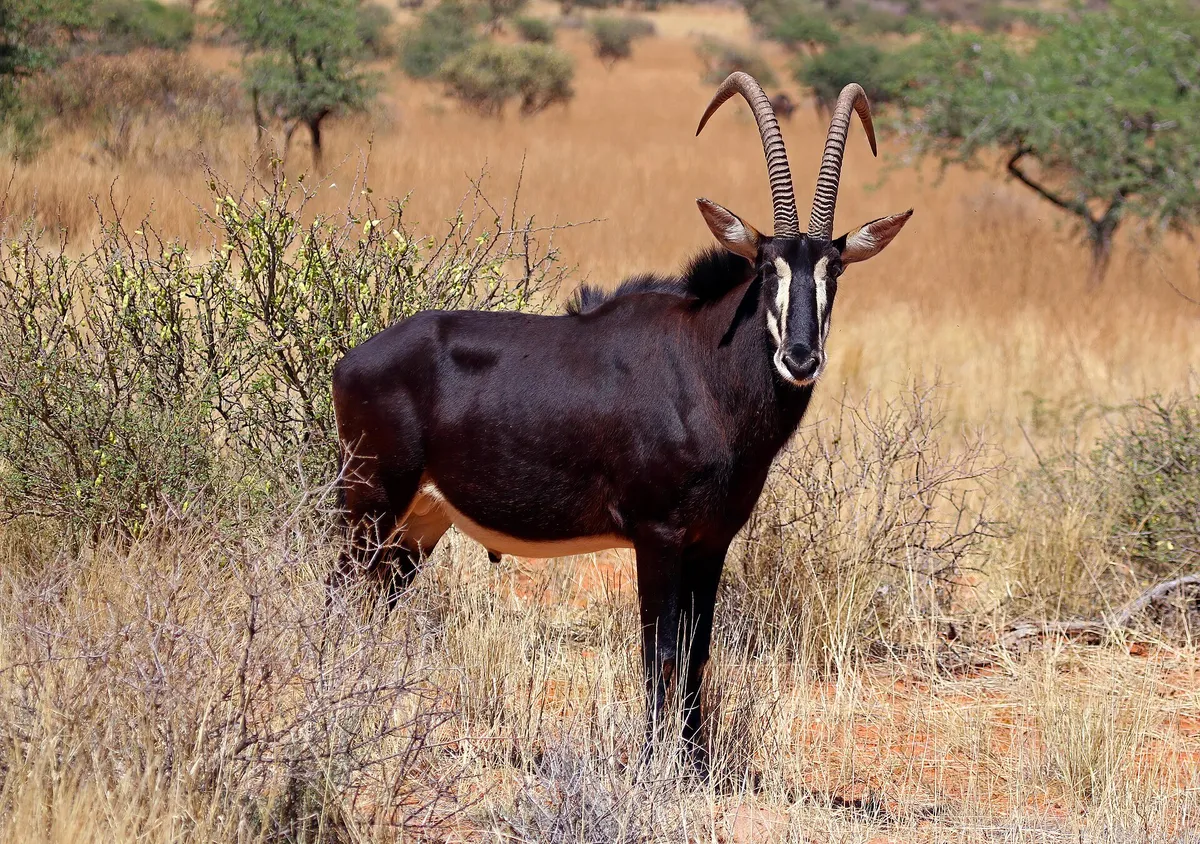
Why it represents the country
No law naming a national animal has been found in Zimbabwe, but the sable antelope is regularly called the country's national animal by newspapers, travel companies and wildlife guides. The conservation organization African Parks describes it as Zimbabwe's national mammal. The country's official emblem, by contrast, is the carved stone Zimbabwe Bird.
The sable antelope is native to Zimbabwe and lives in several of its best-known protected areas. The Zimbabwe Parks and Wildlife Management Authority lists sable among the rare species of Hwange, the country's largest national park, and describes Zambezi National Park, next to Victoria Falls National Park, as rich with herds of sable.
The sable's striking looks have made it a favorite of wildlife photographers. Travel writers describe it as one of the most magnificent antelopes in the animal kingdom, and its black coat and sweeping horns make it one of the easiest animals in Zimbabwe's parks to recognize.
About the animal
The sable antelope is a large antelope with a white belly and bold white markings on the face. Adult males are chestnut to jet black, while females and young are chestnut to dark brown. Both sexes have ringed horns that curve backwards like a scimitar; a male's horns can grow 80 to 165 centimeters long, and a female's 60 to 100 centimeters.
Adults stand about 117 to 143 centimeters at the shoulder and weigh roughly 190 to 270 kilograms, with males larger than females. The body alone is about 190 to 255 centimeters long, plus a tail of 40 to 75 centimeters.
Sable prefer open woodland near grassy clearings and are seldom found more than 3 kilometers from water. They mainly eat grass, adding leaves toward the end of the dry season. When threatened, they defend themselves fiercely with their horns, even against lions, hyenas and wild dogs.
Females and their young live in nursing herds of about 10 to 30 animals, while an adult male defends a territory. Young males leave the nursing herd at about three years old and join bachelor groups. A single calf is born after a pregnancy of about eight to nine months and lies hidden for at least ten days after birth; sable live about 17 years on average.
Conservation
The sable antelope is listed as Least Concern on the IUCN Red List as a species, in an assessment dated 2016 and published in 2017. The IUCN estimates 50,000 to 60,000 mature animals with a stable overall trend, and about 41 to 50 percent of the population lives in protected areas. Hunting, farming and livestock, and the spread of settlements are among the threats it lists.
In July 2025, Matusadona National Park, managed with the Zimbabwe Parks and Wildlife Management Authority, received 14 sable from the Sibilobilo Safari Area, along with buffalo and eland. After 28 days in a release enclosure, the sable were set free, raising the park's sable population from 22 to 36. One sable was fitted with a GPS collar so that its movements can be followed.
The park's managers plan further reintroductions to increase genetic diversity and help the herds grow back toward historical numbers. Local communities around the source areas were thanked for looking after the herds that made the move possible.
Fun facts
- Zimbabwe's men's national rugby team is nicknamed the Sables.
- A sable calf lies hidden for at least ten days after it is born.
- A male sable antelope's horns can reach up to 165 centimeters long.
Frequently asked questions
What is the national animal of Zimbabwe?
The national animal of Zimbabwe is the sable antelope (a widely recognized national symbol, not set by law). The sable antelope is a large, glossy black antelope with long, backward-curving horns that lives in Zimbabwe's national parks, including Hwange and Zambezi.
Which country has the sable antelope as its national animal?
The sable antelope is the national animal of Zimbabwe.
Why is the sable antelope the national animal of Zimbabwe?
No law names the sable antelope as Zimbabwe's national animal, but newspapers, travel companies and wildlife guides widely call it that, and African Parks describes it as Zimbabwe's national mammal. It is a native species found in several of the country's best-known parks.
Is the sable antelope endangered?
The sable antelope is listed as Least Concern on the IUCN Red List as a species, with an estimated 50,000 to 60,000 mature animals and a stable trend. In Zimbabwe, 14 sable were moved to Matusadona National Park in July 2025 to help rebuild its herd.
Where does the sable antelope live?
Savanna woodland mixed with grassland, usually near water; in Zimbabwe, parks such as Hwange, Zambezi, Matobo and Matusadona.
Sources
- African Parks. Buffalo, Eland and Sable Return to Matusadona National Park (2025).
- South Coast Sun (Caxton Local Media). Animal of the week: sable antelope (9 January 2025).
- Intrepid Travel. Zimbabwe: animals to spot (sable antelope).
- Zimbabwe Parks and Wildlife Management Authority. Hwange National Park.
- Zimbabwe Parks and Wildlife Management Authority. Zambezi National Park.
- Ultimate Ungulate. Sable antelope (Hippotragus niger) fact sheet.
- IUCN Red List. Hippotragus niger (IUCN SSC Antelope Specialist Group 2017, e.T10170A50188654).
- Conservation status: IUCN Red List of Threatened Species.