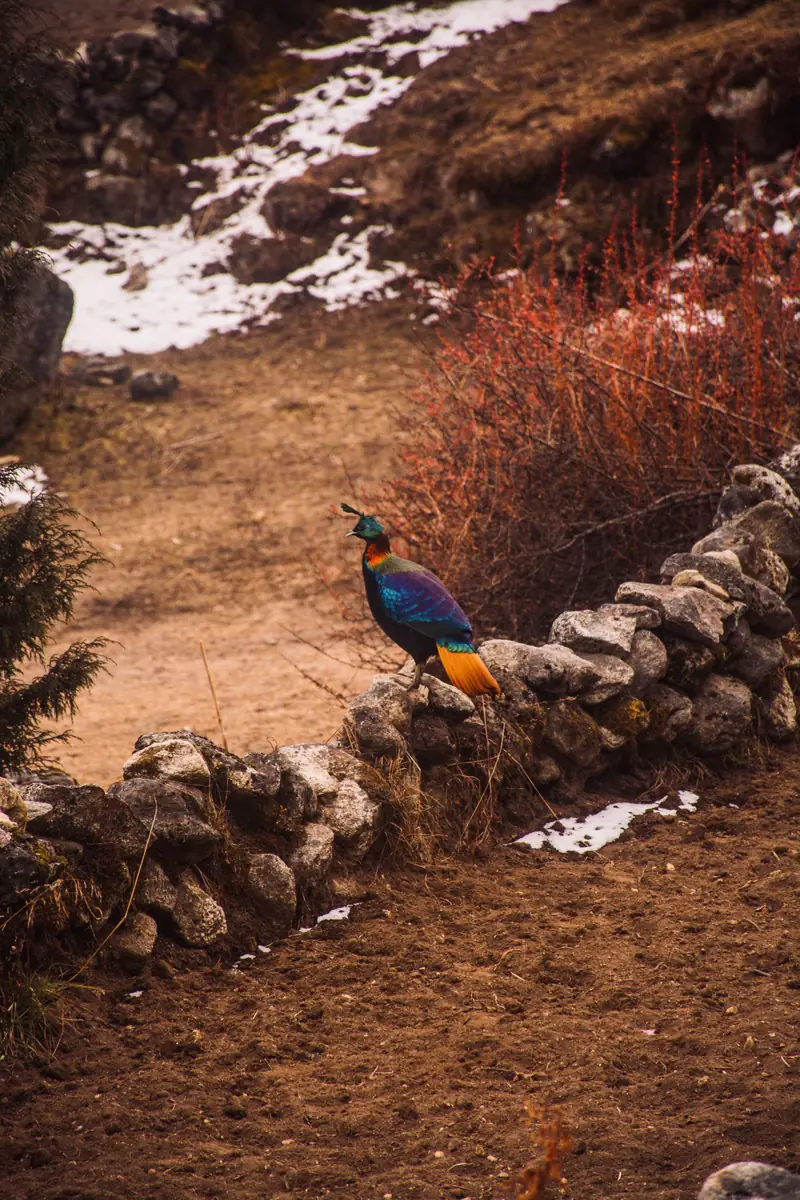
Why it represents the country
Nepal's national bird is the Himalayan monal. Its place as a national symbol is set out in the Constitution of Nepal, adopted in 2015. Article 9(3) lists Nepal's national symbols and names the lophophorus, the monal's scientific genus, as the national bird. The same clause names the rhododendron as the national flower, and the two belong together: monals often live in the rhododendron forests of Nepal's hills and mountains.
In Nepal the bird is called danphe. Its brilliant colors and its home high in the Himalaya make it a natural emblem for a mountain country. Many visitors to the high hills hope to catch sight of a male flashing its colors on a steep slope.
The monal's scientific name, Lophophorus impejanus, honors Lady Mary Impey, the wife of Sir Elijah Impey, a British judge in Bengal in the 18th century. In English the bird is sometimes still called the Impeyan pheasant.
About the animal
The Himalayan monal is a large, stocky pheasant, about 70 centimeters long. The male is one of the most colorful birds in Asia. His head has a crest of long, spoon-tipped metallic green feathers. His neck and back gleam with copper, purple and blue, he has a white patch on the lower back that shows in flight, and his tail is a warm reddish brown. The female is brown and speckled, with a white throat, which helps her stay hidden on the nest.
Monals live high in the mountains, usually between about 2,100 and 4,500 meters, in oak and rhododendron forests, open slopes and alpine meadows near the tree line. In winter many move a little lower, sometimes down to around 2,000 meters, to escape the deepest snow.
They are strong diggers. With their powerful, hooked bills they dig into the soil, and even through snow, for roots, tubers, shoots and seeds, and they also eat insects and other small invertebrates. A feeding monal can leave the ground turned over as if it had been dug with a small tool. When disturbed, it often runs downhill or launches itself off a slope with a loud whistling call.
In spring the male displays to the female by fanning his tail, spreading his wings and bobbing his glossy head. The female lays her eggs in a simple nest on the ground, often under a rock or bush, and raises the chicks herself.
Conservation
The Himalayan monal is listed as Least Concern on the IUCN Red List. It has a wide range along the Himalaya and the mountains to the west, and in many places it is still fairly common.
It still faces pressure in parts of its range. Males are poached for their shining crest feathers, which have long been worn as decorations and seen as a sign of status. Forest cutting, grazing and disturbance from roads and building projects in the mountains can reduce the quiet, undisturbed slopes the monal needs. The species is listed on Appendix I of CITES, which bans international commercial trade in the birds and their parts.
In Nepal, monals are protected, and many live inside national parks and conservation areas in the high hills. Protecting these mountain forests keeps safe not only the danphe but also the rhododendrons and many other species that share its home.
Where to see the Himalayan monal in the wild
Wild Himalayan monals in Nepal live in high mountain forests and shrubland, and Sagarmatha National Park and Langtang National Park are two protected areas where scientists have surveyed the bird.
Sagarmatha National Park
Sagarmatha National Park had Himalayan monals in all five survey blocks in 2022, mostly in pine forest between about 3,250 and 4,020 metres.
Official page ↗Langtang National Park
Langtang National Park has Himalayan monals using grassland in winter and shrubland in summer, with most sightings between 3,600 and 3,900 metres.
Watch wild animals from a distance, never feed them, and follow the rules and rangers of each protected area.
Fun facts
- The male monal's crest feathers are shaped like tiny spoons on thin stalks.
- Monals dig for food even in winter, scraping through snow to reach roots and insects in the soil below.
- Nepal's constitution names both a national bird and a national flower, and the danphe often lives among the rhododendrons that are that flower.
Other national symbols of Nepal
- National flower
Tree rhododendron (lali gurans) Rhododendron arboreum Officially designated
Nepal's 2015 Constitution names Rhododendron arboreum as the national flower in Article 9.
Frequently asked questions
What is the national bird of Nepal?
The national bird of Nepal is the Himalayan monal (officially designated). It is a large, stocky pheasant of the high Himalaya, called danphe in Nepal, and the males shine with metallic green, blue and copper feathers.
Which country has the Himalayan monal as its national bird?
The Himalayan monal is the national bird of Nepal. The Himalayan monal is also known as Impeyan monal, danphe or Impeyan pheasant.
Why is the Himalayan monal the national bird of Nepal?
Article 9(3) of the Constitution of Nepal, adopted in 2015, names the lophophorus, the Himalayan monal's scientific genus, as the national bird, and the same clause names the rhododendron as the national flower; monals often live in Nepal's rhododendron forests. Its brilliant colors and its home high in the Himalaya make the danphe a natural emblem for a mountain country.
Is the Himalayan monal endangered?
The Himalayan monal is listed as Least Concern on the IUCN Red List and is still fairly common in many places along the Himalaya. In parts of its range, though, males are poached for their shining crest feathers.
Where does the Himalayan monal live?
High mountain forests, rhododendron thickets and alpine meadows of the Himalaya.
Where can you see the Himalayan monal in the wild?
Wild Himalayan monals in Nepal live in high mountain forests and shrubland, and Sagarmatha National Park and Langtang National Park are two protected areas where scientists have surveyed the bird.
Sources
- Constitute Project. Nepal's Constitution of 2015.
- IUCN Red List of Threatened Species. Lophophorus impejanus (assessment 2016).
- Constitute Project: Nepal's Constitution of 2015, Article 9(3).
- Banko Janakari – Status, distribution and threats of Himalayan Monal in Sagarmatha National Park (2023).
- Zoological Research: Diversity and Conservation – Seasonal variation in habitat preference of the Himalayan monal in Langtang National Park (2024).
- BirdLife DataZone – Himalayan Monal species factsheet.
- Conservation status: IUCN Red List of Threatened Species.