Why it represents the country
South Korea has no law that names a national animal, but the tiger, called horangi in Korean, is the animal most closely tied to the country's identity. The tigers of the Korean Peninsula belonged to the population now known as the Siberian or Amur tiger, also called the Korean tiger. In the story of Dangun, Korea's founding myth, a tiger and a bear both asked to become human. The bear succeeded and the tiger gave up, yet the tiger remained one of the favorite figures in Korean stories.
In folk art the tiger often appears as a guardian that keeps away bad luck, and it is linked with bravery, nobility and humor. A well-known type of folk painting shows a tiger together with a magpie. When Seoul hosted the 1988 Summer Olympics, the mascot was Hodori, a friendly tiger cub wearing a traditional Korean hat. In 2018, the PyeongChang Winter Olympics chose Soohorang, a white tiger inspired by a tiger and magpie painting.
The designers of the 1988 mascot said that tigers best capture the feelings of the Korean people. White tigers are also seen as guardians in Korean tradition, a natural fit for a winter Games.
About the animal
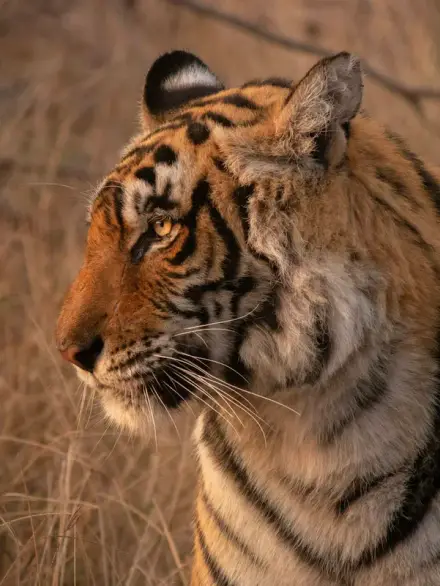
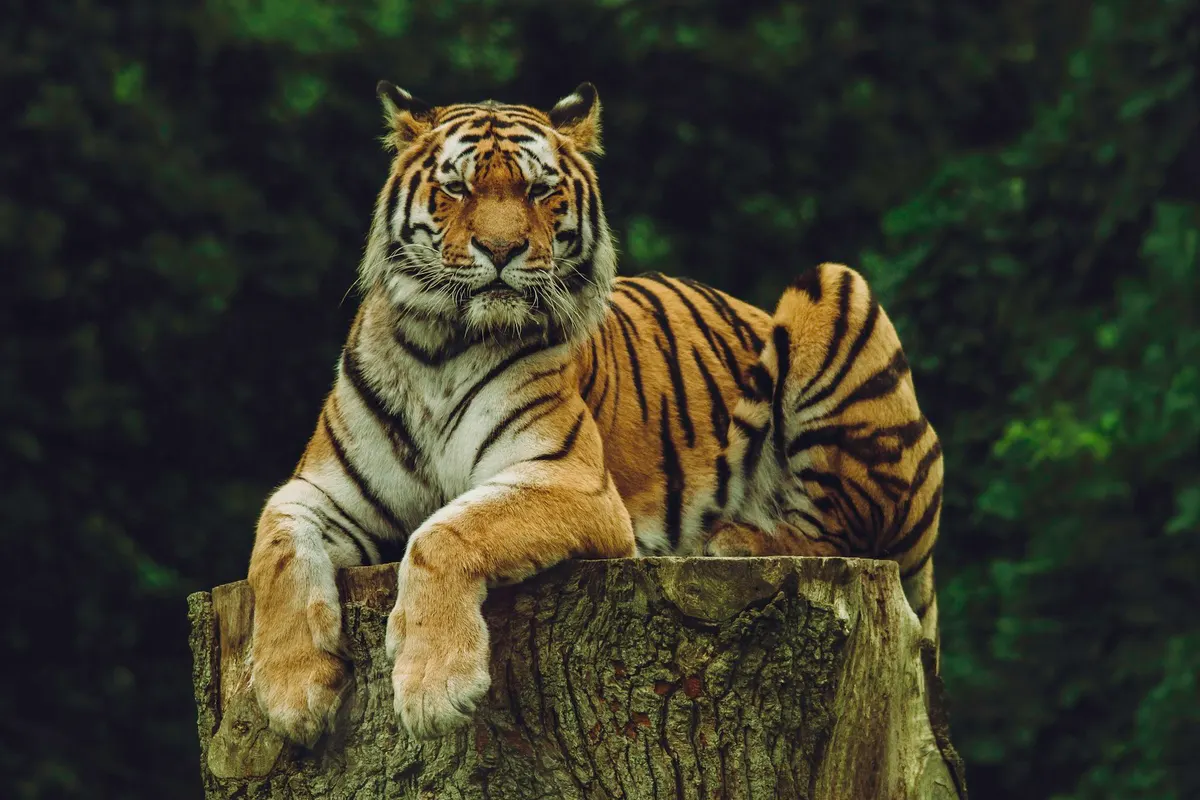
The Siberian tiger, also called the Amur tiger, is the tiger of the cold north. Its winter coat is denser, longer and softer than its coarse summer coat. Like all tigers, it has an orange coat with dark stripes, and a white chest, belly and face markings. No two tigers have exactly the same pattern of stripes.
Siberian tigers are among the biggest cats in the world. In the Russian Far East, wild males measure on average about 1.95 meters from nose to the base of the tail and weigh about 176 kilograms, while females average about 1.74 meters and 118 kilograms. The tail adds roughly another 90 centimeters to 1 meter.
Like most tigers, they live alone and hunt by stalking and ambush. Their main prey are wild boar and deer such as red deer, sika deer and roe deer. Because prey is spread thinly in northern forests, a single tiger needs a huge area. One female may use up to 450 square kilometers, and males need even more.
A tigress gives birth after a pregnancy of about three to three and a half months, usually to two to four cubs. The cubs stay with their mother for a long time while they learn to hunt. Wild tigers usually live 10 to 15 years.
Conservation
Tigers are listed as Endangered on the IUCN Red List. Siberian tigers once lived across the Korean Peninsula, and old records show they were common and sometimes dangerous: around 140 people were reported killed by tigers in 1734 alone. During Japanese rule from 1910 to 1945 tigers were hunted heavily. The last wild tiger recorded in South Korea is usually dated to about 1921 or 1922, on Mount Daedeok near Gyeongju.
Today wild Siberian tigers live mainly in the Russian Far East, with a smaller number in northeast China. After decades of protection, a 2022 count estimated about 750 tigers in the Russian Far East, including about 200 cubs. Poaching, logging and new roads that cut up the forest remain the main threats.
In South Korea, tigers now live only in zoos and large enclosures. The biggest is the tiger forest at the Baekdudaegan National Arboretum in Bonghwa, a fenced area of 4.8 hectares where tigers were moved from 2017. Reports of wild tigers still appear now and then, but none has been confirmed.
Where to see the Siberian tiger in the wild
Wild tigers no longer live in South Korea, and the nearest wild tigers today are Amur tigers in the Russian Far East and northeastern China.
Fun facts
- Hodori, the 1988 Seoul Olympic mascot, wore a traditional hat with a long ribbon shaped like the letter S, for Seoul.
- The name Soohorang combines sooho, meaning protection, with rang, taken from horangi, the Korean word for tiger.
- A wild female Siberian tiger may roam an area of up to 450 square kilometers.
National bird of South Korea: Oriental magpie
Oriental magpie Pica serica National symbol
Also known as: Korean magpie, Chinese magpie, Asian magpie
The magpie was chosen as South Korea's national bird in a 1964 public campaign run by the science desk of the Hankook Ilbo newspaper.
The Oriental magpie is a conspicuous black-and-white bird with a long tail, and its wings and tail shine green and blue in good light. Common in fields, farmland and other open country, the magpie often perches on power lines and fence posts and places its bulky nest prominently in a tall tree or even on a cell tower. The bird's loud chattering call has been compared to the clatter of an old camera.
Other national symbols of South Korea
- National flower
Rose of Sharon (mugunghwa) Hibiscus syriacus National symbol
No special law names it, but the rose of Sharon (mugunghwa) is widely regarded as South Korea's national flower.
Frequently asked questions
What is the national animal of South Korea?
The national animal of South Korea is the Siberian tiger (a widely recognized national symbol, not set by law). Also called the Amur tiger, it is the tiger of the cold north, with a dense winter coat; it once lived across the Korean Peninsula and now lives wild mainly in the Russian Far East and northeast China.
Which country has the Siberian tiger as its national animal?
The Siberian tiger is the national animal of South Korea. The same species is also the national animal of Bangladesh, India and Malaysia. The Siberian tiger is also known as Amur tiger.
Why is the Siberian tiger the national animal of South Korea?
South Korea has no law naming a national animal, but the tiger, called horangi in Korean, is the animal most closely tied to the country's identity, and the tigers of the Korean Peninsula belonged to the Siberian tiger population, also called the Korean tiger. It appears in Dangun, Korea's founding myth, and in folk art as a guardian against bad luck, and tigers were the mascots of both the 1988 Seoul and 2018 PyeongChang Olympics.
Is the Siberian tiger endangered?
Tigers, including the Siberian tiger, are listed as Endangered on the IUCN Red List. Wild tigers disappeared from South Korea in the early 1920s, but after decades of protection a 2022 count estimated about 750 Siberian tigers in the Russian Far East.
Where does the Siberian tiger live?
Cold mixed and conifer forests of the Russian Far East and northeast China; once found across the Korean Peninsula.
What is the national bird of South Korea?
The national bird of South Korea is the Oriental magpie (a widely recognized national symbol, not set by law). The magpie was chosen as South Korea's national bird in a 1964 public campaign run by the science desk of the Hankook Ilbo newspaper. The Oriental magpie is also known as Korean magpie, Chinese magpie or Asian magpie.
Where can you see the Siberian tiger in the wild?
Wild tigers no longer live in South Korea, and the nearest wild tigers today are Amur tigers in the Russian Far East and northeastern China.
Sources
- Korea JoongAng Daily. How the tiger became Korea’s ultimate mascot.
- Korea JoongAng Daily. Preserving Korea’s fierce heritage.
- Encyclopaedia Britannica. Tiger.
- IUCN Red List of Threatened Species. Panthera tigris (assessment 2022).
- Encyclopedia of Korean Culture (Academy of Korean Studies) — 까치 (Magpie).
- Cornell Lab of Ornithology, eBird: Oriental Magpie (Pica serica).
- National Library of Korea — Korean national symbols.
- CBS NoCut News – Korean tiger report citing South Korea's environment ministry.
- Amur Tiger Center – Where does the Amur tiger live?.
- Conservation status: IUCN Red List of Threatened Species.