Why it represents the country
Russia has no officially declared national animal, and its state coat of arms shows a golden double-headed eagle, not a bear. Even so, the brown bear is the animal most people around the world connect with Russia. Foreign cartoonists have drawn Russia as a bear for centuries, often to make the country look big and rough. Russians later adopted the bear themselves, as a symbol of strength and of their vast forests.
The most famous friendly bear in Russian history is Misha, the mascot of the 1980 Summer Olympics in Moscow. He was drawn by the children's book illustrator Viktor Chizhikov, whose design was picked from 60 versions, and he wore a belt in the colors of the Olympic rings. His full name, Mikhail Potapych Toptygin, uses the playful names Russians traditionally give bears in folk tales. At the closing ceremony a giant Misha balloon floated up and out of the stadium.
Bears are deep in Russian folk culture. In fairy tales the bear is often a strong but clumsy forest neighbor. The Russian word for bear, medved, is often explained as meaning the one who knows where the honey is. Bears also appear on the coats of arms of several Russian cities and regions, such as Yaroslavl and Novgorod.
About the animal
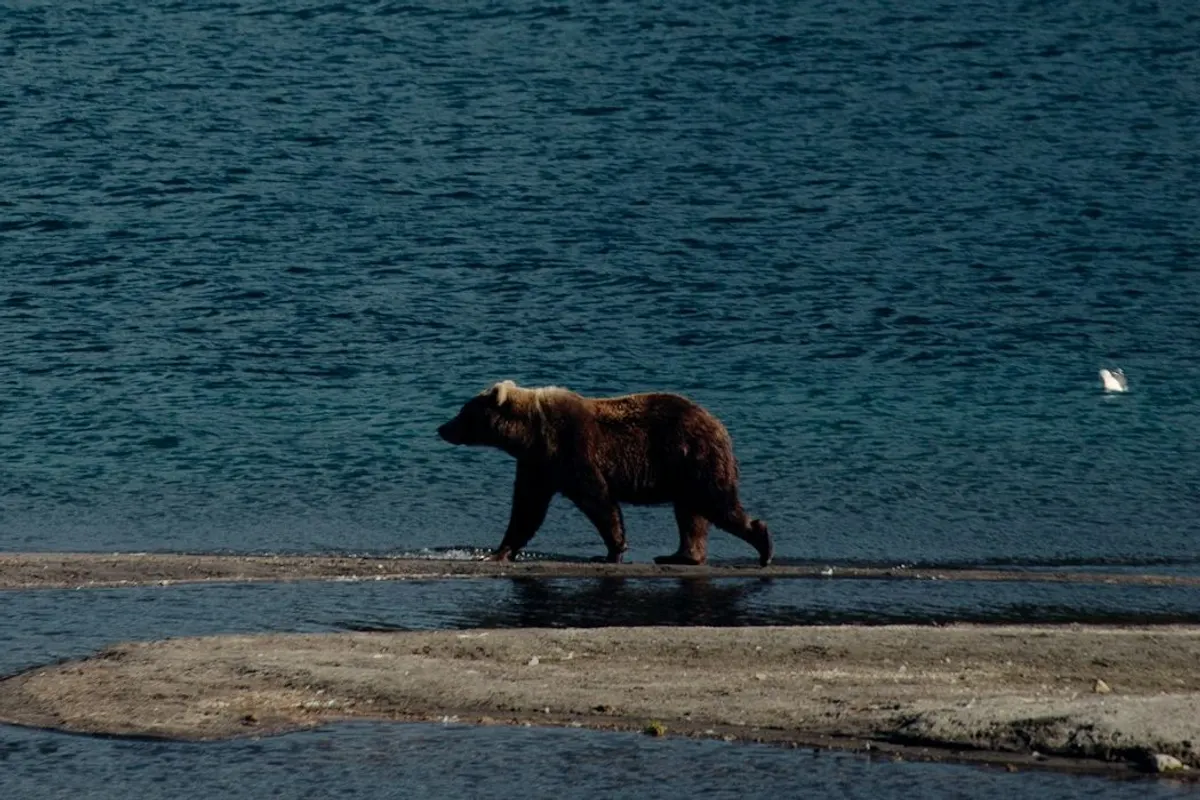
The brown bear is a large, heavily built animal with a hump of muscle over the shoulders, a broad head, small rounded ears and long, curved claws for digging. Its fur ranges from pale golden brown to almost black. Bears in European Russia are similar in size to those in Finland, while the biggest Russian brown bears live in the Far East, especially on the Kamchatka Peninsula.
Brown bears are omnivores, and most of their food comes from plants. They dig up roots, graze on grasses and sedges, and in late summer eat huge amounts of berries and pine nuts. They also eat insects and carrion and sometimes catch young moose or deer. On Kamchatka many bears gather along rivers and lakes in summer to catch salmon swimming upstream to spawn, which helps them build up fat for the winter.
Adult bears usually live alone, except for mothers with cubs. They find food mainly by smell, and despite their size they run fast and swim well. Most bears avoid people, but a surprised bear or a mother with cubs can be dangerous.
In winter Russian bears sleep in dens dug into hillsides, under fallen trees or in thick young forest. In the coldest regions they may stay in the den for more than half the year. Cubs are born there in midwinter, tiny and nearly hairless, and come out with their mother in spring. They usually stay with her for at least a year and a half.
Conservation
The brown bear is listed as Least Concern on the IUCN Red List. It is one of the most widespread large mammals on Earth, found across northern Europe, Asia and North America. Russia has more brown bears than any other country, with an estimated population of more than 100,000.
That large number hides local problems. In some regions bears are hunted heavily, both legally and illegally, and poachers kill bears for body parts that are sold on illegal markets. Scientists have warned that on Kamchatka, home to some of Russia's biggest bears, too much hunting has cut bear numbers in places.
Bears also need large, quiet forests and healthy rivers. Logging, new roads, mining and overfishing of salmon can reduce the food and space they depend on. Nature reserves and national parks, such as the Kronotsky reserve on Kamchatka, give bears places to live with little disturbance.
Fun facts
- Misha, the bear mascot of the 1980 Moscow Olympics, floated out of the stadium as a giant balloon at the closing ceremony.
- The Russian word for bear, medved, is often explained as meaning the one who knows where the honey is.
- Russia is home to more brown bears than any other country in the world.
Frequently asked questions
What is the national animal of Russia?
The national animal of Russia is the Eurasian brown bear (a widely recognized national symbol, not set by law). It is a large, heavily built bear with a muscular hump over the shoulders and fur from pale golden brown to almost black, living in forests, mountains, river valleys and salmon coasts across most of Russia.
Which country has the Eurasian brown bear as its national animal?
The Eurasian brown bear is the national animal of Russia. The same species is also the national animal of Finland and Mongolia.
Why is the Eurasian brown bear the national animal of Russia?
Russia has no officially declared national animal, and its coat of arms shows a double-headed eagle, yet the brown bear is the animal most people connect with the country. Foreign cartoonists drew Russia as a bear for centuries, and Russians later adopted it themselves as a symbol of strength and of their vast forests; Misha the bear was even the mascot of the 1980 Moscow Olympics.
Is the Eurasian brown bear endangered?
The brown bear is listed as Least Concern on the IUCN Red List, and Russia has more brown bears than any other country, an estimated population of more than 100,000. That number hides local problems, as heavy legal and illegal hunting has cut bear numbers in places such as Kamchatka.
Where does the Eurasian brown bear live?
Forests, mountains, river valleys and salmon coasts across most of Russia.
See also: Most Popular Dog Breeds in Russia (2025)
Sources
- Science First Hand. The Most Russian of All Beasts.
- International Olympic Committee. Moscow 1980 Olympic mascot: Misha.
- San Diego Zoo Wildlife Alliance Library. Brown bear fact sheet: population and conservation status.
- IUCN Red List of Threatened Species. Ursus arctos (assessment 2017).
- Conservation status: IUCN Red List of Threatened Species.