Why it represents the country
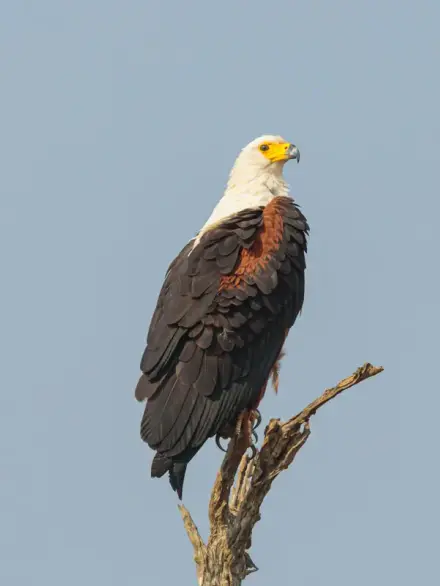
Namibia's coat of arms was created when the country became independent in 1990. A national symbols committee, set up while the constitution was being written, based the shield on the design of the new flag and added two gemsbok, a large antelope also called the oryx, as supporters on either side. Above the shield is an African fish eagle, and below it is a sand dune with a Welwitschia, a famous plant of the Namib Desert.
Because the gemsbok holds up the national arms, it is widely regarded as Namibia's national animal. It is a good match for a country that includes the Namib, one of the driest deserts in the world, and part of the Kalahari. The gemsbok can live in places where few other large animals can survive.
Gemsbok are a familiar sight in Namibia, from the dunes near the Atlantic coast to the dry bushland of the interior. The country has a large population of them, and many live on private farms as well as in national parks.
About the animal
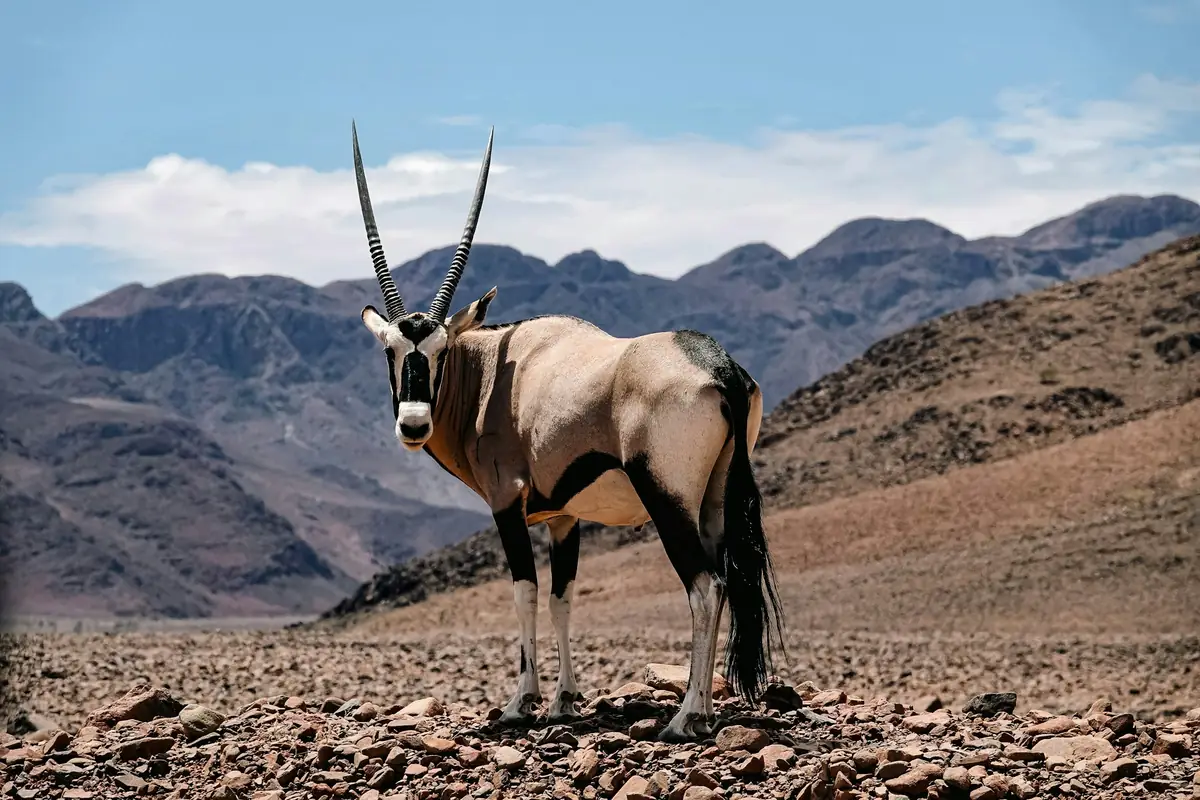
The gemsbok is a large, powerful antelope that stands about 1.2 meters at the shoulder. Its body is grey to tan, with a bold pattern of black and white. Black stripes run down the face and across the eyes, a black line runs along the spine, and black bands mark the lower sides and the tops of the legs, while the lower legs and belly are white. Northern animals are often darker and have black tufts on their ears.
Both males and females have long, straight, ringed horns that can be anywhere from about 60 centimeters to 1.5 meters long. Females' horns are often shorter and more slender than those of males. The horns are powerful weapons, and male gemsbok use them in sparring contests, but when a predator comes near, the usual response is to run.
Gemsbok are built for dry country. They graze on grasses when they can and switch to browsing leaves during droughts. They also dig up to about a meter deep for roots and tubers and eat wild melons and cucumbers, which can give them all the water they need. To save water, a gemsbok can let its body temperature rise during the hottest part of the day instead of cooling itself by sweating. They are most active in the cooler hours around dawn and dusk.
Gemsbok usually live in herds of around a dozen animals, although groups of 50 to 200 may form in the rainy season or during migrations. Many adult males live alone and defend territories. A female gives birth to a single calf after a pregnancy of about eight and a half months. She hides the calf in the bush and returns to nurse it two or three times a day. Calves are brown at birth and develop their adult markings at about three and a half months old.
Conservation
The gemsbok is listed as Least Concern on the IUCN Red List. It remains common in Namibia, Botswana and South Africa. It no longer lives in Angola, where it is considered locally extinct.
Because it can survive in very dry places where few other large grazers can live, the gemsbok faces less competition than many antelopes. It is also a common animal on game ranches, and the value that landowners place on wildlife helps to keep herds on private land as well as in protected areas.
Gemsbok move over long distances in search of fresh grass after the rains. Keeping large, open landscapes where herds can travel freely is important for their future, and for the many other desert animals that share Namibia's wide spaces.
Fun facts
- A gemsbok can let its body temperature rise to about 45 °C during the day to save water.
- Gemsbok dig up to about a meter deep to reach juicy roots and tubers.
- A gemsbok calf is brown at birth and gets its black and white face markings at about three and a half months old.
Frequently asked questions
What is the national animal of Namibia?
The national animal of Namibia is the gemsbok (a widely recognized national symbol, not set by law). The gemsbok, also called the oryx, is a large, powerful desert antelope with long, straight horns and bold black and white markings, and two of them stand on either side of the shield on Namibia's coat of arms.
Which country has the gemsbok as its national animal?
The gemsbok is the national animal of Namibia. The gemsbok is also known as South African oryx.
Why is the gemsbok the national animal of Namibia?
When Namibia became independent in 1990, a national symbols committee added two gemsbok as supporters on either side of the shield on the new coat of arms, so the gemsbok is widely regarded as the national animal. It suits a country that includes the Namib, one of the driest deserts in the world, because the gemsbok can live in places where few other large animals survive.
Is the gemsbok endangered?
The gemsbok is listed as Least Concern on the IUCN Red List and remains common in Namibia, Botswana and South Africa. It no longer lives in Angola, where it is considered locally extinct, but its ability to survive in very dry places means it faces less competition than many antelopes.
Where does the gemsbok live?
Deserts, dry grassland and semi-desert of southwestern Africa.
Sources
- Encyclopaedia Britannica. Gemsbok.
- Animal Diversity Web, University of Michigan. Oryx gazella: gemsbok.
- IUCN Red List of Threatened Species. Oryx gazella (assessment 2020).
- Conservation status: IUCN Red List of Threatened Species.