Why it represents the country
Panama made the harpy eagle its national bird by law. Law No. 18 of 10 April 2002 declares the harpy eagle the national bird of Panama and states that it has represented the nation since pre-Columbian times. The law gives the national environment authority and the Ministry of Education the job of teaching people about the eagle and promoting it as a national symbol. Every 10 April, Panama celebrates Harpy Eagle Day.
An eagle also crowns Panama's coat of arms, and it is widely identified as a harpy eagle. The bird is therefore linked with the country's emblem as well as with its forests.
The choice fits Panama well. The country's environment ministry says Panama has the largest harpy eagle population in Central America, especially in the forests of the eastern province of Darién. The national bird is a daily reminder of how important those forests are.
About the animal
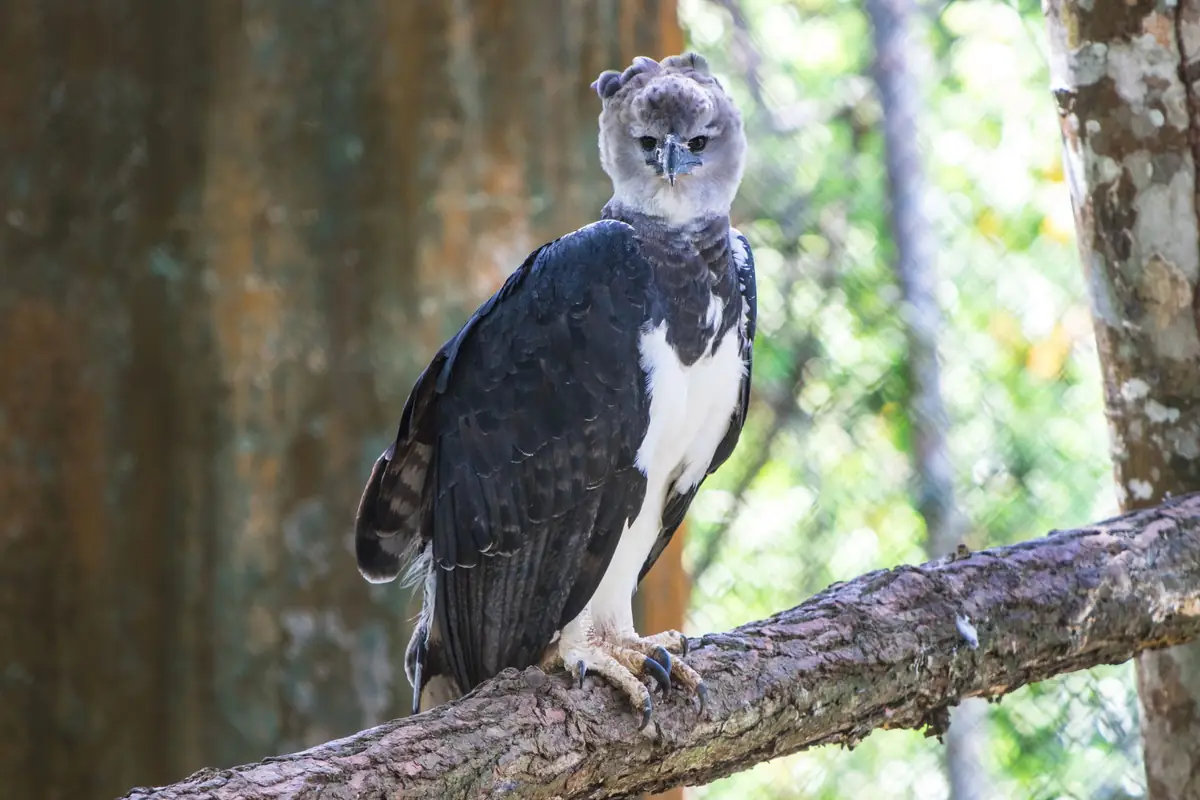
The harpy eagle is one of the largest and most powerful eagles in the world. It lives in tropical lowland rainforests from southern Mexico to northern Argentina, but it has become rare or has disappeared in many parts of that range. Adults have slate-black backs, a pale gray head, a white belly and a broad black band across the chest. A double crest of feathers on the head can be raised when the bird is alert.
Females are clearly larger than males and can weigh up to about 9 kilograms. The legs are thick and strong, and the rear talons can be as long as about 12 centimeters. The wingspan reaches about 2 meters.
Harpy eagles hunt within the forest canopy rather than soaring high above it. They often wait quietly on a perch, watching and listening, and then strike. Sloths and monkeys make up much of their diet. One study in Brazil found that sloths made up about four fifths of their prey. They also take lizards, birds and other mammals.
Pairs build huge stick nests high in the tallest trees, often more than 25 meters above the ground, and use them again and again. A nest can be about 1.5 meters across. The female usually lays two eggs, but only one chick is raised. The young eagle leaves the nest at about six months old and depends on its parents for many months after that. Because of this long care, a pair raises only one chick every two to three years. Healthy adults can live for 25 to 35 years.
Conservation
The harpy eagle is listed as Vulnerable on the IUCN Red List, and its numbers are falling across much of its range from Mexico to Argentina.
The biggest threat is the loss of large areas of old forest. Harpy eagles need big territories with tall trees for nesting and plenty of sloths and monkeys to eat, so logging and clearing for farms quickly push them out. Some are also shot. Because they breed so slowly, every adult that is lost is hard to replace.
Panama is an important stronghold. The Peregrine Fund has run a harpy eagle research and conservation program in Darién since 2002, and Panama's national law asks environment and education officials to teach people about protecting the national bird and its forests.
Fun facts
- A harpy eagle's rear talons can be as long as about 12 centimeters.
- Sloths are a favorite prey, and in one study in Brazil they made up about four fifths of the harpy's diet.
- A pair of harpy eagles raises only one chick every two to three years.
Other national symbols of Panama
- National flower
Holy Ghost orchid (flor del Espíritu Santo) Peristeria elata Officially designated
Panama declared the Holy Ghost orchid, named for the dove shape at its center, its national flower in Law No. 46 of 1980.
Frequently asked questions
What is the national bird of Panama?
The national bird of Panama is the harpy eagle (officially designated). The harpy eagle is one of the largest and most powerful eagles in the world, a bird of tropical lowland rainforests with a slate-black back, a pale gray head and a double crest, and the eagle crowning Panama's coat of arms is widely identified as a harpy eagle.
Which country has the harpy eagle as its national bird?
The harpy eagle is the national bird of Panama. The harpy eagle is also known as American harpy eagle.
Why is the harpy eagle the national bird of Panama?
Law No. 18 of 10 April 2002 declares the harpy eagle the national bird of Panama and states that it has represented the nation since pre-Columbian times; every 10 April the country celebrates Harpy Eagle Day. The choice fits Panama well, because the environment ministry says the country has the largest harpy eagle population in Central America, especially in the forests of Darién.
Is the harpy eagle endangered?
The harpy eagle is listed as Vulnerable on the IUCN Red List, and its numbers are falling across much of its range from Mexico to Argentina. The biggest threat is the loss of large areas of old forest, and because the eagles breed so slowly, every adult that is lost is hard to replace.
Where does the harpy eagle live?
Tall, undisturbed lowland rainforests of Central and South America.
Sources
- Gaceta Oficial de Panamá. Ley 18 de 2002.
- MiAmbiente, Panamá. Panamá posee la población más grande de águilas harpías de Centroamérica.
- Animal Diversity Web, University of Michigan. Harpia harpyja: harpy eagle.
- IUCN Red List of Threatened Species. Harpia harpyja (assessment 2021).
- Ley 46 de 1980 – Por la cual se declara flor nacional la Flor del Espíritu Santo (Gaceta Oficial 19208).
- Conservation status: IUCN Red List of Threatened Species.