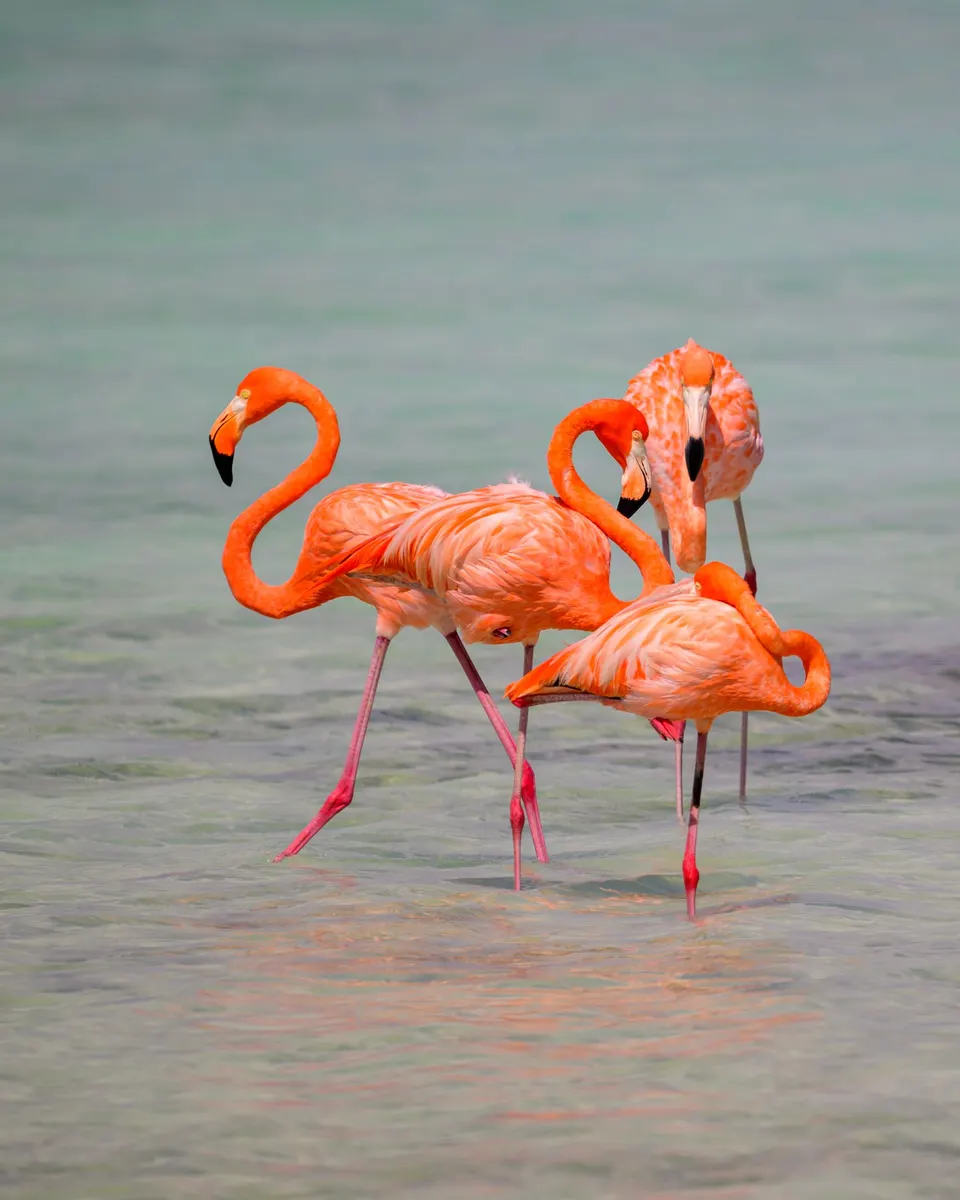
Why it represents the country
The flamingo is the national bird of the Bahamas, and the government uses it widely as a national emblem. It is also one of the two animals holding up the shield on the coat of arms adopted in 1971: the flamingo stands for the land and a blue marlin for the sea.
The bird is also at the heart of one of the country's biggest conservation stories. Flamingos were once hunted for their meat and feathers, wild pigs ate their eggs and young, and low-flying planes scared the colonies. In the early 1950s Robert Porter Allen of the National Audubon Society found the flamingos of Great Inagua in decline, and in 1952 a society to protect them was formed, with local man Sam Nixon as the first flamingo warden.
In 1959 the Bahamian Parliament created the Bahamas National Trust, which took over care of the colony and had the airspace above it made a restricted zone. Inagua National Park was set up in 1965 and covers 287 square miles, or about 743 square kilometers. Saving the flamingo helped launch the national park system of the Bahamas.
About the animal
The American flamingo, also called the Caribbean flamingo, is a large wading bird about 120 to 145 centimeters long and up to about 1.5 meters tall. It weighs about 2 to 4 kilograms, and males are slightly larger than females. Its feathers are a deep pink to orange-pink, with black flight feathers that show when it flies. The bill is pale with a black tip, and the long legs are pink.
Flamingos feed with their heads upside down. They stir up the mud with their feet, then pump water through the bill, where comb-like plates along the edges sieve out food. They eat algae, small seeds, brine shrimp, fly larvae and other tiny animals. Pigments in this food are what turn their feathers pink.
American flamingos live on Caribbean islands, along the northern coast of South America, on Mexico's Yucatán Peninsula and in the Galápagos Islands. They are very social and live in large colonies, often of thousands of birds, in shallow, salty lagoons and lakes where few other large animals feed.
Pairs build a cone-shaped nest of mud and lay a single white egg on top. Both parents take turns incubating it for about 28 days. When the chicks are a few days old, they gather in large groups called crèches, where their parents still find and feed them. Flamingos are long-lived birds that can reach 40 years or more.
Conservation
The American flamingo is listed as Least Concern on the IUCN Red List. BirdLife International estimates there are about 150,000 to 205,000 adult birds and believes the population is increasing.
On Great Inagua the recovery has been remarkable. The Bahamas National Trust estimates that about 70,000 flamingos now live on the island, which it describes as the largest breeding colony of the species in the world. Wardens still patrol the park today, and one of them, Henry Nixon, is a descendant of the first wardens.
The birds still face threats. Development and habitat loss threaten flamingos in much of their range, and nesting colonies are easily disturbed by people, aircraft and animals such as wild pigs. Keeping the salt lakes of Inagua quiet and protected remains vital for the national bird.
Fun facts
- Flamingos eat with their heads upside down, filtering food from the water with their bills.
- A flamingo pair lays just one egg at a time, on top of a nest built from mud.
- On Great Inagua, flamingos far outnumber the people who live on the island.
Other national symbols of the Bahamas
- National flower
Yellow elder Tecoma stans National symbol
The yellow elder became The Bahamas' national flower in the 1970s through a vote by members of New Providence's four garden clubs.
Frequently asked questions
What is the national bird of the Bahamas?
The national bird of the Bahamas is the American flamingo (a widely recognized national symbol, not set by law). It is a large pink wading bird that stands on the Bahamian coat of arms, and the island of Great Inagua holds the largest breeding colony of the species in the world.
Which country has the American flamingo as its national bird?
The American flamingo is the national bird of the Bahamas. The American flamingo is also known as Caribbean flamingo.
Why is the American flamingo the national bird of the Bahamas?
The government uses the flamingo widely as a national emblem, and it is one of the two animals holding up the shield on the coat of arms adopted in 1971, standing for the land while a blue marlin stands for the sea. The bird is also at the heart of one of the country's biggest conservation stories: efforts to save the declining flamingos of Great Inagua, starting in 1952, led to Inagua National Park in 1965 and helped launch the national park system of the Bahamas.
Is the American flamingo endangered?
The American flamingo is listed as Least Concern on the IUCN Red List, and BirdLife International believes its population is increasing. On Great Inagua the recovery has been remarkable, with about 70,000 flamingos now living on the island, according to the Bahamas National Trust.
Where does the American flamingo live?
Shallow salt lakes, lagoons and tidal flats.
Sources
- Embassy of The Bahamas, Washington, D.C.. National Symbols.
- Bahamas National Trust. Inagua National Park.
- Smithsonian's National Zoo and Conservation Biology Institute. American flamingo.
- IUCN Red List of Threatened Species. Phoenicopterus ruber (assessment 2021).
- Embassy of The Bahamas, Washington, D.C. — National Symbols.
- The Tribune (Nassau) — A nation in full bloom (2013).
- Levy Preserve — Tecoma stans.
- Conservation status: IUCN Red List of Threatened Species.