Why it represents the country
The United Kingdom has never named an official national animal, but the lion is the animal most often linked with it. On the Royal Arms of the United Kingdom, the three lions of England fill the first and fourth quarters of the shield, and the shield is supported by an English lion on the left and a Scottish unicorn on the right. The unicorn is a mythical creature, which leaves the lion as the real animal at the heart of the arms. In the UK, the Royal Arms are borne only by the Sovereign.
The lion has been an emblem of English kings for about eight hundred years. Henry I, who reigned from 1100 to 1135, is believed to be the first king to have borne a single lion rampant. Richard I first used a seal with one lion; a new seal was recorded in 1195, and the earliest surviving impression of this three lions seal dates from 1198. The three gold lions passant guardant, walking with their heads turned to face the viewer, have been England's arms ever since, and the separate English and Scottish versions of the Royal Arms go back to the Union of the Crowns in 1603.
The lion was also a living presence in England's royal history. In 1235 Henry III received three "leopards", probably lions, which inspired him to start a zoo at the Tower of London, and the animals' permanent home there became known as the Lion Tower. The menagerie closed for good in 1835, and many of its animals went to the Zoological Gardens in Regent's Park, today's London Zoo. Henry III's three lions also live on in the Three Lions badge worn by England's football team.
About the animal
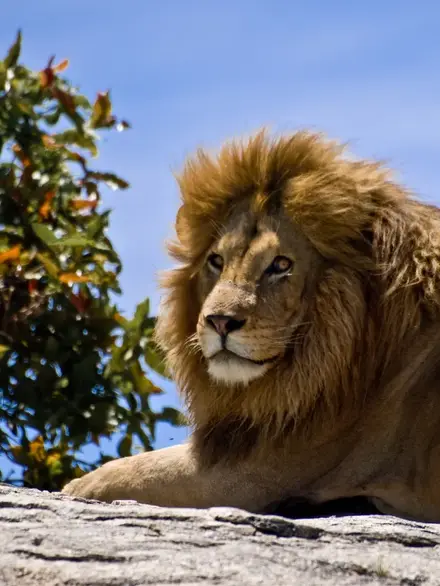
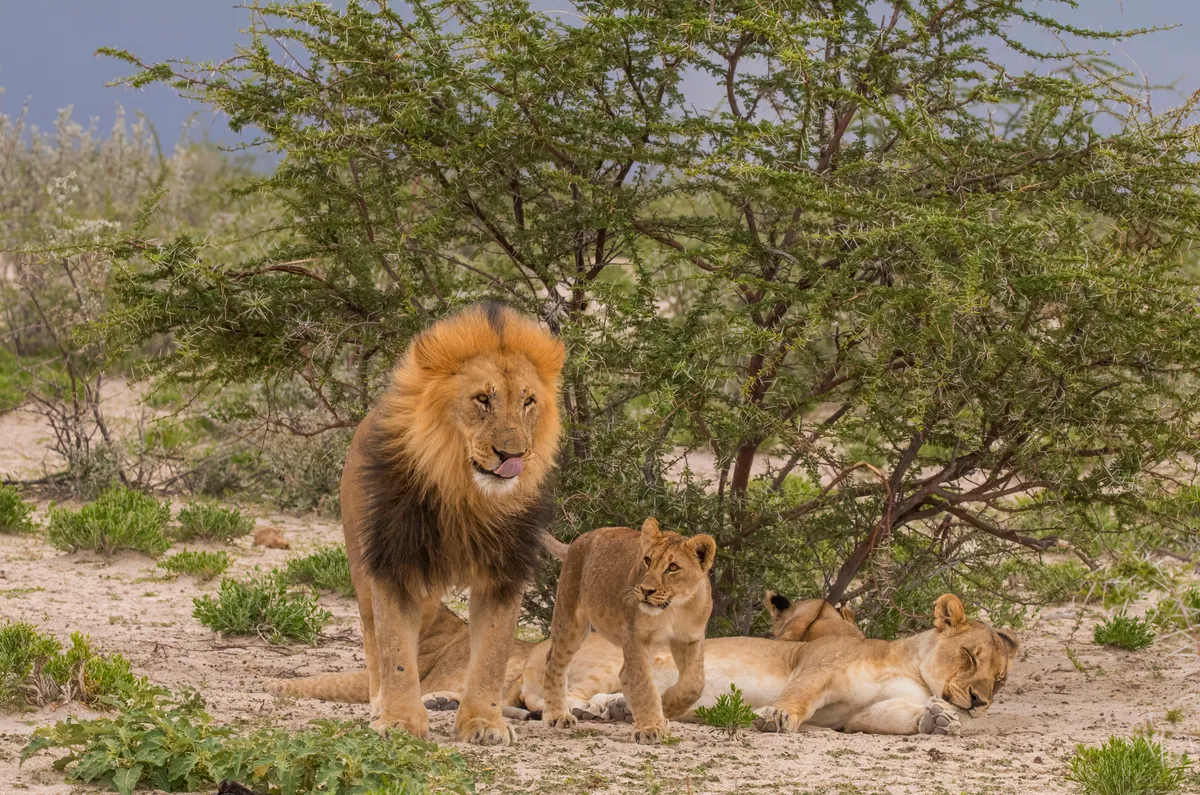
The lion is a large, muscular cat, and adult males are easy to recognize by their shaggy manes, which range in color from blond to reddish-brown to black. Females measure about 1.4 to 1.7 meters from head to rump and males about 1.7 to 2.5 meters, with a tail of 70 to 105 centimeters on top. Lions stand about 1 to 1.2 meters at the shoulder. Females weigh 122 to 180 kilograms, and males 150 to 260 kilograms.
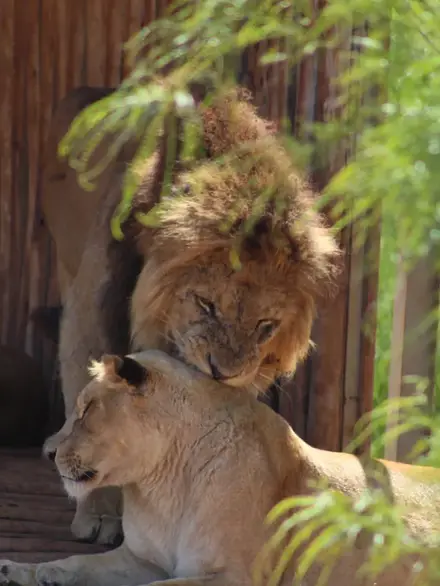
Lions are the only cats that live in large social groups, called prides. A pride is built around related females and may include several to as many as 40 lions, along with one or more resident males. The females raise the cubs and do most of the hunting, going after large animals such as zebras and wildebeest, while males sometimes join in.
Much of a lion's day is spent resting: lying around can add up to 21 hours in a 24-hour period. In the wild, a lioness may live up to 16 years, but males rarely live past 12.
Lions live in a wide range of habitats, from open plains to thick brush and dry thorn forest. Today they are found across much of sub-Saharan Africa, while the Asiatic lion survives only in the Gir Forest of northwest India.
Conservation
The lion is listed as Vulnerable on the IUCN Red List, and its 2023 reassessment kept it in that category. That assessment used estimates of about 23,000 adult and subadult lions in Africa and about 670 in India. Lions are already extinct in North Africa and Southwest Asia.
The main threats to lions come from a shrinking living space. Human settlements, farming and road building are eating into their habitat and reducing their natural prey, which pushes lions toward livestock, and farmers often kill lions in return. Lions are also killed for trophies and for body parts used in traditional medicine, and they are regionally extinct in 15 African countries.
In March 2025, IUCN published its first Green Status assessment for the lion, which measures how far a species has recovered, and ranked it "Largely Depleted". The species remains Vulnerable on the Red List.
Fun facts
- A lion's roar can be heard up to 4.8 kilometers away.
- Lions can spend up to 21 hours of a 24-hour day lying around.
- Lions were kept at the Tower of London for centuries, and when the royal menagerie closed in 1835, many of its animals moved to what is now London Zoo.
National bird of the United Kingdom: European robin
European robin Erithacus rubecula National symbol
Also known as: robin redbreast
The robin won an unofficial public poll for the UK's national bird, run by ornithologist David Lindo in 2015, in which more than 200,000 people voted; it has not been officially designated.
The European robin is a small bird with a bright red breast and a brown back, found in British gardens, parks and countryside all year round. Robins sing almost all year, even at night next to street lights, and despite their friendly look they fiercely drive intruders out of their territory. Curious by nature, robins often follow gardeners, ready to pounce on freshly unearthed worms and grubs.
Frequently asked questions
What is the national animal of the United Kingdom?
The national animal of the United Kingdom is the lion (a widely recognized national symbol, not set by law). The lion is the animal most closely tied to the country's heraldry: three lions stand for England on the Royal Arms, and an English lion holds up one side of the shield.
Which country has the lion as its national animal?
The lion is the national animal of the United Kingdom. The same species is also the national animal of Belgium, Czechia, Ethiopia, Kenya and Morocco.
Why is the lion the national animal of the United Kingdom?
The United Kingdom has never named an official national animal, but the lion is the one most often linked with it because it is the real animal at the heart of the Royal Arms, where the three lions of England fill two quarters of the shield and an English lion supports it (the Scottish unicorn on the other side is mythical). The lion has been an emblem of English kings for about eight hundred years, and Richard I's three lions have been England's arms ever since; they also live on in the Three Lions badge of England's football team.
Is the lion endangered?
The lion is listed as Vulnerable on the IUCN Red List, a category its 2023 reassessment kept. Shrinking living space is the main threat, and lions are already extinct in North Africa and Southwest Asia and regionally extinct in 15 African countries.
Where does the lion live?
Open plains, thick brush and dry thorn forest in sub-Saharan Africa, plus India's Gir Forest.
What is the national bird of the United Kingdom?
The national bird of the United Kingdom is the European robin (a widely recognized national symbol, not set by law). The robin won an unofficial public poll for the UK's national bird, run by ornithologist David Lindo in 2015, in which more than 200,000 people voted; it has not been officially designated. The European robin is also known as robin redbreast.
See also: Most Popular Dog Breeds in the United Kingdom (2025)
Sources
- The Royal Family (royal.uk). Coats of Arms.
- The Heraldry Society. The Origin of the Royal Arms of England – a European Connection.
- Historic Royal Palaces. The Tower of London Menagerie.
- San Diego Zoo Wildlife Alliance. Lion.
- Smithsonian's National Zoo & Conservation Biology Institute. Lion.
- Animal Diversity Web (University of Michigan). Panthera leo.
- African Wildlife Foundation. Lion.
- Down To Earth. 'Largely depleted': IUCN's new Green Status assessment for the lion in Africa and India.
- VN Online (15 June 2015): Robin voted UK's national bird.
- RSPB: Robin (Erithacus rubecula).
- Conservation status: IUCN Red List of Threatened Species.