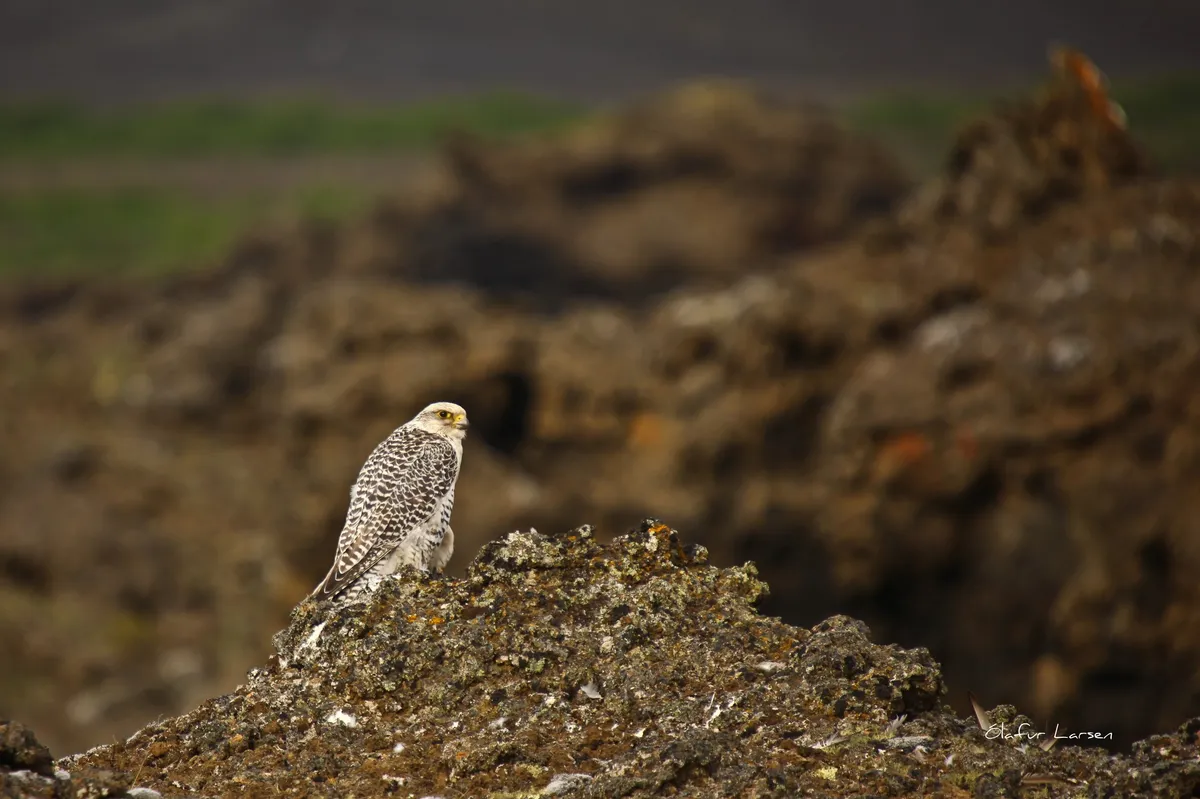
Why it represents the country
The gyrfalcon has never been named Iceland's national animal by law or by an official vote, but it is the animal with the strongest claim. According to Perlan, the nature museum in Reykjavík, most Icelanders see the falcon, fálki in Icelandic, as their national bird.
The gyrfalcon was the main figure of Iceland's coat of arms from 1903 to 1919. The arms adopted on 11 December 1903 showed a silver falcon on a blue field, replacing the crowned stockfish that had stood for Iceland for centuries. The idea was not new: around 1870 the Icelandic artist Sigurður Guðmundsson had proposed a flag with a silver falcon on blue, and it became popular among students.
The gyrfalcon also gives its name to the Order of the Falcon, the highest honour the Icelandic state awards. The order was founded by royal decree on 3 July 1921, and since 1944 the President of Iceland has been its Grand Master. The Office of the President explains that the falcon was chosen because falcons were considered precious gifts to dignitaries in past centuries and were valuable export items from Iceland. The order's badge still shows a silver falcon with wings raised for flight on a blue shield.
About the animal
The gyrfalcon is the largest true falcon in the world. Adults measure about 50 to 63 centimeters from bill to tail, with a wingspan of about 1.2 to 1.3 meters. Females are clearly bigger than males: males weigh roughly 0.8 to 1.3 kilograms, females 1.4 to 2.1 kilograms.
Gyrfalcons come in three color phases, white, grey and dark, and individual birds range from dappled white to almost pure black. The species nests in the Arctic and subarctic regions of North America, Europe, Asia, Greenland and Iceland. Iceland's gyrfalcons are genetically distinct from those elsewhere in the Arctic, and Iceland is thought to have one of the highest densities of breeding gyrfalcons in the world.
Gyrfalcons eat mainly other birds, and ptarmigan make up most of their diet by weight. Rather than relying on speed alone, a gyrfalcon uses raw power, often catching its prey after a chase from behind. In Iceland, the number of falcons rises and falls with the number of rock ptarmigan, their main prey.
Gyrfalcons do not build their own stick nests. They usually lay their eggs on a cliff ledge under an overhang, and sometimes reuse an old nest built by common ravens. In Iceland, nesting begins in late April or early May. A clutch can hold 2 to 7 eggs, usually about 4, and incubation takes about 35 days.
Conservation
The gyrfalcon is listed as Least Concern on the IUCN Red List. It is also listed on Appendix II of the Convention on Migratory Species, where it has been since 1979. Possible threats include pesticides in the environment, habitat loss and falling prey numbers, and as the climate warms, peregrine falcons may move north and compete with gyrfalcons for nest sites.
In Iceland, falcons have been studied since 1981, with long-term monitoring over more than 5,000 square kilometers in the northeast. In January 2024, Iceland Review reported that the falcon population had never been smaller since research began: young birds were found in only 38 of 88 known nests in the study area.
Experts see bird flu as the most likely cause of the recent decline of gyrfalcons in Iceland. Only one case of bird flu in a falcon was confirmed in Iceland in 2022, but many more falcons are suspected to have died of it.
Fun facts
- In the Middle Ages, only a king could hunt with a gyrfalcon, and the white gyrfalcon earned the title "bird of kings".
- A silver falcon on a blue field was Iceland's coat of arms from 1903 to 1919, and a silver falcon still decorates the badge of the Order of the Falcon.
- Iceland's gyrfalcons depend so much on rock ptarmigan that the two populations rise and fall together.
Other national symbols of Iceland
- National flower
Mountain avens (holtasóley) Dryas octopetala National symbol
The mountain avens, holtasóley in Icelandic, was chosen as Iceland's national flower in a public vote in 2004, according to Visit Akureyri and Perlan.
Frequently asked questions
What is the national bird of Iceland?
The national bird of Iceland is the gyrfalcon (a widely recognized national symbol, not set by law). The largest falcon in the world, it was the main figure on the Icelandic coat of arms from 1903 to 1919 and gives its name to the country's highest honour, the Order of the Falcon.
Which country has the gyrfalcon as its national bird?
The gyrfalcon is the national bird of Iceland.
Why is the gyrfalcon the national bird of Iceland?
The gyrfalcon has never been named by law or official vote, but it has the strongest claim: according to Perlan, the nature museum in Reykjavík, most Icelanders see the falcon, fálki in Icelandic, as their national bird. A silver falcon on blue was Iceland's coat of arms from 1903 to 1919, replacing the crowned stockfish, and the falcon also names the Order of the Falcon, chosen because falcons were precious gifts to dignitaries and valuable exports from Iceland in past centuries.
Is the gyrfalcon endangered?
The gyrfalcon is listed as Least Concern on the IUCN Red List. In Iceland, however, the falcon population was reported in January 2024 to be at its smallest since research began in 1981, and experts see bird flu as the most likely cause.
Where does the gyrfalcon live?
Arctic and subarctic regions, nesting on cliff ledges; in Iceland, open country where rock ptarmigan are plentiful.
Sources
- Office of the President of Iceland. History of the Order (The Order of the Falcon).
- Office of the President of Iceland. Classes of the Order.
- Flags of the World (FOTW). Iceland: Historical flags.
- Perlan (Reykjavík nature museum). Iceland national bird.
- Iceland Review. Falcon population dwindling (2 January 2024).
- The Peregrine Fund. Gyrfalcon.
- Animal Diversity Web (University of Michigan). Falco rusticolus.
- CMS Raptors MOU. Falco rusticolus.
- Visit Akureyri: Holtasóley (15 June 2021).
- Perlan: Iceland national flower – mountain avens.
- Conservation status: IUCN Red List of Threatened Species.