Why it represents the country
The southern lapwing, called the tero in Uruguay, is widely described as the country's national bird and is the animal most often named as its national animal. No law or decree naming it has been found; its place rests on popular tradition rather than an official act.
The tero's link with Uruguayan identity is clearest in sport. Uruguay's national rugby team is known as Los Teros, after the bird, and the tero appears on the team's jerseys and on its pennant flag.
The tero is also one of the most familiar birds in the country. It lives in open fields, near streams and wetlands, and often in towns and cities. Its loud, shrill alarm call, which gives it its name, has earned it a reputation as a watchful guardian, and on some farms it is even kept partly tame for that reason.
About the animal
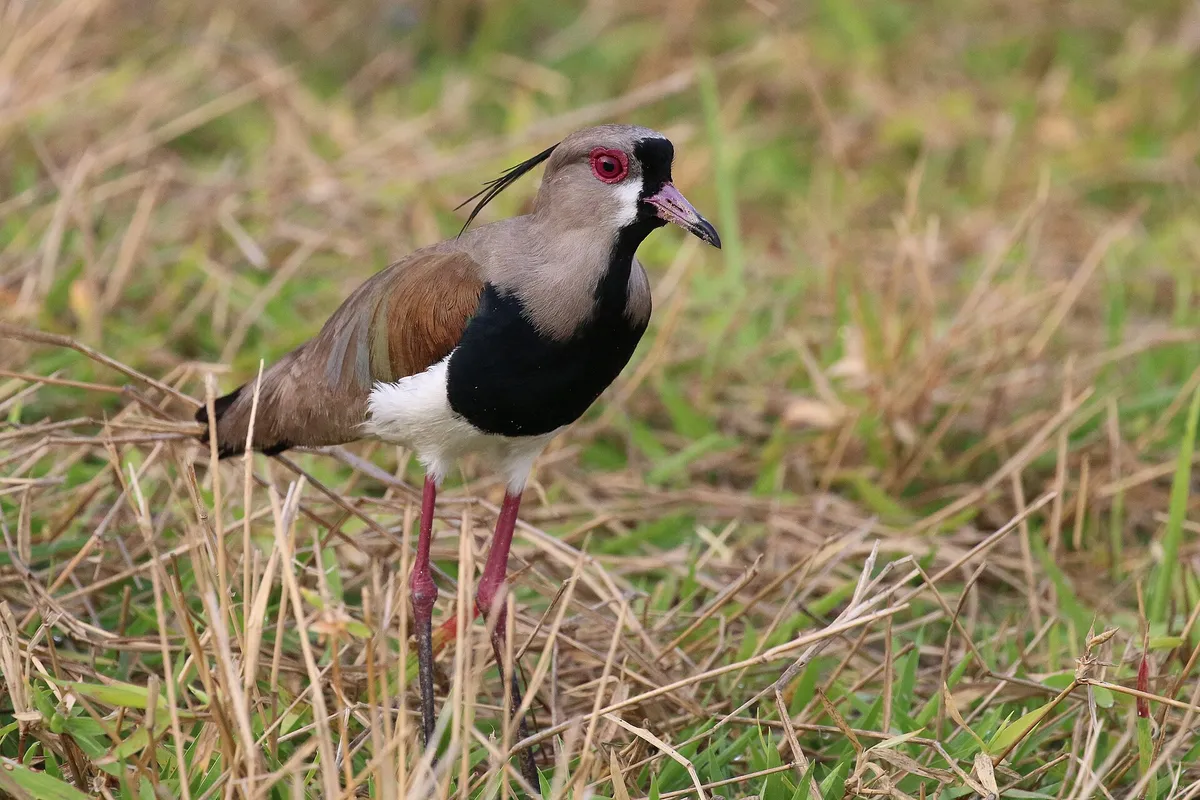
The southern lapwing is a large, crested plover. Its head is grey with a thin black crest, a black patch runs from the forehead down the throat into a broad black breast band, and the belly is white. The back is greyish brown with bronze and olive tones on the shoulders, and the eyes, legs and base of the bill are reddish. Adults measure about 30 to 35 centimeters long and weigh roughly 250 to 425 grams.
The tero has small red, horny spurs on its wings. It uses them against predators and when males fight over a female.
Teros usually live in pairs or small groups, and are often seen in threes. They feed mainly on earthworms, grubs and insects picked from the ground with their short bill, often in farm fields, and they also forage at night. When resting, a tero often stands on one leg.
The tero nests on the ground in a shallow hollow hidden among grass. The female lays 3 or 4 cream-colored eggs with dark spots, which are incubated for about 27 days. The chicks can feed themselves a few days after hatching. When an intruder comes near, the adults call loudly, swoop low over it, or pretend to have a broken wing to lead it away, and some young birds stay on as helpers that guard the territory and sometimes even incubate the eggs.
Conservation
The southern lapwing is listed as Least Concern on the IUCN Red List as a species, most recently assessed in 2020. It has a very large range, its population appears to be increasing, and BirdLife International estimates it at somewhere between 5 million and 50 million mature birds. It has been rated as low risk in every assessment since 1988, and it is also considered Least Concern within Uruguay.
Unlike many birds, the tero has gained from human changes to the land. It copes well with disturbance, and its range has grown as forests have been cleared and land cultivated. Today it lives from Panama and northern South America to Tierra del Fuego, and it is at home in pastures, parks, airports and gardens.
Fun facts
- The tero gets its name from its loud alarm call, which sounds like "teru-teru."
- The tero carries small red spurs on its wings, which it uses against predators and rival males.
- Some young southern lapwings stay with their parents as helpers, guarding the territory and sometimes even sitting on the eggs.
Other national symbols of Uruguay
- National flower
Ceibo (cockspur coral tree) Erythrina crista-galli National symbol
The ceibo is named as Uruguay's national flower by the Argentine government's national symbols page and by Billiken, but no Uruguayan law or decree designating it was found.
Frequently asked questions
What is the national bird of Uruguay?
The national bird of Uruguay is the southern lapwing (a widely recognized national symbol, not set by law). The southern lapwing, or tero, is a crested grey, black and white plover of open grassland that is common across Uruguay, from farm fields to city lawns.
Which country has the southern lapwing as its national bird?
The southern lapwing is the national bird of Uruguay. The southern lapwing is also known as queltehue or quero-quero.
Why is the southern lapwing the national bird of Uruguay?
The southern lapwing, or tero, is the bird most widely described as Uruguay's national bird, and it is the emblem of the national rugby team, Los Teros. No law or decree naming it has been found, so its status rests on popular tradition.
Is the southern lapwing endangered?
The southern lapwing is listed as Least Concern on the IUCN Red List as a species, and its population appears to be increasing.
Where does the southern lapwing live?
Open grassland, pastures, farmland, the edges of streams, marshes and lagoons, and city parks; across Uruguay and most of South America.
Sources
- World Rugby Museum. From the Vaults: Uruguay pennant flag (6 Sep 2021).
- Billiken. ¿Cuál es el ave nacional de Uruguay?.
- Montevideo Portal. Tero: emplea diferentes estrategias para despistar sobre la ubicación del nido (8 Apr 2021).
- Contenidos Educativos Digitales (edu.uy). 020 Aves: Tero, Vanellus chilensis.
- BirdLife International. Southern Lapwing Vanellus chilensis: species factsheet (IUCN Red List assessment 2020).
- Cornell Lab of Ornithology, Birds of the World. Southern Lapwing (Vanellus chilensis), E. S. A. Santos, version 1.0 (2020).
- The University of the West Indies. The Online Guide to the Animals of Trinidad and Tobago: Vanellus chilensis (Southern Lapwing).
- Argentina.gob.ar: El ceibo ('Uruguay (donde también es flor nacional)').
- Billiken: ¿Cuál es la flor nacional de Uruguay? (ceibo, Erythrina crista-galli; traditionally planted at public schools).
- Conservation status: IUCN Red List of Threatened Species.