Why it represents the country
Venezuela declared the troupial its national bird on 23 May 1958. The choice followed a contest promoted by the Venezuelan Society of Natural Sciences, and the declaration was made by the governing junta of the time, led by Wolfgang Larrazábal. The orchid had been named the national flower on the same date in 1951, so 23 May is remembered in Venezuela as a day for both natural symbols.
In Spanish the bird is called the turpial, and it is one of the best-known birds in the country. It lives across most of Venezuela, from the plains of the east and the state of Zulia in the west to the Amazonas region and the north, so many Venezuelans can see or hear one not far from home.
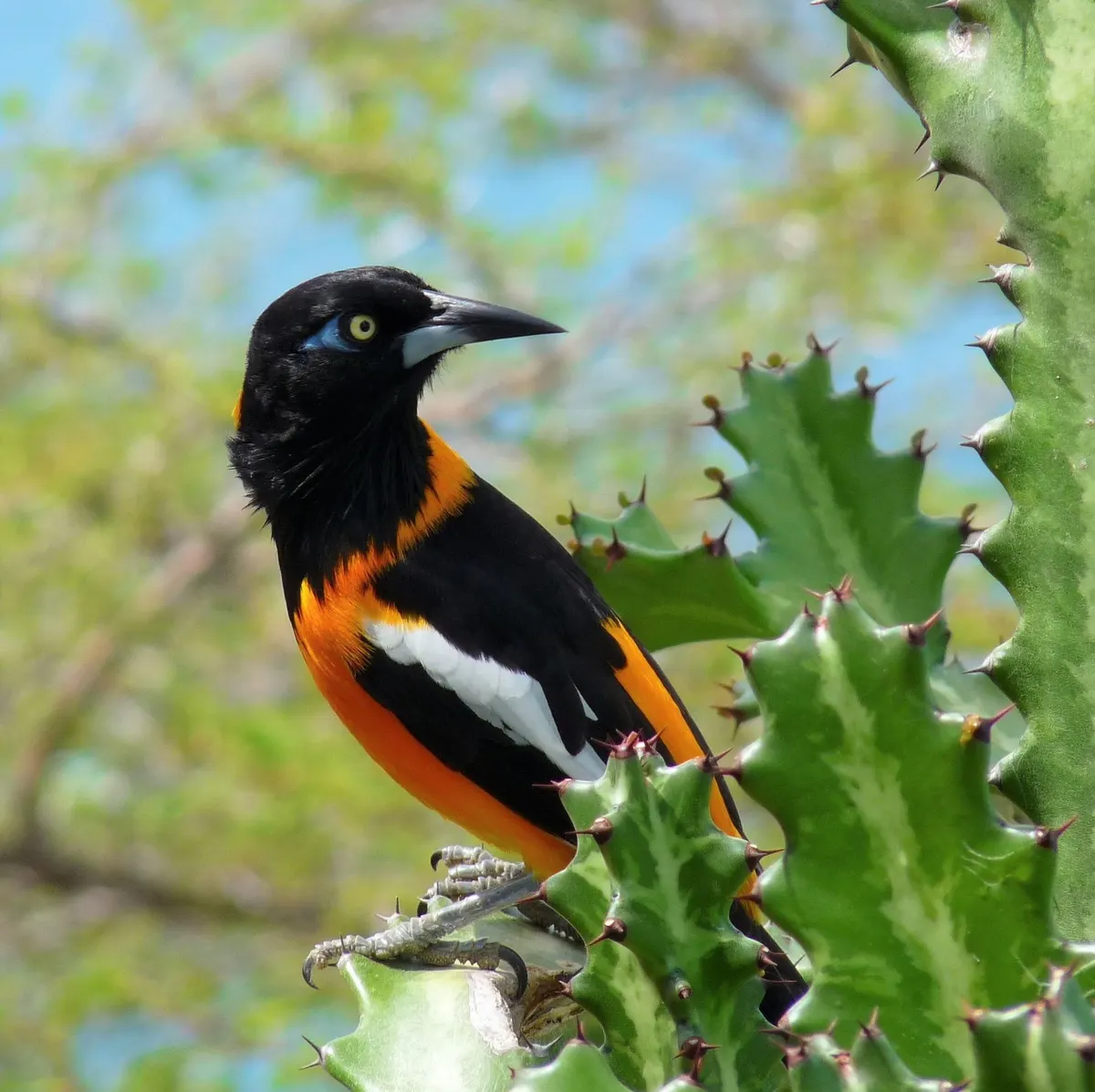
The troupial is admired above all for its looks and its voice. Its bright orange body, black head and white wing stripe make it easy to recognize, and its loud, clear song makes it a favorite with birdwatchers. The same colors and song have also made it a popular cage bird, which is why it is best enjoyed in the wild.
About the animal
The Venezuelan troupial is a large member of the New World oriole family, about 23 to 27 centimeters long, with a long, wedge-shaped tail and a long, pointed bill. Its head, throat and upper breast are black, and the rest of the underparts are bright orange, with an orange collar around the back of the neck. The wings are black with a long white stripe, and a patch of bare, bright blue skin surrounds each eye.
It lives in northern Colombia and Venezuela and on the islands of Aruba, Curaçao and Margarita, and it has been introduced to Puerto Rico, St. Thomas and Bonaire. It prefers dry, open places such as cactus scrub, dry woodland, savanna and the edges of riverside forest, mostly below about 500 meters, and it also visits fruit plantations and gardens.
The troupial is famous as a nest pirate. It builds no nest of its own. Instead, a pair finds the covered, hanging stick nest of another bird, such as a rufous-fronted thornbird or a great kiskadee, and takes it over, sometimes attacking the owners and eating any eggs or chicks left inside. The pair adds its own lining and may widen the entrance. The female usually lays three eggs, which hatch after 15 or 16 days, and the chicks stay in the nest for about three weeks.
Troupials hunt insects in trees and bushes, especially in the breeding season, and they eat a lot of fruit. When giant cacti are fruiting, cactus fruit can make up almost their entire diet, and they also eat mangoes, sapodillas, soursop and other fruits. Males sing most in the early morning, with loud, repeated whistled notes, and females often answer them.
Conservation
The Venezuelan troupial is listed as Least Concern on the IUCN Red List. Its global population has not been counted, but BirdLife International describes it as fairly common, though patchily distributed, and believes its numbers are stable.
The main pressure on the species is capture for the cage-bird trade, because people value its bright colors and song. Even so, it remains common in much of its range, and in some places it is abundant.
Because it likes dry scrub, open woodland and even gardens and orchards, the troupial lives alongside people more easily than many forest birds. Protecting dry forest and cactus scrub, and leaving wild birds in the wild rather than in cages, are the best ways to keep Venezuela's national bird singing.
Fun facts
- The troupial builds no nest of its own and takes over the nests of other birds instead.
- Adult troupials have a patch of bright blue bare skin around each eye.
- Venezuela remembers its national bird and its national flower on the same day, 23 May.
Other national symbols of Venezuela
- National flower
May flower orchid (flor de mayo) Cattleya mossiae Officially designated
Venezuela declared the orchid Cattleya mossiae its national flower by official decree on 23 May 1951, after a study by the Venezuelan Society of Natural Sciences.
Frequently asked questions
What is the national bird of Venezuela?
The national bird of Venezuela is the Venezuelan troupial (officially designated). Known at home as the turpial, it is a black, orange and white songbird with a bright orange body, black head, white wing stripe and a patch of bare blue skin around each eye.
Which country has the Venezuelan troupial as its national bird?
The Venezuelan troupial is the national bird of Venezuela. The Venezuelan troupial is also known as turpial.
Why is the Venezuelan troupial the national bird of Venezuela?
Venezuela declared the troupial its national bird on 23 May 1958, after a contest promoted by the Venezuelan Society of Natural Sciences; the declaration was made by the governing junta of the time, led by Wolfgang Larrazábal. The turpial is one of the best-known birds in the country, living across most of Venezuela, and it is admired for its bright colors and loud, clear song.
Is the Venezuelan troupial endangered?
The Venezuelan troupial is listed as Least Concern on the IUCN Red List, and BirdLife International describes it as fairly common and believes its numbers are stable. The main pressure on it is capture for the cage-bird trade, but it remains common in much of its range.
Where does the Venezuelan troupial live?
Dry woodland, cactus scrub, open savanna and the edges of riverside forest.
Sources
- Ministerio del Poder Popular para la Salud (Venezuela). 23 de mayo: Día del Turpial como Ave Nacional.
- Universidad de Carabobo, Vicerrectorado Académico. El turpial es el ave nacional de Venezuela.
- Animal Diversity Web, University of Michigan. Icterus icterus: troupial.
- IUCN Red List of Threatened Species. Icterus icterus (assessment 2018).
- Universidad de Carabobo, Vicerrectorado Académico — La orquídea venezolana.
- Conservation status: IUCN Red List of Threatened Species.