Why it represents the country
The kiwi is not the subject of a law, yet it is New Zealand's most beloved national symbol. The Department of Conservation calls it the national icon of New Zealand and an unofficial national emblem. The word Kiwi has been used as an affectionate name for New Zealanders for more than a century.
The bird became an emblem step by step. By the late 1800s it was used on banknotes and as a trademark, and it appeared on the sixpenny stamp when New Zealand issued its first picture stamps in 1898. Regiments used it on military badges, and by 1917 New Zealand soldiers were themselves being called Kiwis, simply because the bird was so clearly unique to their country. When New Zealand issued its own currency in 1934, the kiwi was on the two-shilling coin and on banknotes.
The bird is also a good fit for a country with a very unusual natural history. New Zealand was isolated for a long time, and before people arrived there were almost no land mammals apart from bats. Birds filled many of the roles that mammals play elsewhere, and some, like the kiwi, lost the ability to fly. The kiwi also has deep cultural meaning for Māori, the Indigenous people of New Zealand. Kiwi feather cloaks, called kahu kiwi, were highly valued and usually reserved for chiefs, and the bird is regarded as a treasure, or taonga.
About the animal
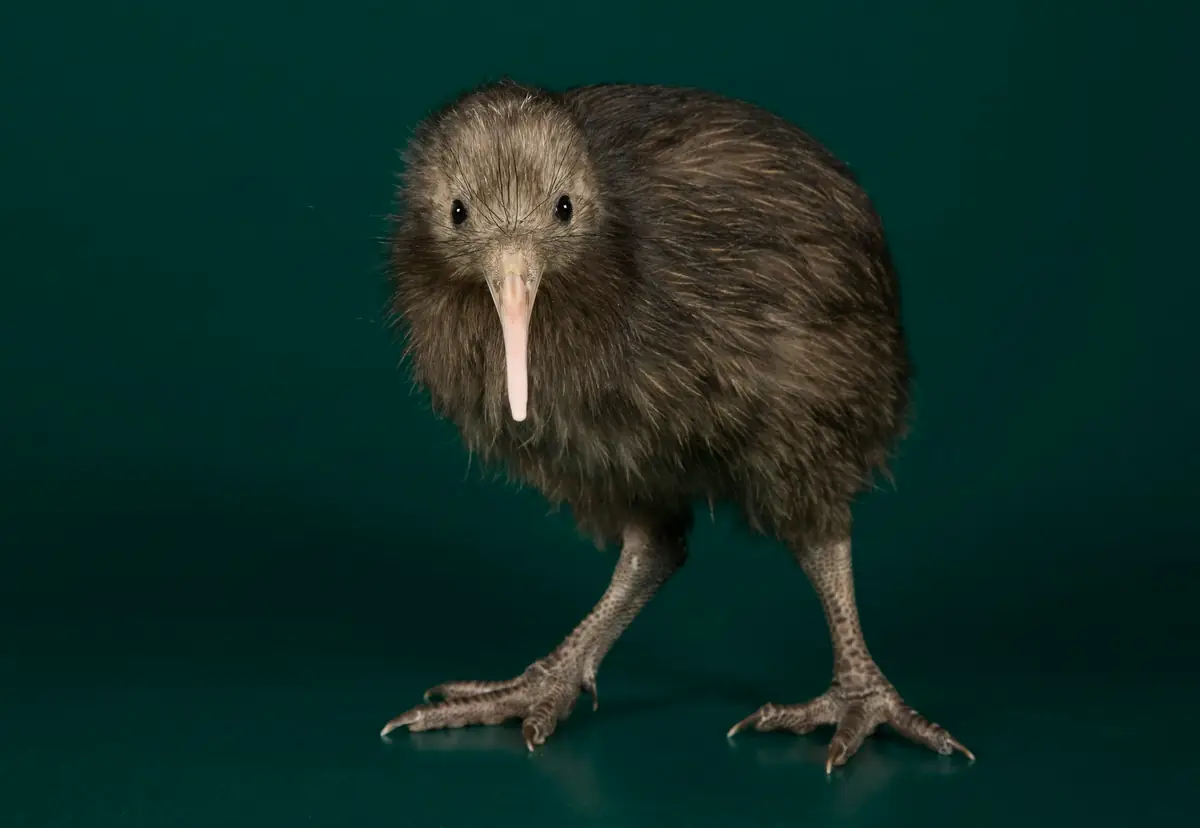
There are five species of kiwi, all found only in New Zealand. They are roughly the size of a domestic chicken, with shaggy, hair-like feathers, tiny wings hidden under their plumage and no tail. The quick facts on this page are for the North Island brown kiwi, the most numerous species. Kiwi belong to the ratites, a group of mostly flightless birds that also includes the ostrich, the emu and the extinct moa. DNA studies suggest that their closest relative was the extinct elephant bird of Madagascar.
Kiwi are mostly active at night. They have a long, slightly curved bill with nostrils at the very tip, which is unique among birds. Walking slowly through the forest floor, a kiwi probes up to about 10 centimeters into the soil and leaf litter and sniffs out worms, insect larvae, other small animals and fallen fruit. Sensitive pits near the tip of the bill may also help it feel for prey.
Kiwi have several features that are unusual for a bird, which is why they are sometimes called honorary mammals. Their bones are heavy and filled with marrow instead of being light and hollow, females have two working ovaries instead of one, and their body temperature is about 38 degrees Celsius, around two degrees lower than most birds.
The kiwi is famous for its enormous egg. In most species the egg weighs about one-fifth as much as the mother, one of the largest eggs for body size of any bird. A North Island brown kiwi egg weighs about 430 grams. In the brown kiwi and the little spotted kiwi, the male alone incubates the egg, and incubation takes between about 65 and 90 days. Kiwi chicks hatch fully feathered and look like small adults. They leave the nest burrow within days and feed themselves, without being fed by their parents.
Conservation
When people arrived in New Zealand they brought predators that kiwi had never faced, including stoats, cats, dogs and rats. Stoats and cats kill many chicks, and dogs can kill adult birds. A chick is not big enough to fight off a stoat until it weighs about 1 kilogram. Forest clearing also took away much of the kiwi's habitat.
Conservation groups report that in areas without predator control, the large majority of kiwi chicks do not survive to adulthood. Te Ara, the Encyclopedia of New Zealand, notes that there may once have been millions of kiwi, but fewer than 100,000 by the mid-2000s. Several species are classed as threatened on the IUCN Red List, and the North Island brown kiwi is listed as Vulnerable.
Kiwi were given legal protection in 1896, and New Zealand has since built one of the world's most active conservation programs around the bird. Community groups trap predators, and through Operation Nest Egg, which began in 1994, eggs are collected and hatched in safety. Young birds are released onto predator-free islands or fenced sanctuaries until they are big enough to defend themselves. In many areas, these efforts have helped kiwi numbers to grow again.
Fun facts
- Kiwi are the only birds with nostrils at the tip of the bill, which they use to smell food underground.
- A kiwi egg is huge compared with the mother, one of the largest eggs for body size of any bird.
- Kiwi have tiny wings hidden under their feathers, even though they cannot fly.
Frequently asked questions
What is the national bird of New Zealand?
The national bird of New Zealand is the kiwi (a widely recognized national symbol, not set by law). It is a shy, flightless bird about the size of a chicken, with shaggy, hair-like feathers and no tail, found only in New Zealand and so closely tied to the country that New Zealanders themselves are nicknamed Kiwis.
Which country has the kiwi as its national bird?
The kiwi is the national bird of New Zealand.
Why is the kiwi the national bird of New Zealand?
The kiwi became an emblem step by step rather than by law: by the late 1800s it was used on banknotes and as a trademark, it appeared on a stamp in 1898, and by 1917 New Zealand soldiers were themselves called Kiwis because the bird was so clearly unique to their country. It also suits a land where birds filled the roles that mammals play elsewhere, and for Māori the kiwi is a treasure, or taonga.
Is the kiwi endangered?
Several kiwi species are classed as threatened on the IUCN Red List, and the North Island brown kiwi, the species described in this page's quick facts, is listed as Vulnerable. Introduced predators such as stoats and cats kill many chicks, but predator trapping and Operation Nest Egg have helped kiwi numbers grow again in many areas.
Where does the kiwi live?
Native forests, scrubland, tussock grassland and some farmland in New Zealand.
See also: Most Popular Dog Breeds in New Zealand (2025)
Sources
- New Zealand Department of Conservation. Kiwi.
- Te Ara, the Encyclopedia of New Zealand. Kiwi.
- IUCN Red List of Threatened Species. Apteryx mantelli (assessment 2017).
- Conservation status: IUCN Red List of Threatened Species.