Why it represents the country
The doctor bird is Jamaica's national bird and one of the country's national symbols. The Jamaica National Heritage Trust lists it among the national emblems, alongside the flag, the coat of arms, the ackee, the lignum vitae and the blue mahoe. It was chosen in 1962 by a National Flower Committee that also picked the national tree and fruit, and the ministry paper on national emblems described it as living only in Jamaica and as one of the most outstanding of the 320 species of hummingbirds.
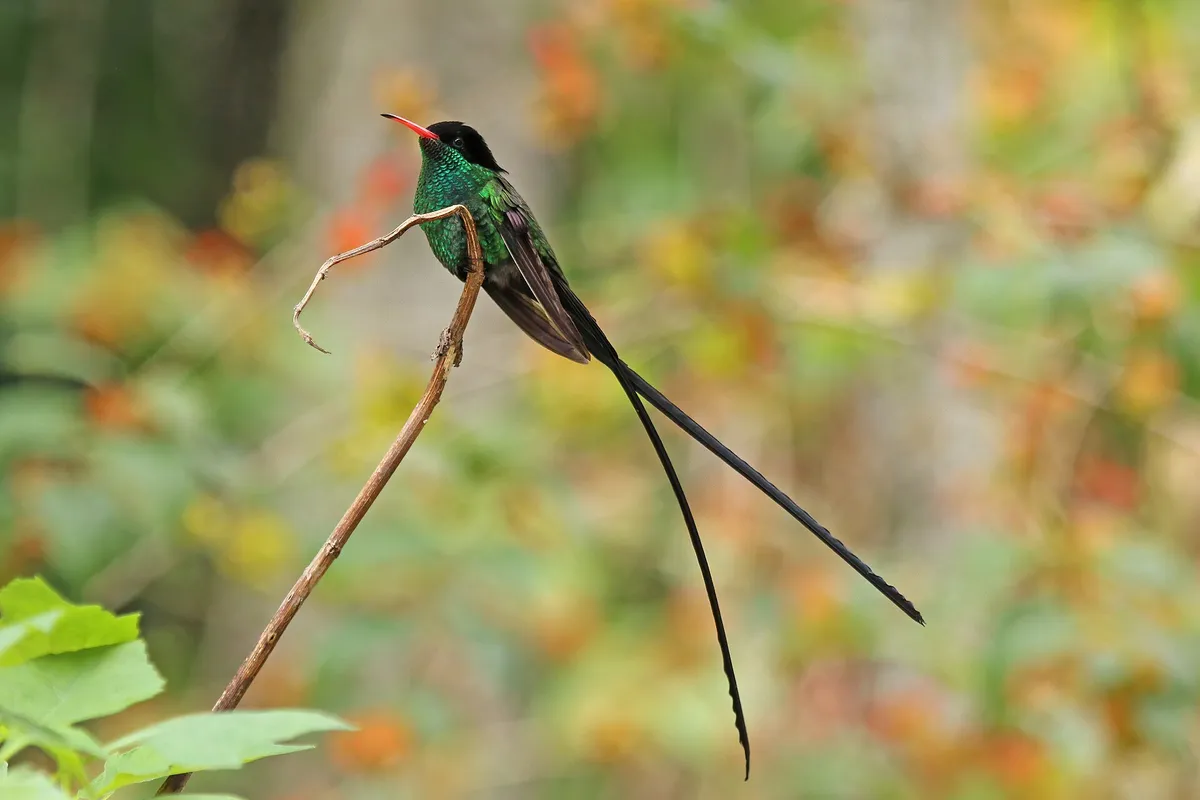
The name doctor bird has no single agreed origin. One long-standing explanation is that the male's black crest and long black tail look like the top hat and tailcoat worn by doctors long ago. Another is that the bird seems to lance flowers with its bill, like a doctor, when it reaches in for nectar.
The doctor bird also has deep roots in Jamaican folklore. The Taino, the island's first people, called it the God bird and believed it carried the souls of the dead, and in many rural areas people still say that killing one brings bad luck. Today it appears on Jamaican passports and driver's licences and on special banknotes issued by the Bank of Jamaica.
About the animal
The red-billed streamertail is a small hummingbird with very different males and females. The male has a black head, an iridescent emerald-green body, a straight coral-red bill with a black tip, and a black forked tail with two very long streamer feathers. The female is green above and white below, has a duller bill and has no streamers. Females average about 10.5 centimeters long and 4.4 grams, while males, counting their tails, usually measure 20 to 30 centimeters and weigh about 5.2 grams.
The red-billed streamertail lives only in Jamaica and is found over most of the island. It is most common at around 1,000 meters but ranges from the coast up to about 1,500 meters, in and along the edges of mountain forests and in plantations, parks and gardens. In the far east of the island it gives way to its close relative, the black-billed streamertail, and the two sometimes interbreed where they meet.
Doctor birds feed mainly on nectar from tubular flowers, and they also catch small insects and spiders; females eat insects more often than males. They are solitary and fiercely territorial, chasing rivals and even large hawk moths away from their feeding spots. They are important pollinators of flowers that many other animals cannot reach.
The doctor bird can breed in any month, with a peak from January to mid-May. The female builds the nest, lays two eggs and raises the chicks alone, and she may raise up to three broods in a year. The eggs hatch after 17 to 19 days, and the young leave the nest 19 to 24 days later.
Conservation
The red-billed streamertail is listed as Least Concern on the IUCN Red List, in an assessment published in 2016 by BirdLife International. It remains common across most of Jamaica and uses plantations, parks and gardens as well as forest. Like other hummingbirds, it is also listed on Appendix II of CITES, which controls international trade.
The red-billed streamertail was once widely trapped for the bird trade, but this had become rare by the 1960s. Today its main recorded conflict with people is the occasional destruction of nests. It has disappeared from the far northeastern coast of the island, where the black-billed streamertail now lives instead.
The doctor bird is also a favorite with visitors to Jamaica. Feeding stations such as the Rocklands Bird Sanctuary, south of Montego Bay, let people see the birds up close, a reminder of how much a flower-rich island landscape matters to this national symbol.
Fun facts
- The Taino called the doctor bird the God bird and believed it carried the souls of the dead.
- A male doctor bird makes a humming sound with his scalloped tail streamers as he flies.
- A Jamaican folk saying, "Doctor bud a cunny bud, hard bud fe dead", means the doctor bird is a clever bird that cannot easily be killed.
Other national symbols of Jamaica
- National flower
Lignum vitae Guaiacum officinale Officially designated
The lignum vitae is listed among Jamaica's national emblems by the Jamaica National Heritage Trust, a government agency, and is described by The Gleaner as Jamaica's national flower.
Frequently asked questions
What is the national bird of Jamaica?
The national bird of Jamaica is the red-billed streamertail (officially designated). Jamaicans call it the doctor bird: a hummingbird found nowhere else in the world, whose adult males trail two long black tail streamers behind a glittering green body, and it appears on Jamaican passports and driver's licences.
Which country has the red-billed streamertail as its national bird?
The red-billed streamertail is the national bird of Jamaica. The red-billed streamertail is also known as swallow-tail hummingbird.
Why is the red-billed streamertail the national bird of Jamaica?
The doctor bird was chosen in 1962 by a National Flower Committee that also picked the national tree and fruit, and the ministry paper on national emblems described it as living only in Jamaica and as one of the most outstanding of the 320 species of hummingbirds. It also has deep roots in Jamaican folklore: the Taino, the island's first people, called it the God bird and believed it carried the souls of the dead.
Is the red-billed streamertail endangered?
The red-billed streamertail is listed as Least Concern on the IUCN Red List and remains common across most of Jamaica, using plantations, parks and gardens as well as forest. It was once widely trapped for the bird trade, but this had become rare by the 1960s.
Where does the red-billed streamertail live?
Montane forests and forest edges, plantations, parks and gardens across Jamaica, from the coast up to about 1,500 m.
Sources
- Jamaica National Heritage Trust. Fast Facts – National Emblems.
- African Caribbean Institute of Jamaica / Jamaica Memory Bank (Institute of Jamaica). Jamaica's National Bird: The Doctor Bird (Rochelle Clarke).
- African Caribbean Institute of Jamaica / Jamaica Memory Bank (Institute of Jamaica). Jamaica's National Bird: The Doctor Bird.
- The Gleaner (Jamaica). Pieces of the Past: The Doctor Bird (Rebecca Tortello, 2004).
- 10,000 Birds. What is the National Bird of Jamaica?.
- Animal Diversity Web (University of Michigan). Trochilus polytmus (red-billed streamertail).
- IUCN / BirdLife International (Crossref DOI record). Trochilus polytmus, The IUCN Red List of Threatened Species 2016: e.T22687469A93153469.
- GBIF. Trochilus polytmus – IUCN Red List category.
- Jamaica National Heritage Trust: Fast Facts – National Emblems (Lignum Vitae, Guiacum officinale).
- The Gleaner (31 May 2026): National flower hangs in the balance as calls grow stronger for protection of lignum vitae.
- Conservation status: IUCN Red List of Threatened Species.