Why it represents the country
The Philippine eagle was declared the national bird of the Philippines in 1995 by a presidential proclamation. The bird was once known in English as the monkey-eating eagle, but it was renamed the Philippine eagle, a name that reflects that it lives only in the Philippines.
Its size, strength and rarity make it a proud symbol of the country's natural heritage. It is found only on a few large islands, including Luzon, Samar, Leyte and Mindanao, and Mindanao holds most of the remaining birds. Scientists first described the species in 1896, from a bird collected on Samar by the English explorer John Whitehead. Its scientific name, Pithecophaga jefferyi, honors his father, Jeffery Whitehead.
Making it the national bird also helped raise awareness of how threatened it is. Killing a Philippine eagle is a serious crime under Philippine law, and the bird has become the focus of education campaigns about protecting forests. When the Philippines hosted the Southeast Asian Games in 2005, the eagle was the official mascot.
About the animal
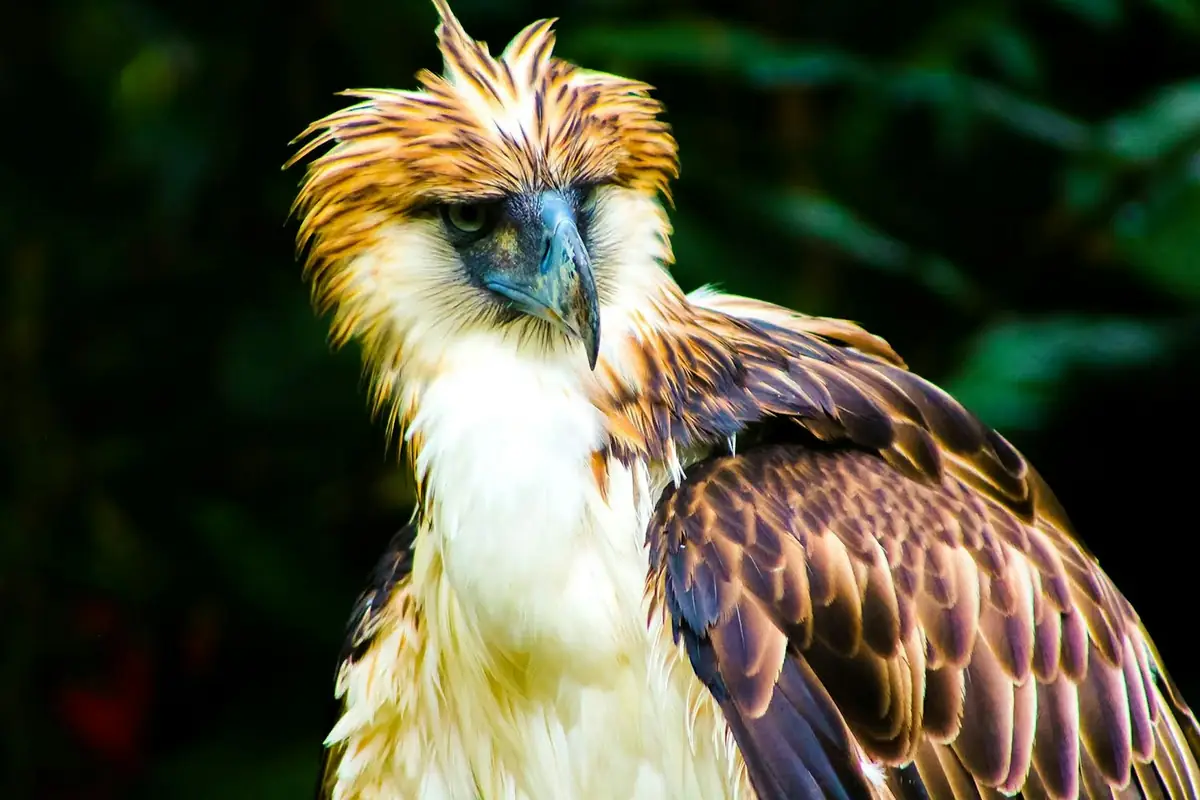
The Philippine eagle is one of the largest eagles in the world by length and wing area. It stands roughly 1 meter tall, has a wingspan of about 2 meters and usually weighs around 6 to 7 kilograms. It has a shaggy crest of long brown and cream feathers on its head, a creamy white chest, pale blue-grey eyes and a huge, deep blue-grey bill. Its short, broad wings and long tail help it move quickly between trees in thick forest, and its claws are about 7.5 centimeters long.
It is a top predator of the rainforest and has no natural predators apart from people. Its prey includes flying lemurs, also called colugos, as well as monkeys, civets, flying squirrels, bats, large birds, snakes and other animals. Pairs sometimes hunt together, with one bird drawing attention while the other attacks.
Philippine eagles raise young very slowly. Pairs are thought to stay together for life, and they build large stick nests in the crowns of tall forest trees, often dozens of meters above the ground. A pair usually lays a single egg every two years. Both parents incubate the egg, with the female doing most of the work, and it hatches after about 60 days. The chick depends on its parents for a long time, and the family stays together for well over a year while the young eagle learns to hunt. Young birds take several years to reach breeding age, and eagles can live for several decades.
Each pair needs a large area of forest to find enough food, and a pair's territory can cover up to about 130 square kilometers. That makes the eagle a good indicator of forest health: where eagles still breed, large and healthy forests remain.
Conservation
The Philippine eagle is listed as Critically Endangered on the IUCN Red List. Population studies suggest that only a few hundred adult birds remain in the wild.
The main threat is the loss of lowland and hill forest to logging, farming and mining. Fewer prey animals, pollution and the build-up of pesticides in the birds' bodies may add to the pressure. Eagles are also killed by hunting and trapping, sometimes by accident, and young birds that have just left their parents are especially at risk. Because they breed so slowly, the loss of even a few adults can have a large effect on the population.
Conservation work for the species began in the 1970s. Today conservation groups in the Philippines run breeding programs, rescue and release injured birds, survey and monitor nests, and work with local and Indigenous communities to protect nesting sites and forests. Some communities act as forest guardians and are rewarded when eagle nests in their area succeed. These efforts, together with legal protection, give the national bird a fighting chance.
Where to see the Philippine eagle in the wild
Wild Philippine eagles in the Philippines survive in forest on eastern Luzon, Samar, Leyte and Mindanao, with Mindanao protected areas such as Mount Apo and Mount Kitanglad among their strongholds.
Mount Apo Natural Park
Mount Apo Natural Park on Mindanao is described by the ASEAN Centre for Biodiversity as the last stronghold of the remaining Philippine eagle population.
Official page ↗Mount Kitanglad Range Natural Park
Mount Kitanglad Range Natural Park is one of the few remaining rainforests in the Philippines where the Philippine eagle can still be found.
Official page ↗Mount Hamiguitan Range Wildlife Sanctuary
Mount Hamiguitan Range Wildlife Sanctuary, a UNESCO World Heritage Site, counts the critically endangered Philippine eagle among its 1,380 recorded species.
Official page ↗
Watch wild animals from a distance, never feed them, and follow the rules and rangers of each protected area.
Full guide: Where to See the Philippine Eagle in the Wild, and Why It Is Rare →
Fun facts
- The Philippine eagle was once called the monkey-eating eagle, even though it eats many other animals too.
- A pair usually raises just one chick every two years.
- Philippine eagle pairs are thought to stay together for life.
Other national symbols of the Philippines
- National flower
Sampaguita (Arabian jasmine) Jasminum sambac Officially designated
Governor-General Frank Murphy declared the sampaguita the national flower of the Philippines through Proclamation No. 652 of 1934.
Frequently asked questions
What is the national bird of the Philippines?
The national bird of the Philippines is the Philippine eagle (officially designated). It is one of the largest and rarest eagles on Earth, lives only in the forests of islands such as Luzon, Samar, Leyte and Mindanao, and was the official mascot of the 2005 Southeast Asian Games.
Which country has the Philippine eagle as its national bird?
The Philippine eagle is the national bird of the Philippines. The Philippine eagle is also known as monkey-eating eagle or great Philippine eagle.
Why is the Philippine eagle the national bird of the Philippines?
A presidential proclamation declared the Philippine eagle the national bird in 1995. Its size, strength and rarity make it a proud symbol of the country's natural heritage, it lives only in the Philippines, and the title also helped raise awareness of how threatened it is.
Is the Philippine eagle endangered?
The Philippine eagle is listed as Critically Endangered on the IUCN Red List, and population studies suggest that only a few hundred adult birds remain in the wild. The main threat is the loss of lowland and hill forest to logging, farming and mining.
Where does the Philippine eagle live?
Old-growth rainforest on Luzon, Samar, Leyte and Mindanao.
Where can you see the Philippine eagle in the wild?
Wild Philippine eagles in the Philippines survive in forest on eastern Luzon, Samar, Leyte and Mindanao, with Mindanao protected areas such as Mount Apo and Mount Kitanglad among their strongholds.
Sources
- Animal Diversity Web, University of Michigan. Pithecophaga jefferyi: Philippine eagle.
- Philippine Eagle Foundation. The Philippine Eagle.
- Encyclopaedia Britannica. Philippine eagle.
- IUCN Red List of Threatened Species. Pithecophaga jefferyi (assessment 2018).
- National Commission for Culture and the Arts (NCCA): sampaguita and narra declared national flower and tree through Proclamation No. 652.
- Senate of the Philippines bill citing Executive Proclamation No. 652 of 1 February 1934.
- BirdLife International DataZone – Philippine Eagle Pithecophaga jefferyi species factsheet.
- ASEAN Centre for Biodiversity – Mt. Apo Natural Park.
- ASEAN Centre for Biodiversity – Mt. Kitanglad Range Natural Park.
- UNESCO World Heritage Centre – Mount Hamiguitan Range Wildlife Sanctuary.
- Conservation status: IUCN Red List of Threatened Species.