Why it represents the country
No law naming a national animal has been found in Jordan, but Jordanian media and conservation groups commonly describe the Arabian oryx, al-maha in Arabic, as the national animal. Several Gulf countries also count the oryx as theirs.
In Jordan, the oryx is closely tied to the story of nature conservation itself. The Royal Society for the Conservation of Nature, started by a small group of volunteers in 1966, created the country's first nature reserve at Shaumari, near the oasis town of Azraq, in 1975. One of its main purposes was to breed threatened animals such as the Arabian oryx so that they could one day be returned to the wild.
The oryx had been hunted out of Jordan roughly a hundred years ago. Its return to Shaumari became a symbol of what careful protection can achieve, and oryx from Jordan's herd have since been sent to help other reserves in the region.
About the animal
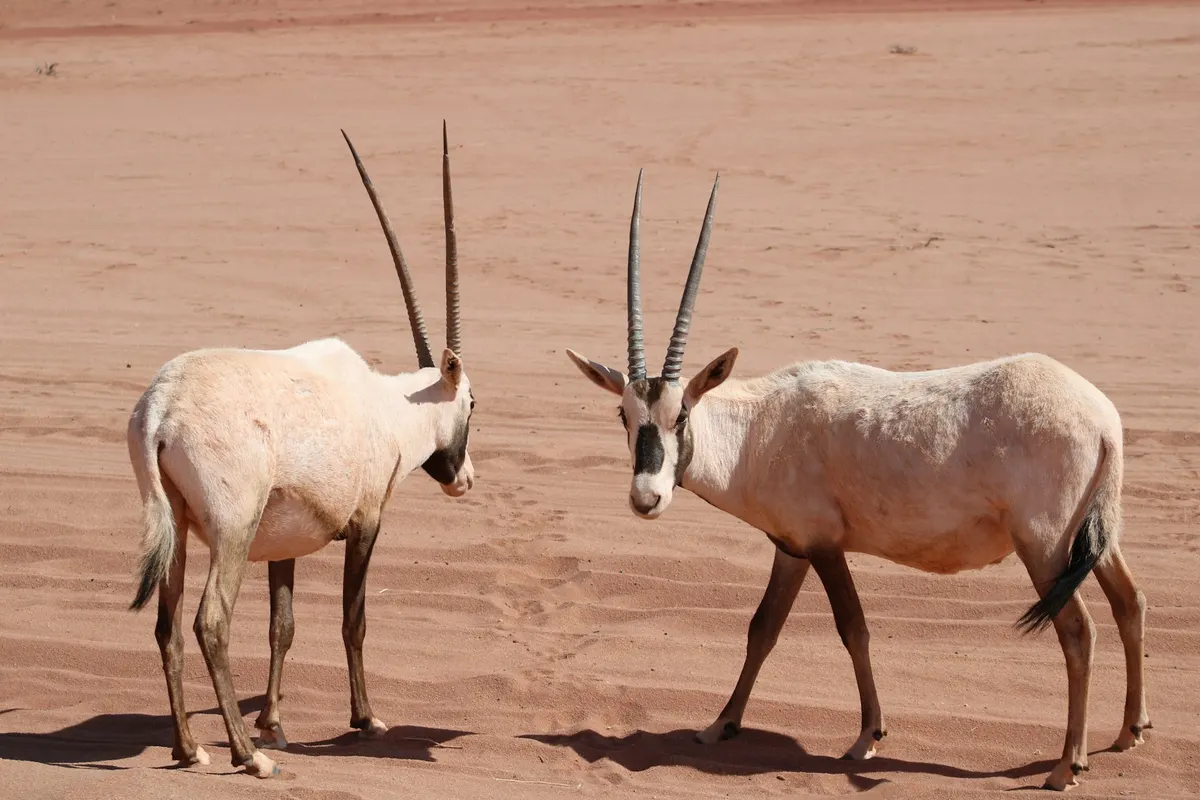
The Arabian oryx is the smallest of the oryx antelopes. Its coat is almost pure white, with dark brown to black markings on the face and legs. Both males and females carry long, thin, ringed horns that are nearly straight and usually more than half a meter long. Adults stand roughly 80 to 100 centimeters at the shoulder and usually weigh well under 100 kilograms.
The pale coat reflects the strong desert sun and helps keep the animal cool. Calves are born a sandy brown color and turn white as they grow up.
The oryx is built for a land with very little water. It can go a long time without drinking, getting much of its moisture from plants and dew, and it feeds mostly in the cooler hours of night and early morning. In the heat of the day it rests in the shade of a tree or in a shallow hollow it scrapes in the ground.
Oryx are sociable and usually live in herds of about ten animals or fewer, though groups of up to 100 have been seen. A captive herd usually has one dominant male, several females and their young. A female gives birth to a single calf after a pregnancy of about eight months, and oryx in captivity have lived for about 20 years.
Conservation
The Arabian oryx is listed as Vulnerable on the IUCN Red List. Hunting wiped it out in the wild by the early 1970s, and it survived only in zoos and private collections. Captive breeding saved it, and in 2011 it became the first animal to move back to Vulnerable after once being classed as extinct in the wild. In 2016 about 1,220 oryx were thought to live wild across the region.
Jordan's part in this comeback began in 1978, when 11 oryx were brought to Shaumari from breeding herds abroad. The herd grew, and Shaumari became a source of oryx for other countries. In 2020, the Royal Society for the Conservation of Nature and the Environment Agency of Abu Dhabi agreed to bring 60 more oryx to Shaumari over two years to improve the herd's genetic health, at a time when the reserve's herd numbered 68.
In July 2009, 20 oryx flown in from Abu Dhabi were released in the Wadi Rum Protected Area in the south, but the rugged, mountainous landscape has made it hard for them, and experts have questioned whether it suits the species. Most of Jordan's oryx live in protected, carefully managed areas, where water shortages remain an ongoing challenge.
Fun facts
- Shaumari, founded in 1975 partly to breed Arabian oryx, was Jordan's first nature reserve.
- Arabian oryx calves are born brown and turn white as they grow up.
- In 2011, the Arabian oryx became the first animal to go from extinct in the wild back to Vulnerable on the IUCN Red List.
National bird of Jordan: Sinai rosefinch
Sinai rosefinch Carpodacus synoicus National symbol
The Sinai rosefinch, chosen for a rosy color like Petra's stone, is Jordan's national bird and appears on the redesigned one-dinar note.
The Sinai rosefinch is a small, long-tailed finch of deep desert canyons that often flies long distances to reach water. The male has a pink face and breast with a whitish forehead and crown, while the female is a plain, pale grey-brown with a whitish belly. The rosefinch's song is rarely heard, a quick run of six or seven metallic notes.
Other national symbols of Jordan
- National flower
Black iris Iris nigricans National symbol
The black iris, a near-black wild iris, is widely recognized as Jordan's national flower.
Frequently asked questions
What is the national animal of Jordan?
The national animal of Jordan is the Arabian oryx (a widely recognized national symbol, not set by law). It is a white desert antelope, the smallest of the oryx, with long, thin, nearly straight horns, and in Jordan it lives in protected reserves such as Shaumari.
Which country has the Arabian oryx as its national animal?
The Arabian oryx is the national animal of Jordan. The same species is also the national animal of Qatar and the United Arab Emirates. The Arabian oryx is also known as white oryx.
Why is the Arabian oryx the national animal of Jordan?
No law naming a national animal has been found in Jordan, but Jordanian media and conservation groups commonly describe the Arabian oryx, al-maha in Arabic, as the national animal. In Jordan it is closely tied to the story of conservation: hunted out of the country about a hundred years ago, it was bred at Shaumari, the country's first nature reserve, created in 1975, and its return became a symbol of what careful protection can achieve.
Is the Arabian oryx endangered?
The Arabian oryx is listed as Vulnerable on the IUCN Red List, with about 1,220 thought to live wild across the region in 2016. Hunting had wiped it out in the wild by the early 1970s, but captive breeding saved it, and in 2011 it became the first animal to move back to Vulnerable after once being classed as extinct in the wild.
Where does the Arabian oryx live?
Gravel plains and desert steppe; in Jordan, protected reserves such as Shaumari.
What is the national bird of Jordan?
The national bird of Jordan is the Sinai rosefinch (a widely recognized national symbol, not set by law). The Sinai rosefinch, chosen for a rosy color like Petra's stone, is Jordan's national bird and appears on the redesigned one-dinar note.
Sources
- Royal Society for the Conservation of Nature (RSCN). Our history.
- Jordan News. Life after extinction: Shaumari's Arabian oryx.
- Encyclopaedia Britannica. Arabian oryx.
- IUCN Red List of Threatened Species. Oryx leucoryx (assessment 2017).
- Jordan News — National bird featured on new JD1 bill (2022).
- Cornell Lab of Ornithology, eBird: Sinai Rosefinch (Carpodacus synoicus).
- EcoPeace Middle East — The Iris of Jordan (2012).
- Conservation status: IUCN Red List of Threatened Species.