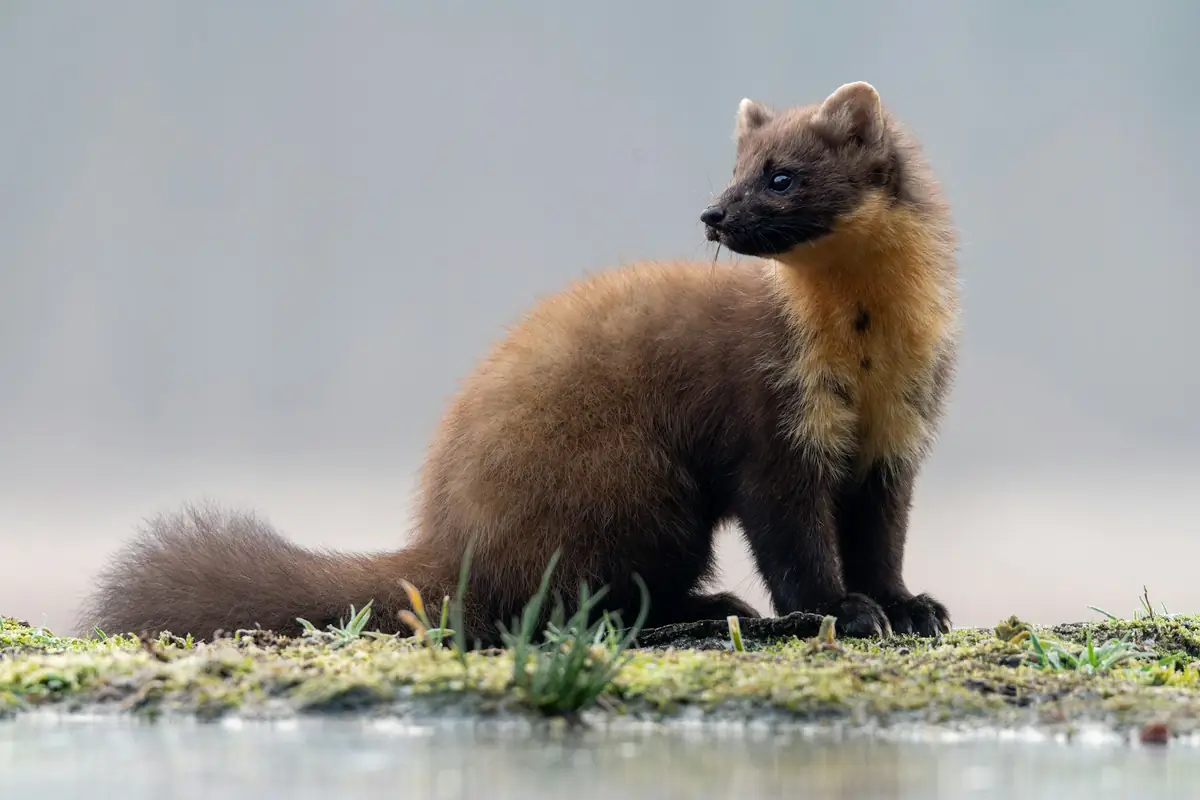
Why it represents the country
Croatia has no law that names a national animal, but the pine marten has a unique place in the country's history. In Croatian the marten is called kuna, and from 1994 until the end of 2022 the kuna was also the name of Croatia's currency. When Croatia adopted the euro on 1 January 2023, the marten moved onto the new coins: the Croatian 1 euro coin shows a stylized marten on a checkerboard background.
The link between martens and money is very old. In the Middle Ages, marten fur was highly valued, and in the lands of the Pannonian plain, including Slavonia in today's Croatia, taxes and payments were recorded in marten skins. A tax paid this way was known as marturina, meaning marten tax. In the 13th century, silver coins decorated with a marten were minted in Slavonia.
Because of this long history, the marten is widely recognized as a Croatian symbol. The small forest animal has appeared on coins for centuries and is familiar to almost everyone in the country.
About the animal
The European pine marten is a slim, agile member of the weasel family. Its body is about 45 to 58 centimeters long, with a long, bushy tail that adds about 16 to 28 centimeters more. Adults usually weigh roughly 1 to 2 kilograms, and males are larger than females. The coat is rich brown, thick and silky in winter, and each marten has a creamy yellow to orange patch on its throat and chest. The shape of this patch varies, which helps researchers tell individuals apart.
Pine martens are excellent climbers. They have sharp claws, and they can turn their feet to climb down tree trunks head first. They move easily through the branches and use their tails for balance. They are active mainly at night and around dawn and dusk, and they rest in hollow trees, old nests or rock crevices, often using several dens within their home range.
The pine marten eats almost anything it can catch or find. Voles and other small rodents are its main prey, but it also eats squirrels, birds, eggs, insects, frogs and carrion. In late summer and autumn, fruit and berries can make up a large part of its diet, and martens help spread the seeds of the plants they eat.
Martens mate in summer, but the fertilized eggs do not start to grow right away. After a pause of several months, called delayed implantation, the young develop and are born the next spring. A litter usually has about three kits, which are born blind in a tree hollow or other den and depend on their mother for several months.
Conservation
The pine marten is listed as Least Concern on the IUCN Red List. It lives across a large area from western Europe to western Siberia, and in Croatia it is found in forests across much of the country.
In the past, martens were trapped in large numbers for their fur, and in some European countries they became rare because of trapping, poisoning and the loss of old forests. Where they are protected and forests remain, pine martens have been recovering. Some studies in Britain and Ireland suggest that where martens return, the numbers of introduced grey squirrels fall, which can help native red squirrels.
The pine marten's main need is large areas of forest with old trees that provide hollows for dens and plenty of prey. Keeping Croatia's forests healthy and connected helps this national symbol and the many other animals that live alongside it.
Fun facts
- The Croatian word for pine marten, kuna, was also the name of Croatia's currency from 1994 to 2022.
- In medieval Slavonia, taxes were recorded in marten skins, and this tax was called marturina.
- A pine marten can turn its hind feet to climb down a tree trunk head first.
Other national symbols of Croatia
- National flower
Iris Iris National symbol
Croatia's Ministry of Foreign Affairs names the iris (perunika) as the Croatian national flower in its 2010 publication on national symbols.
Frequently asked questions
What is the national animal of Croatia?
The national animal of Croatia is the pine marten (a widely recognized national symbol, not set by law). It is a slim, agile forest predator of the weasel family, and a stylized marten on a checkerboard background appears on the Croatian 1 euro coin.
Which country has the pine marten as its national animal?
The pine marten is the national animal of Croatia.
Why is the pine marten the national animal of Croatia?
In Croatian the marten is called kuna, which was also the name of Croatia's currency from 1994 until the end of 2022, and the link goes back to the Middle Ages, when taxes and payments in lands including Slavonia were recorded in marten skins. Because of this long history on coins and in payments, the pine marten is widely recognized as a Croatian symbol, even though no law names a national animal.
Is the pine marten endangered?
The pine marten is listed as Least Concern on the IUCN Red List and is found in forests across much of Croatia. Once trapped in large numbers for its fur, it has been recovering where it is protected and forests remain.
Where does the pine marten live?
Deciduous, mixed and coniferous forests with old, hollow trees.
Sources
- Animal Diversity Web, University of Michigan. Martes martes: European pine marten.
- IUCN Red List of Threatened Species. Martes martes (assessment 2016).
- Ministry of Foreign Affairs and European Integration of Croatia - MVPEI Planer 2010 ("Hrvatski nacionalni cvijet je perunika (iris)").
- Conservation status: IUCN Red List of Threatened Species.