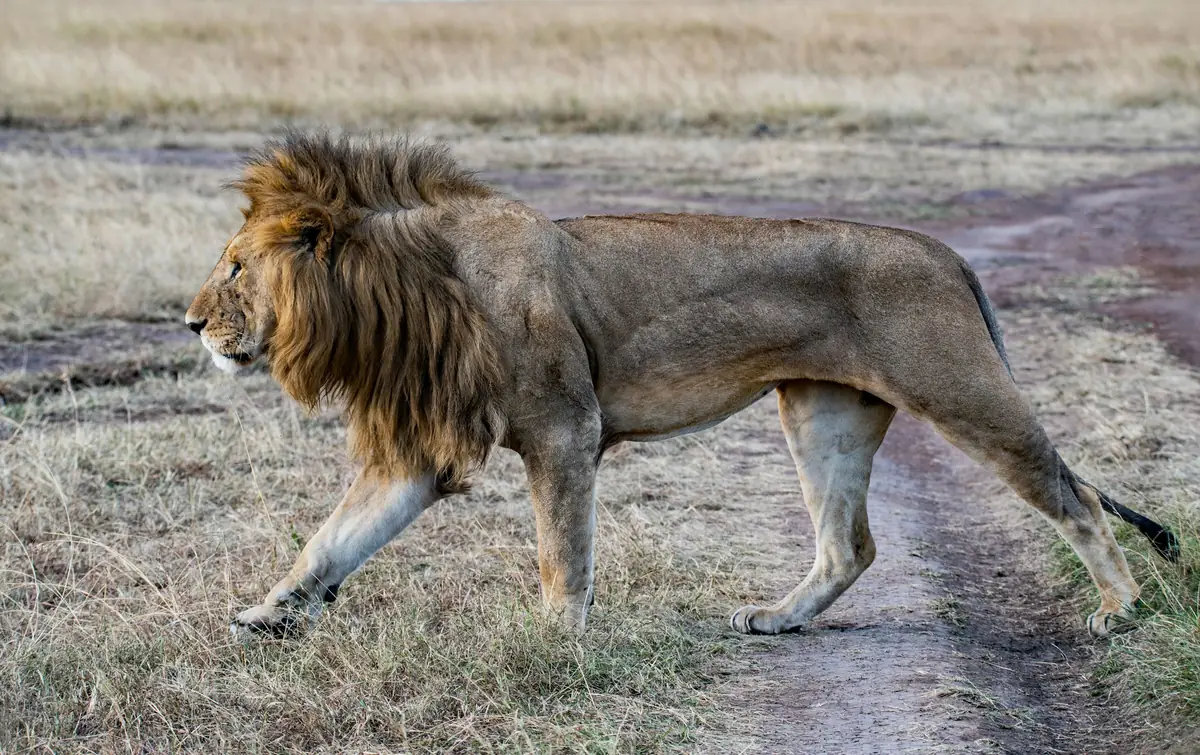
Why it represents the country
Look at Kenya's coat of arms: a lion stands on each side of the shield, each holding a spear. Below them are Mount Kenya, crops and a scroll reading Harambee, Swahili for pulling together. The lions are part of a national emblem, not just an animal chosen for a wildlife poster.
Article 9 of Kenya's Constitution names the coat of arms as a national symbol. It does not separately name a national animal; we have not verified a separate legal designation for the lion. Calling it Kenya's national animal describes its place in the country's imagery, not a status established by that constitutional clause.
The emblem has a living counterpart. Kenya Wildlife Service lists lions in the Maasai Mara, Tsavo East and Nairobi National Park on the edge of the capital. That last park makes the contrast unusually sharp: the same animal appears on a state symbol and lives beside Kenya's largest city.
About the animal
A lion is more than the lone, maned figure often used in symbols. Females, cubs and one or more males live in prides; members may hunt or rest separately and meet again. In Kenya's savannas, they depend on large wild prey and enough connected land for young lions to move between groups.
Lions often hunt in the cooler hours and rest through much of the day. They also share parts of Kenya's wider landscape with livestock and the people who keep it. That overlap matters more to their future than the familiar details of a mane or a roar.
Conservation
The IUCN lists the lion as Vulnerable at the species level worldwide; that category is not a separate rating for Kenya's lions. For Kenya itself, Kenya Wildlife Service says the 2025 National Wildlife Census counted 2,512 lions, compared with 2,589 in 2021: 77 fewer in the two published counts. Its World Lion Day article does not explain the census methods or identify where the difference arose, so the two figures should not be read as a precise year-by-year trend for every park.
The pressure is easier to picture than the count. When farms, fences and settlements break up habitat, a lion moving between wild areas may encounter livestock. Losing a cow can be a serious blow to a family, while retaliation can kill a lion. Kenya Wildlife Service's 2020-2030 recovery plan focuses on coexistence with communities, protecting prey and addressing poaching, disease and encroachment.
The question behind the coat of arms is therefore practical: can lions still move through a landscape that people also need? Parks such as Nairobi and Tsavo protect important habitat, but the agency's plan also depends on what happens beyond park boundaries.
Where to see the lion in the wild
Wild lions in Kenya are most often seen in savanna protected areas such as the Maasai Mara National Reserve, Nairobi National Park and Tsavo East National Park.
Maasai Mara National Reserve
The Maasai Mara National Reserve in Narok County is home to all of the Big Five, including the lion.
Official page ↗Nairobi National Park
Nairobi National Park, on the edge of the capital, has three lion prides known as Kingfisher, Athi and Mokoyet.
Official page ↗Tsavo East National Park
Tsavo East National Park lists its maneless lions among the park's main wildlife attractions.
Official page ↗
Watch wild animals from a distance, never feed them, and follow the rules and rangers of each protected area.
Fun facts
- Kenya's coat of arms shows two lions, each holding a spear beside the shield.
- Kenya Wildlife Service reported 77 fewer lions in its 2025 census than in its 2021 count.
- Nairobi National Park, on the capital's edge, has wild lion prides.
Frequently asked questions
What is the national animal of Kenya?
The national animal of Kenya is the lion (a widely recognized national symbol, not set by law). Two lions flank the shield on Kenya's coat of arms, each holding a spear. The lion is widely treated as a national animal symbol.
Which country has the lion as its national animal?
The lion is the national animal of Kenya. The same species is also the national animal of Belgium, Czechia, Ethiopia, Morocco and the United Kingdom.
Why is the lion the national animal of Kenya?
Kenya's Constitution names the coat of arms as a national symbol, and the emblem shows two lions. Article 9 does not separately designate a national animal; we have not verified a separate legal designation for the lion.
Is the lion endangered?
The IUCN rates lions worldwide as Vulnerable. Kenya Wildlife Service reported 2,512 lions in its 2025 National Wildlife Census, compared with 2,589 in 2021, and identifies habitat pressure and conflict with people among the threats.
Where does the lion live?
Open savanna, grassland and dry bush with plenty of prey.
Where can you see the lion in the wild?
Wild lions in Kenya are most often seen in savanna protected areas such as the Maasai Mara National Reserve, Nairobi National Park and Tsavo East National Park.
Sources
- Kenya Law Reform Commission. Constitution of Kenya, Article 9: National symbols and national days.
- Kenya Wildlife Service. Celebrating The Monarch and His Fragile Kingdom on World Lion Day (2026).
- Encyclopaedia Britannica. Lion.
- IUCN Red List of Threatened Species. Panthera leo (assessment 2024).
- Kenya Biodiversity Clearing-House – Maasai Mara National Reserve.
- Kenya Wildlife Service – Nairobi National Park.
- Kenya Wildlife Service – Tsavo East National Park.
- Conservation status: IUCN Red List of Threatened Species.