Why it represents the country
The dodo lived on Mauritius and nowhere else, and today it is the island nation's best-known symbol. It appears on the coat of arms of Mauritius, which was granted in 1906 and kept after independence in 1968. The dodo stands on one side of the shield and a sambar deer on the other, each holding up a stalk of sugar cane. Below them is the Latin motto Stella Clavisque Maris Indici, which means Star and Key of the Indian Ocean.
The bird is part of daily life on the islands. It appears on Mauritian coins, is used as a watermark on the country's banknotes, and is used as a mascot for many local products.
Around the world, the dodo is perhaps the most famous extinct animal of all. That is part of why it matters to Mauritius. On the coat of arms, it is a reminder of how unique the island's wildlife is, and how easily such wildlife can be lost.
About the animal
The dodo was a large, flightless bird. Scientists now know that it was a kind of pigeon, and its closest living relative is the Nicobar pigeon of Southeast Asia. Its ancestors could fly and probably reached Mauritius by hopping between islands. With plenty of food and no mammal predators on the island, they slowly lost the ability to fly and grew much larger.
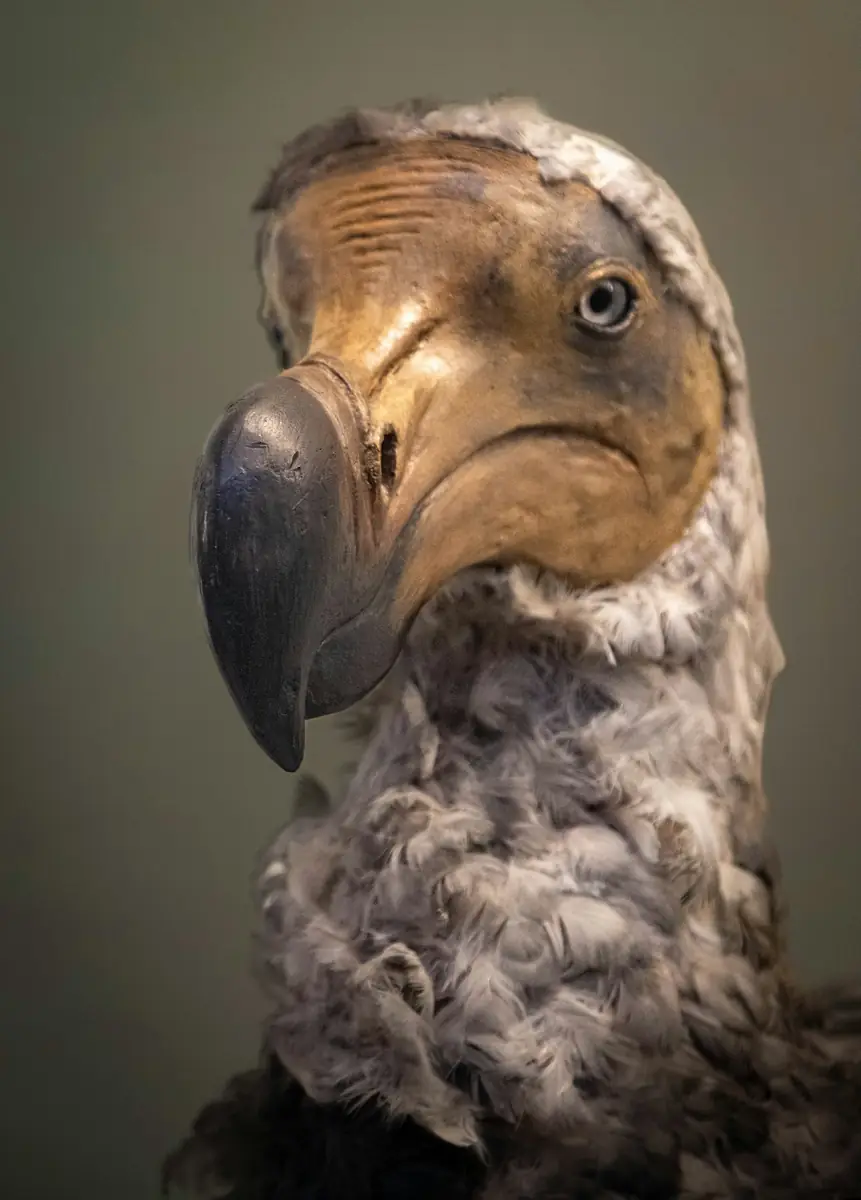
No complete dodo specimen survives, so its appearance has been pieced together from bones, a few remains in museums, and drawings and written accounts from the 1600s. Most show a plump bird with greyish or brownish feathers, a bare grey face, a large hooked beak colored black, yellow and green, stout yellowish legs and a curly tuft of pale feathers on its rear. A visitor who saw a live dodo in London in about 1638 described it as somewhat bigger than the largest turkey. Estimates of its weight vary, but in the wild it probably weighed roughly 10 to 18 kilograms.
Its wings were small, but they were not useless: they may have been used for balance and display. Studies of its leg bones suggest that the dodo could run quite fast, and a study of its brain found it was probably about as intelligent as other pigeons, not the foolish bird of popular stories.
Little is known about how the dodo lived. It probably ate fallen fruit, nuts, seeds and roots, and it swallowed stones that helped grind up food in its gizzard. It seems to have lived mainly in the woods of the drier coastal areas, and it probably nested on the ground. One old account says it laid a single egg in a nest of grass.
Conservation
The dodo is listed as Extinct on the IUCN Red List. Dutch sailors first recorded it in 1598, and the last widely accepted sighting was in 1662. Less than a century after it was first recorded, the dodo was gone.
People did hunt dodos for food, but hunting was probably not the main cause of the extinction. Ships and settlers brought animals that had never lived on the island, including pigs, crab-eating macaques, cats, dogs and rats. These newcomers raided nests and competed for food, while forests were cleared. A bird that had no fear of people, could not fly and laid a single egg had little chance. The dodo's loss was one of the first times people realized that humans could wipe out an entire species.
Mauritius has learned from this loss. The country and its partners, including the Mauritian Wildlife Foundation and the Durrell Wildlife Conservation Trust, have worked to save several native birds that came close to following the dodo. In the 1970s only a handful of Mauritius kestrels were known in the wild, and the pink pigeon and the echo parakeet later fell to very small numbers. Captive breeding, the release of young birds and the restoration of native forest, including on the small island nature reserve of Île aux Aigrettes, helped all three survive and increase. They are still rare, but they are alive today because people acted in time.
Fun facts
- The dodo's closest living relative is the Nicobar pigeon.
- The only soft tissue of a dodo that survives today is part of a dried head, kept at a museum in Oxford.
- Lewis Carroll put a dodo in Alice's Adventures in Wonderland in 1865, helping to make it the world's best-known extinct animal.
Other national symbols of Mauritius
- National flower
Boucle d'oreille (earring flower) Ruizia boutoniana National symbol
Boucle d'oreille (Trochetia boutoniana) is recognized as the national flower of Mauritius and is listed among its national symbols.
Frequently asked questions
What is the national bird of Mauritius?
The national bird of Mauritius is the dodo (a widely recognized national symbol, not set by law). The dodo was a large, flightless kind of pigeon that lived only on Mauritius, and it appears on the coat of arms and on Mauritian coins and is used as a watermark on the country's banknotes.
Which country has the dodo as its national bird?
The dodo is the national bird of Mauritius.
Why is the dodo the national bird of Mauritius?
The dodo lived on Mauritius and nowhere else, and today it is the island nation's best-known symbol, standing beside the shield on the coat of arms granted in 1906 and kept after independence in 1968. As perhaps the most famous extinct animal in the world, it is a reminder of how unique the island's wildlife is, and how easily such wildlife can be lost.
Is the dodo extinct?
The dodo is listed as Extinct on the IUCN Red List; Dutch sailors first recorded it in 1598, and the last widely accepted sighting was in 1662. Hunting was probably not the main cause: pigs, macaques, cats, dogs and rats brought by ships and settlers raided its nests and competed for its food while forests were cleared.
Sources
- Encyclopaedia Britannica. Dodo.
- IUCN Red List of Threatened Species. Raphus cucullatus (assessment 2016).
- CIA World Factbook (2020 archive): Mauritius - National symbol(s).
- Conservation status: IUCN Red List of Threatened Species.