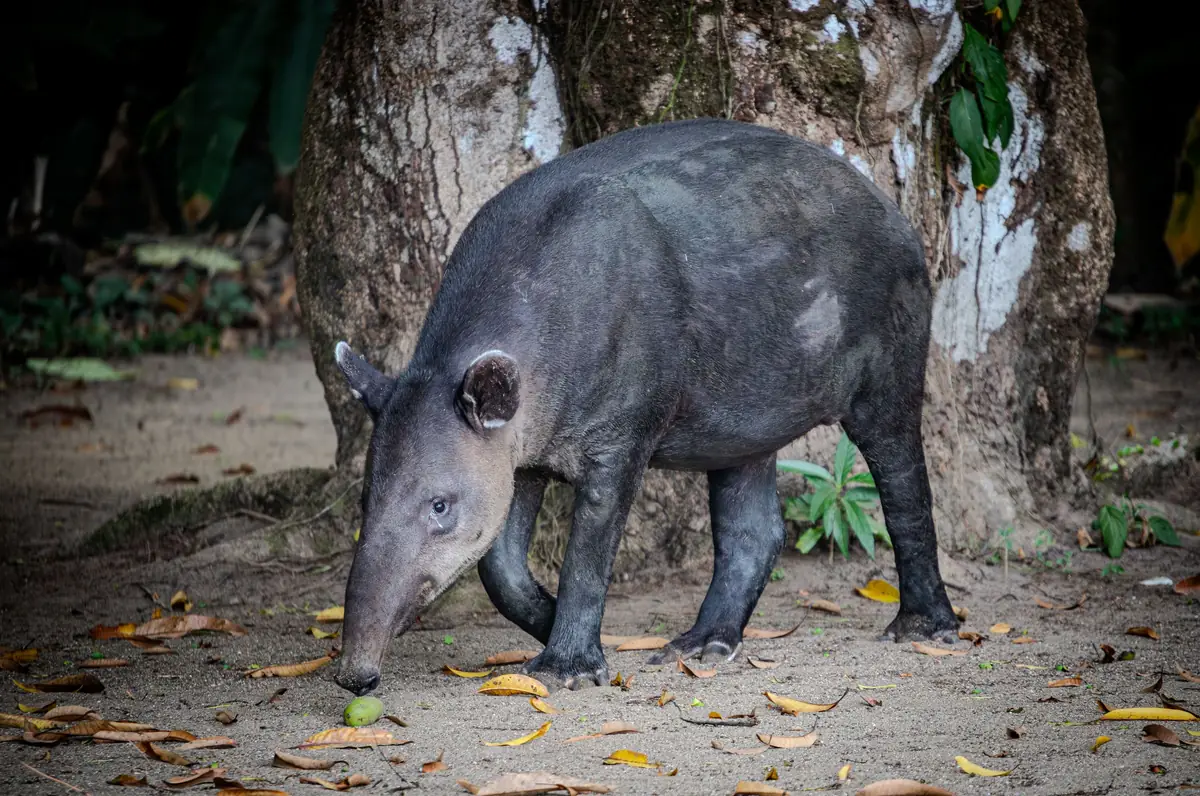
Why it represents the country
Baird's tapir is the national animal of Belize, where most people know it as the mountain cow. It was chosen as one of the country's national symbols around the time of independence in 1981, together with the keel-billed toucan as the national bird, the black orchid as the national flower and the mahogany as the national tree.
The nickname mountain cow is misleading. The tapir is not a cow at all. The Government of Belize's own description of the national animal points out that it is closely related to the horse and also to the rhinoceros. Tapirs, horses and rhinos all belong to the same group of hoofed mammals, the odd-toed ungulates.
The tapir suits a country with large areas of forest, rivers and wetlands. Belize protects the tapir by law, and tapirs at the Belize Zoo have helped many visitors and schoolchildren meet the national animal up close.
About the animal
Baird's tapir is the largest native land mammal in Central and South America. Adults usually weigh about 150 to 300 kilograms and are around 2 meters long, with a heavy, rounded body and short legs. The coat is dark brown to gray, and the large ears and the lips are edged with white. Its most unusual feature is a short, flexible snout, a small trunk formed by the nose and upper lip, which it uses to pull leaves and fruit toward its mouth.
Tapirs live in many kinds of habitat, from lowland rainforest, mangroves and swamps to mountain cloud forest up to about 3,600 meters. They like to stay near water. They are excellent swimmers, even under water, and often go into rivers and pools to cool off or escape danger.
Baird's tapirs are mostly active at night and usually live alone. They eat only plants, including leaves, twigs, fruit, flowers and grasses, and they browse from the ground up to about 1.5 meters high. Seeds from the fruit they eat pass through their gut and are dropped in new places, so tapirs help spread forest plants. They keep in touch with shrill whistles and squeaks.
A female gives birth to a single calf after a pregnancy of about 13 months. The calf is reddish brown with white stripes and spots, a pattern that helps it hide in the patchy light of the forest floor. The pattern fades as it grows. Calves can swim within a few weeks, are weaned at about one year and may stay with their mothers for a year or two.
Conservation
Baird's tapir is listed as Endangered on the IUCN Red List. Fewer than 5,000 mature animals are thought to remain in the wild, living in separate populations from southern Mexico to northwestern South America. It has already disappeared from El Salvador.
The main threats are the loss and splitting up of forests, hunting, and diseases passed on from domestic livestock. Tapirs breed very slowly, with a long pregnancy and only one calf at a time, so a population takes a long time to recover from any losses.
Belize still has large areas of forest, much of it in protected areas, where tapirs can live. Researchers and conservation groups study tapirs, protect habitat and teach people about the national animal. Keeping forests connected, so that tapirs can move between them, is key to the future of the mountain cow.
Fun facts
- Despite its local name, the mountain cow is related to horses and rhinoceroses, not cows.
- Baby tapirs are born with white stripes and spots that fade as they grow up.
- Tapirs call to each other with shrill whistles and squeaks.
National bird of Belize: Keel-billed toucan
Keel-billed toucan Ramphastos sulfuratus Officially designated
Also known as: rainbow-billed toucan, sulphur-breasted toucan
Belize's National Symbols Act of 2025 names the keel-billed toucan as the national bird.
The keel-billed toucan lives in lowland forests and forest edges from southern Mexico to northern Colombia and north-eastern Venezuela. The toucan's green bill, marked with a bright orange blaze, can be up to a third the size of its body yet is surprisingly light. Flocks of six to twelve adults travel together, and at night several birds may crowd into a single tree hole to roost.
Other national symbols of Belize
- National flower
Black orchid Prosthechea cochleata Officially designated
Belize's National Symbols Act of 2025 names the black orchid as the national flower.
Frequently asked questions
What is the national animal of Belize?
The national animal of Belize is Baird's tapir (a widely recognized national symbol, not set by law). Baird's tapir, known in Belize as the mountain cow, is a heavy, short-legged forest mammal with a small trunk formed by its nose and upper lip, and it is a relative of the horse and the rhinoceros, not a cow.
Which country has Baird's tapir as its national animal?
Baird's tapir is the national animal of Belize. Baird's tapir is also known as Central American tapir.
Why is Baird's tapir the national animal of Belize?
Baird's tapir was chosen as one of Belize's national symbols around the time of independence in 1981, together with the keel-billed toucan as national bird, the black orchid as national flower and the mahogany as national tree. It suits a country with large areas of forest, rivers and wetlands, and Belize protects the tapir by law.
Is Baird's tapir endangered?
Baird's tapir is listed as Endangered on the IUCN Red List, with fewer than 5,000 mature animals thought to remain in the wild. The main threats are the loss and splitting up of forests, hunting and diseases from livestock, and because tapirs breed very slowly, populations take a long time to recover from losses.
Where does Baird's tapir live?
Rainforests, swamps, riverbanks and mountain forests of Central America.
What is the national bird of Belize?
The national bird of Belize is the keel-billed toucan (officially designated). Belize's National Symbols Act of 2025 names the keel-billed toucan as the national bird. The keel-billed toucan is also known as rainbow-billed toucan or sulphur-breasted toucan.
Sources
- Government of Belize. National Symbols.
- Animal Diversity Web, University of Michigan. Tapirus bairdii: Baird's tapir.
- IUCN Red List of Threatened Species. Tapirus bairdii (assessment 2016).
- Belize National Symbols Act, 2025 (Act No. 9 of 2025), Attorney General's Ministry.
- Animal Diversity Web: Ramphastos sulfuratus (keel-billed toucan).
- Belize National Symbols Act, 2025 (Act No. 9 of 2025), Attorney General's Ministry.
- Conservation status: IUCN Red List of Threatened Species.