Why it represents the country
Australia has not passed a law naming a national animal, but the kangaroo is its best-known wildlife symbol. A kangaroo and an emu hold up the shield on the Commonwealth coat of arms. The Australian Government explains that these two native animals were chosen to symbolize a nation moving forward, because neither can easily move backward.
The pairing is more than a century old. The first Commonwealth coat of arms, granted in 1908, already showed a kangaroo and an emu standing on either side of the shield. The current version, granted in 1912, keeps both animals and adds symbols of the six states on the shield itself. Today it is used by government departments, the Parliament and the courts.
Kangaroos also appear on Australian coins, on the logos of airlines and sporting teams, and on the familiar green and gold triangle that marks products made in Australia. For visitors and Australians alike, a kangaroo bounding across open country is one of the most recognizable images of the continent. There are several kinds of kangaroo, and the coat of arms does not name a particular species. The red kangaroo is the largest, and as the biggest living marsupial it is a fitting representative of the whole group.
About the animal
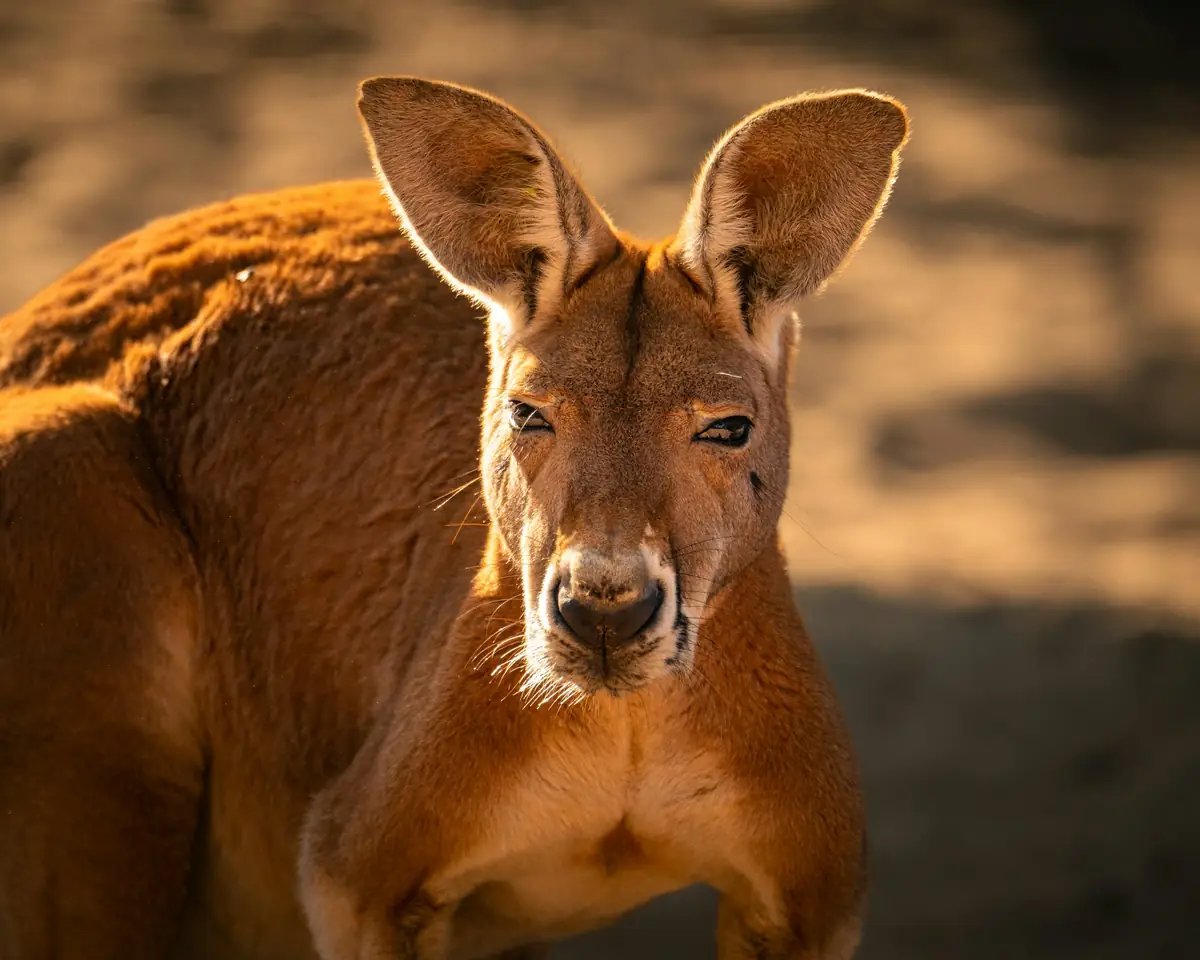
The red kangaroo lives across the dry interior of Australia, in grassland, shrubland, desert, open woodland and savanna. Males usually have an orange-red coat, while females are often blue-grey, and both are paler underneath. A clear black and white patch on each cheek and a broad white stripe from the mouth toward the ear help to tell this species apart. A large male standing upright can be taller than many adults. Males can weigh up to about 90 kilograms, more than twice as much as females, and the tail alone can be up to 1 meter long.
Kangaroos move by hopping on their powerful back legs, using their thick tail for balance. Hopping is an efficient way to travel long distances across open land, and red kangaroos can reach high speeds and cover several meters in a single bound. When moving slowly while grazing, they use the tail as a fifth leg to support their weight.
Red kangaroos are well suited to heat and drought. They feed mainly on grasses, along with other small plants and the leaves of shrubs. They rest in the shade during the hottest part of the day, feed mainly at dawn, dusk and night, and can get much of the water they need from the plants they eat. To cool down, they lick their forearms, where blood vessels run close to the skin.
Like other marsupials, a kangaroo gives birth to a very small, undeveloped baby called a joey after a pregnancy of only about 33 days. The newborn, about the size of a jelly bean, crawls into its mother's pouch and attaches to a teat. It stays in the pouch for around eight months and keeps drinking milk until it is about a year old. Red kangaroos can breed at any time of year. A female can also pause the development of a new embryo until conditions improve, which helps kangaroos breed quickly after rain.
Conservation
The red kangaroo is common and is listed as Least Concern on the IUCN Red List. Its numbers rise and fall with rainfall, increasing after good seasons and dropping during long droughts, when food becomes scarce.
The spread of farm water points across inland Australia has helped kangaroos in some areas by giving them more places to drink. Kangaroos are protected under Australian law, and state governments monitor their populations and set rules for managing them.
Other members of the kangaroo family are not so lucky. Several smaller wallabies and rat-kangaroos have declined or disappeared because of introduced predators such as foxes and cats and changes to their habitat, which is a reminder that the family's most famous member is not the whole story.
Where to see the red kangaroo in the wild
Wild red kangaroos in Australia live throughout the arid and semi-arid inland of the mainland, and outback parks in New South Wales such as Sturt, Kinchega and Mungo national parks list them among their wildlife.
Sturt National Park
Sturt National Park lists the red kangaroo among its animals, and the park notes that kangaroos are often seen along the Jump-Up walking track and around its campgrounds.
Official page ↗Kinchega National Park
Kinchega National Park lists the red kangaroo, the largest marsupial in the world, among the animals found in the park.
Official page ↗Mungo National Park
Mungo National Park has thriving kangaroo and emu populations, and the red kangaroo is one of the animals the park lists.
Official page ↗
Watch wild animals from a distance, never feed them, and follow the rules and rangers of each protected area.
Fun facts
- A newborn kangaroo is about the size of a jelly bean when it climbs into its mother's pouch.
- Kangaroos cannot easily walk backward, which is one reason given for their place on the coat of arms.
- A group of kangaroos is called a mob.
National bird of Australia: Emu
Emu Dromaius novaehollandiae National symbol
The emu supports Australia's coat of arms beside a kangaroo, both chosen to show a nation moving forward.
The emu is a flightless bird of Australia and the second largest living bird, standing more than 1.5 metres tall and sometimes weighing over 45 kilograms. Stout-bodied and long-legged, emus can sprint at nearly 50 kilometres per hour and forage in small flocks for fruit and insects. Emu pairs mate for life, and the male incubates seven to ten dark green eggs in a ground nest for about 60 days.
Other national symbols of Australia
- National flower
Golden wattle Acacia pycnantha Officially designated
Australia's Governor-General proclaimed the golden wattle the national floral emblem in 1988.
Frequently asked questions
What is the national animal of Australia?
The national animal of Australia is the red kangaroo (a widely recognized national symbol, not set by law). The largest kangaroo and the biggest living marsupial, it lives across the dry interior of Australia, and kangaroos also appear on Australian coins, on airline and sports logos, and on the green and gold triangle that marks products made in Australia.
Which country has the red kangaroo as its national animal?
The red kangaroo is the national animal of Australia.
Why is the red kangaroo the national animal of Australia?
Australia has no law naming a national animal, but a kangaroo and an emu hold up the shield on the Commonwealth coat of arms, chosen to symbolize a nation moving forward because neither can easily move backward. The coat of arms does not name a species, and the red kangaroo, the largest of them all, is a fitting representative of the whole group.
Is the red kangaroo endangered?
The red kangaroo is common and is listed as Least Concern on the IUCN Red List. Its numbers rise after good seasons and drop during long droughts, when food becomes scarce.
Where does the red kangaroo live?
Dry grasslands, shrublands and open plains of inland Australia.
What is the national bird of Australia?
The national bird of Australia is the emu (a widely recognized national symbol, not set by law). The emu supports Australia's coat of arms beside a kangaroo, both chosen to show a nation moving forward.
Where can you see the red kangaroo in the wild?
Wild red kangaroos in Australia live throughout the arid and semi-arid inland of the mainland, and outback parks in New South Wales such as Sturt, Kinchega and Mungo national parks list them among their wildlife.
See also: Most Popular Dog Breeds in Australia (2025)
Sources
- Australian Government, Department of the Prime Minister and Cabinet. Commonwealth Coat of Arms.
- Australian Museum. Red Kangaroo.
- IUCN Red List of Threatened Species. Osphranter rufus (as Macropus rufus) (assessment 2016).
- Department of the Prime Minister and Cabinet – Commonwealth Coat of Arms.
- Encyclopaedia Britannica: Emu.
- Australian National Botanic Gardens – Proclamation, Commonwealth of Australia Gazette No. S 259, 1 Sept 1988.
- Australian Museum – Red Kangaroo.
- NSW National Parks – Sturt National Park: Learn more.
- NSW National Parks – Kinchega National Park: Learn more.
- NSW National Parks – Mungo National Park: Learn more.
- Conservation status: IUCN Red List of Threatened Species.