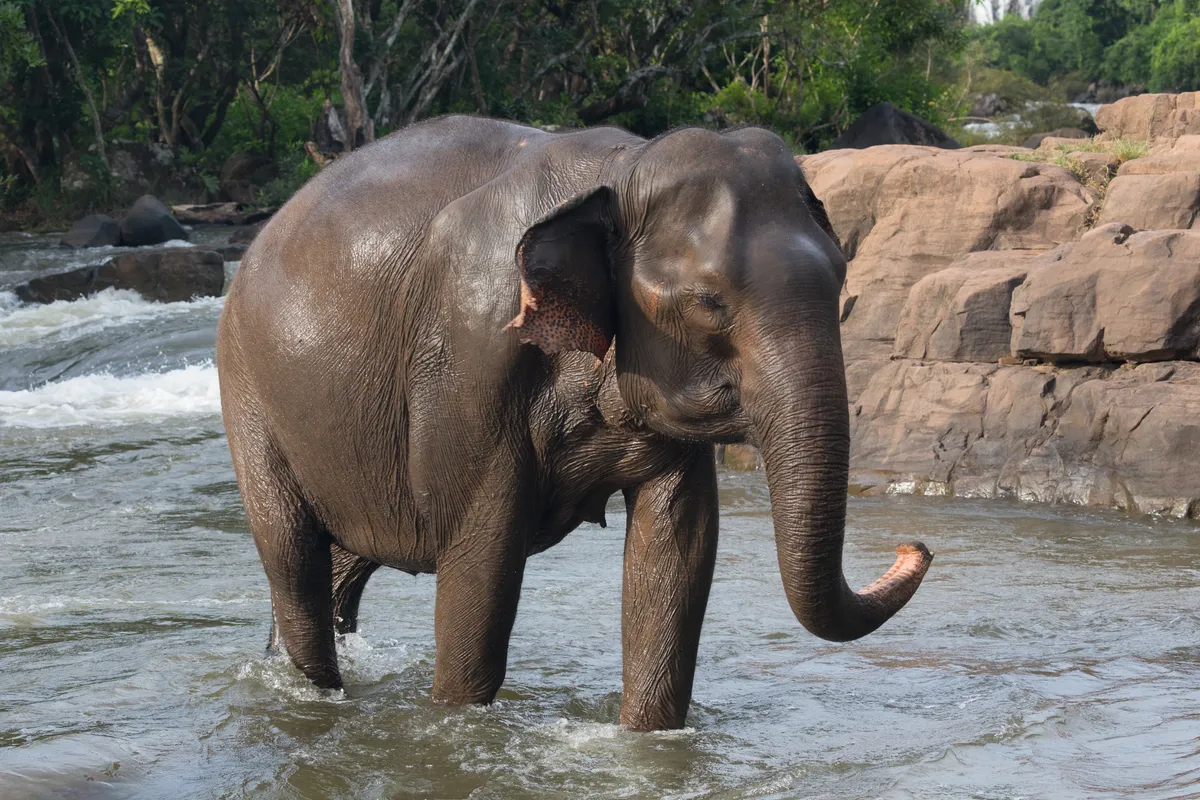
Why it represents the country
An account published by the UN Food and Agriculture Organization in 2002 says that, in former times, a king assigned the elephant as the national animal and that elephants have long been highly respected by Lao people. It does not identify a current law or decree.
The elephant is part of the country's very name in history. Laos was once known as Lan Xang, which means "Land of a Million Elephants". Lao people have used elephants for work, for carrying goods and in religious and cultural ceremonies, and the king once gave elephants to neighboring countries as a sign of friendship.
Xinhua reported on 30 January 2025 that the Xayaboury Elephant Festival was scheduled for 18 to 24 February 2025 and would feature 50 elephants, with parades, traditional rituals and performances.
About the animal
The Asian elephant is one of the last few mega-herbivores, plant-eating mammals that weigh more than 1,000 kilograms as adults. Adult females weigh about 2,000 to 3,500 kilograms and males about 3,500 to 6,000 kilograms. Compared with African elephants, Asian elephants have smaller ears, a more level back, and a single finger-like tip on the trunk instead of two.
Most female Asian elephants have no tusks or only small ones called tushes, and only some males grow large tusks. Elephants live in grasslands and many kinds of forest, as well as farmland and scrub, from sea level to over 3,000 meters. They may spend 14 to 19 hours a day feeding and can eat up to 150 kilograms of plants.
Asian elephant society is built around related females and their young, who form family groups within larger clans. Young males leave their family as they grow up, and adult bulls mostly live alone, joining female groups only for a time.
Female Asian elephants are pregnant for about 22 months, among the longest gestation periods of land mammals, and usually give birth to one calf every four to five years or more. Asian elephants can live 60 to 70 years.
Conservation
The Asian elephant is listed as Endangered in the IUCN assessment published in 2020, which was assessed on 18 September 2019. The assessment inferred a decline of at least 50 percent since 1945 over three generations, about 75 years, mainly through habitat loss. Its 2018 compilation estimated 48,323 to 51,680 wild Asian elephants globally and cautioned that many range-country estimates are uncertain.
That 2018 compilation gave a likely estimate of 500 to 600 wild elephants in Lao PDR. This is an estimate rather than a current census, and it should not be combined with counts that include captive elephants. Habitat loss, poaching and conflict with people remain major threats.
The Elephant Conservation Center in Sayaboury Province opened to the public in 2011. It is one of the places working to raise awareness of elephant conservation in Laos.
Fun facts
- Laos was once known as Lan Xang, the "Land of a Million Elephants".
- An Asian elephant's pregnancy lasts about 22 months, among the longest of land mammals.
- The tip of an Asian elephant's trunk has one finger-like projection, while an African elephant's has two.
Other national symbols of Laos
- National flower
Dok champa (frangipani) Plumeria rubra National symbol
The frangipani, known in Laos as dok champa, is called the national flower of Laos by the state-run Vientiane Times and by Seasia; no designation act was found.
Frequently asked questions
What is the national animal of Laos?
The national animal of Laos is the Asian elephant (a widely recognized national symbol, not set by law). It is a giant plant-eater, with adult males weighing about 3,500 to 6,000 kilograms, smaller ears than African elephants and a single finger-like tip on the trunk, and it has long worked alongside people in Laos.
Which country has the Asian elephant as its national animal?
The Asian elephant is the national animal of Laos. The same species is also the national animal of Thailand.
Why is the Asian elephant the national animal of Laos?
Laos was once known as Lan Xang, the "Land of a Million Elephants". Lao people have used elephants for work, carrying goods and cultural ceremonies. An FAO account says that, in former times, a king assigned the elephant as the national animal; the source does not identify a current law or decree.
Is the Asian elephant endangered?
The 2020 IUCN assessment lists the Asian elephant as Endangered and infers a decline of at least 50 percent since 1945 over three generations. Its 2018 compilation gave a likely estimate of 500 to 600 wild elephants in Lao PDR and cautioned that range-country estimates are uncertain.
Where does the Asian elephant live?
Forests, grasslands and scrub from lowlands to mountains; in Laos, patchy forest areas such as Nam Pouy in Xayaboury Province and the Nakai Plateau.
Sources
- Tourism Laos (Ministry of Culture and Tourism) / Laotian Times. World Elephant Day: Laos' 'Land of a Million Elephants' Now Home to Just 500-1,000 (16 Aug 2025).
- FAO Regional Office for Asia and the Pacific. Giants on Our Hands (2002): The care and management of domesticated Asian elephants in Lao PDR, Bounleuam Norachack.
- IUCN Asian Elephant Specialist Group. Elephas maximus, The IUCN Red List of Threatened Species 2020 (Williams et al.), e.T7140A45818198.
- San Diego Zoo Wildlife Alliance Library. Asian Elephant (Elephas maximus) Fact Sheet: Population & Conservation Status.
- San Diego Zoo Wildlife Alliance Library. Asian Elephant (Elephas maximus) Fact Sheet: Physical Characteristics.
- Smithsonian's National Zoo. Asian elephant.
- Animal Diversity Web. Elephas maximus.
- Elephant Conservation Center. About us.
- International Elephant Project. Elephant Conservation Center.
- Tourism Laos / Laotian Times. Xayaboury Confirms Elephant Festival on 18-24 February (6 Feb 2025).
- Xinhua. Laos to host annual Elephant Festival (30 Jan 2025).
- Vientiane Times: 75 years of Thailand–Lao PDR relations ("the frangipani or 'Dok Champa,' the national flower of Laos").
- Seasia: Dok Champa: The Fragrant Soul of Laos (14 Oct 2025).
- Conservation status: IUCN Red List of Threatened Species.