Why it represents the country
The rooster has never been named Portugal's national animal by law, but it is the animal most closely tied to the country's image, through the Rooster of Barcelos, or Galo de Barcelos. UNESCO describes the northern town of Barcelos as the cradle of the Rooster of Barcelos, "the Portuguese emblem and symbol of good faith and justice", and the town council says the ceramic rooster spread the old legend so widely that the rooster became a symbol of Portugal.
The Rooster of Barcelos comes from a medieval legend linked to the pilgrim route to Santiago de Compostela. In the version told by Portugal's official tourism site and the Barcelos council, a pilgrim from Galicia was wrongly suspected of a crime in Barcelos and sentenced to hang. Taken to the judge, who was feasting with friends, he pointed to a roasted rooster on the table and said that it was as certain that he was innocent as that the rooster would crow when he was hanged. When the sentence was carried out, the roasted rooster stood up and crowed. The judge ran to the gallows and found that a loose knot had saved the man, and years later the pilgrim returned to raise a monument in praise of Saint James and the Virgin. A medieval stone cross linked to the legend is kept in the town's Archaeological Museum.
The rooster grew from a local legend into a national symbol in the 20th century. The colorful Rooster of Barcelos was used for many years as the symbol of Turismo de Portugal, which runs the country's official tourism website, and the newspaper Diário de Notícias credits the writer António Ferro, who was in charge of promoting Portugal's image from 1933, with reinventing the rooster until it became a symbol of Portugal. Researchers today call it one of the symbols of Portuguese tourism, and since 2017 Barcelos has belonged to UNESCO's Creative Cities Network for Crafts and Folk Art.
About the animal
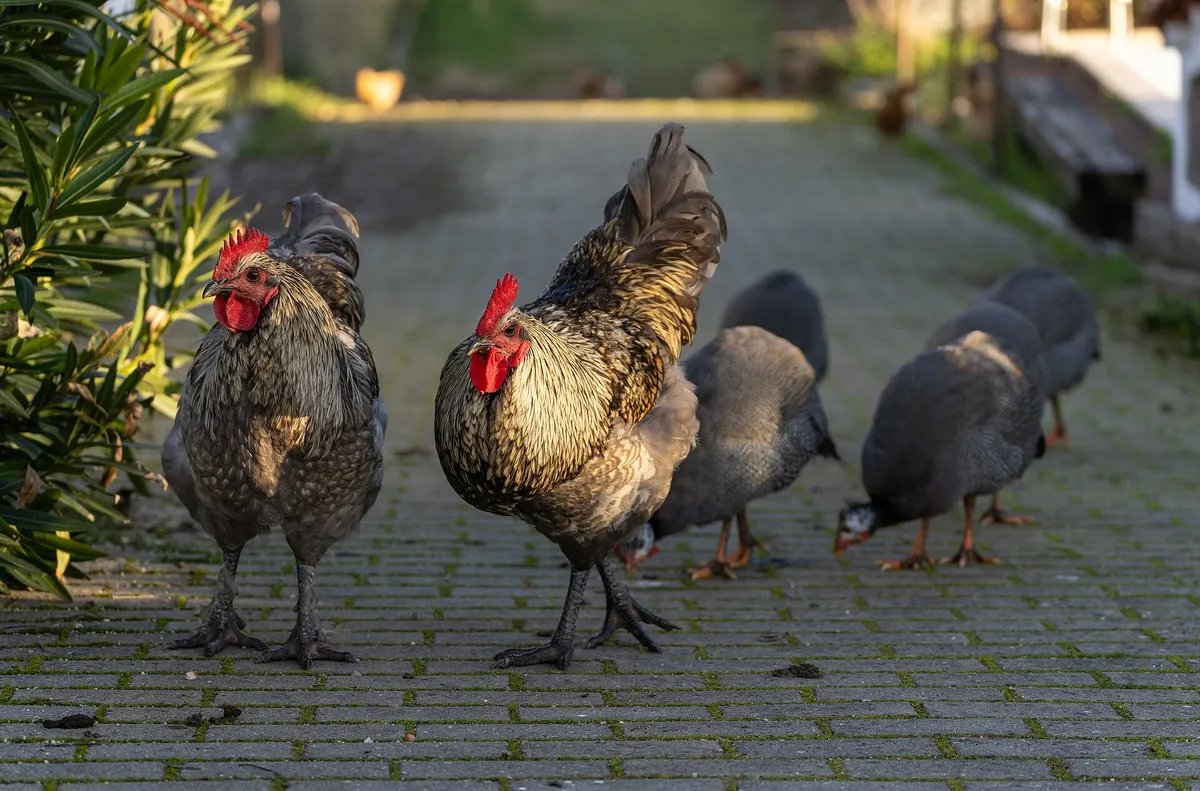
The rooster is the adult male of the domestic chicken. Domestic chickens are believed to descend from the red junglefowl, a wild bird native to southern Asia, especially the jungles of India. Male red junglefowl measure about 65 to 78 centimeters including the tail and females about 41 to 46 centimeters, and a rooster's tail alone can be almost 28 centimeters long.
Portugal has four native chicken breeds: the Amarela, the Branca, the Pedrês Portuguesa and the Preta Lusitânica. They are known for their genetic diversity, hardiness and unusual beauty, and they are raised mostly on small family farms, above all in the northwest of the country, for both meat and eggs. A study of three of these breeds estimated the adult weight of roosters at about 2.9 to 3.2 kilograms and of hens at about 2.0 to 2.3 kilograms.
Chickens live by a pecking order, with one ranking for hens and a separate one for roosters. A dominant rooster shows his rank by holding his head and tail high, while a lower-ranking bird lowers them and crouches, and hens feed under the protection of the dominant cock.
A chick develops inside the egg for 21 days before it hatches. In the red junglefowl, chicks are usually fully feathered by 4 to 5 weeks old and become mature at about five months.
Conservation
The domestic chicken is a domestic animal and has not been assessed on the IUCN Red List. Its wild ancestor, the red junglefowl, is listed as Least Concern, although interbreeding with domestic and feral chickens is a threat to the purity of wild populations.
Portugal's own chicken breeds are much rarer. According to a 2019 booklet from INIAV, Portugal's national institute for agricultural and veterinary research, the country has 50 native livestock breeds, 4 of them chickens. Each chicken breed is kept pure by fewer than two thousand hens, so all four are considered at risk of extinction.
Conservation of these breeds relies on keeping them useful, so that farmers continue to raise them and people continue to eat their meat and eggs. In Barcelos, the roast rooster cooked in the Barcelos style recalls the legend at the table, and the town council has linked the dish to the region's native breeds through a roast rooster competition that has run for ten editions.
Fun facts
- Researchers at Nagoya University in Japan reported in 2013 that roosters crow before dawn because of an internal body clock: on a schedule of 12 hours of light and 12 hours of darkness, most crows came in the 2 hours before the lights went on.
- A rooster's tail can be almost 28 centimeters long, and the chicken's wild ancestor has 14 tail feathers in total.
- Barcelos, the home of the famous painted rooster, has been a UNESCO Creative City for Crafts and Folk Art since 2017.
Frequently asked questions
What is the national bird of Portugal?
The national bird of Portugal is the rooster (a widely recognized national symbol, not set by law). The rooster is the male domestic chicken, known in Portugal above all through the colorful ceramic Rooster of Barcelos from the northern town of Barcelos.
Which country has the rooster as its national bird?
The rooster is the national bird of Portugal. The same species is also the national bird of France.
Why is the rooster the national bird of Portugal?
The rooster is seen as Portugal's national animal because of the Rooster of Barcelos, from a medieval legend in which a roasted rooster crowed to prove a pilgrim's innocence. No law names it, but in the 20th century the rooster became a symbol of Portugal and was long used as the symbol of Turismo de Portugal.
Where does the rooster live?
Farms, villages and backyards; Portugal's four native chicken breeds are kept mainly on small farms in the northwest.
See also: Most Popular Dog Breeds in Portugal (2025)
Sources
- UNESCO Creative Cities Network. Barcelos.
- Câmara Municipal de Barcelos. A gastronomia ao serviço da valorização da identidade e raças autóctones / X Concurso Galo Assado (municipal brochure, PDF).
- Turismo de Portugal (visitportugal.com). Lenda do galo de Barcelos (Wayback copy, June 2026).
- Diário de Notícias. À redescoberta de António Ferro: génio ou propagandista? (ep. 1) (9 April 2026).
- Revista Turismo & Desenvolvimento (Gonçalves & Costa, 2022). Barcelos, Cidade Criativa da UNESCO: contributo para o desenvolvimento sustentável do Artesanato através do Turismo Criativo.
- INIAV (Instituto Nacional de Investigação Agrária e Veterinária). Galinha Portuguesa, o melhor à sua mesa (June 2019, PDF).
- Italian Journal of Animal Science (Soares, Lopes, Brito & Carvalheira, 2015). Growth and Carcass Traits of Three Portuguese Autochthonous Chicken Breeds: Amarela, Preta Lusitânica and Pedrês Portuguesa.
- Animal Diversity Web (University of Michigan). Gallus gallus (red junglefowl).
- Singapore Birds Project. Red Junglefowl.
- Asian Scientist Magazine. Circadian Rhythms Control Rooster Crowing, Say Researchers (25 March 2013).
- Conservation status: IUCN Red List of Threatened Species.