Why it represents the country
The rooster is one of the best-known symbols of France, but it is not an official one. The French Constitution lists the national symbols in Article 2, and these are the flag, the anthem and the motto. The rooster, called le coq gaulois or the Gallic rooster, is a traditional emblem that has grown up over many centuries.
Its origin is a play on words. In Latin, gallus means both rooster and a Gaul, one of the ancient people who lived in what is now France. The rooster appeared on some coins of ancient Gaul. The symbol faded in the Middle Ages and returned during the Renaissance, when it was used in pictures of French kings. It became popular again after the French Revolution. Napoleon disliked it and said the rooster had no strength and could not represent an empire like France, but in 1830 a royal order placed it on the flags and uniform buttons of the National Guard, and later governments used it on seals and coins. A rooster with spread wings still stands on the garden gate of the Élysée Palace in Paris.
Today the rooster is best known at sporting events. French national teams in many sports wear it on their shirts, and fans wave rooster flags and wear rooster costumes to support their teams. As the French presidency's own website puts it, the rooster remains the emblem of France in the eyes of the world, especially in sport.
About the animal
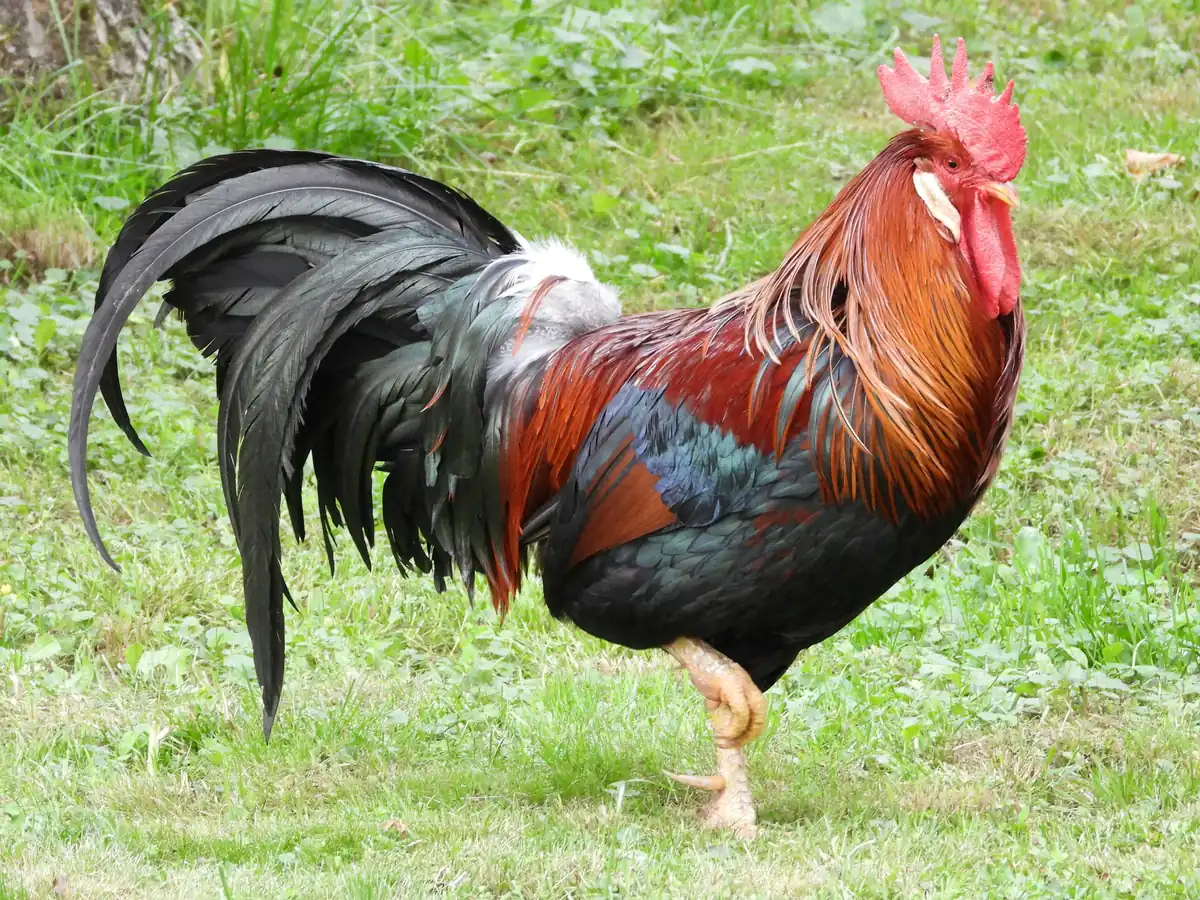
The rooster is simply a male domestic chicken. Roosters are usually larger and more colorful than hens, with a tall red comb on the head, red wattles under the bill, long curved tail feathers and shiny neck feathers. Weight depends on the breed, and many farm breeds weigh a few kilograms.
Roosters are famous for crowing, especially early in the morning, although they crow at other times of day too. Crowing tells other roosters where a male is and warns them to keep away. A rooster also watches over his group of hens, calls them over when he finds food, and gives alarm calls when he spots a hawk or a fox.
Chickens are omnivores. They scratch the ground with their feet and peck at seeds, grain, green plants, insects, worms and even small animals such as lizards. They like to bathe in dust, which helps keep their feathers clean and free of parasites.
France has many traditional chicken breeds, and some regions are known for them. One old breed is even called the Gauloise, and its dorée (golden) form looks very much like the classic rooster of French pictures, with a red comb and fiery orange and black feathers.
Conservation
Because the rooster is a domestic animal, it is not evaluated on the IUCN Red List. Chickens now live on every inhabited continent and number in the billions, which makes them one of the most common birds on Earth.
All domestic chickens descend mainly from a wild bird, the red junglefowl, which still lives in forests and forest edges from India and Pakistan to Southeast Asia. Male red junglefowl look very much like a slim, wild version of a farmyard rooster, with golden neck feathers, dark glossy tail feathers and a red comb. People in Southeast Asia began keeping these birds thousands of years ago, and over time they spread around the world.
The red junglefowl is listed as Least Concern on the IUCN Red List. Its main conservation problem is an unusual one: in many places wild birds breed with domestic or free-roaming chickens, and scientists worry that truly wild red junglefowl, with their original wild genes, are becoming harder to find. Protecting forests and keeping domestic chickens away from wild populations helps keep this ancestor of the French rooster wild.
Fun facts
- The link between France and the rooster began with a Latin word play: gallus means both rooster and Gaul.
- Napoleon refused to use the rooster as a symbol, saying it had no strength and could not represent an empire.
- Every farmyard chicken in the world descends mainly from the red junglefowl, a wild bird of Asian forests.
Frequently asked questions
What is the national bird of France?
The national bird of France is the Gallic rooster (a widely recognized national symbol, not set by law). It is simply a male domestic chicken, and French national teams in many sports wear it on their shirts.
Which country has the Gallic rooster as its national bird?
The Gallic rooster is the national bird of France. The same species is also the national bird of Portugal.
Why is the Gallic rooster the national bird of France?
The Gallic rooster began as a play on words: in Latin, gallus means both rooster and a Gaul, one of the ancient people who lived in what is now France, and the rooster appeared on some coins of ancient Gaul. The French Constitution lists only the flag, the anthem and the motto, so the rooster is a traditional emblem that grew up over many centuries rather than an official one, and today it is best known in sport.
Where does the Gallic rooster live?
Farms and villages; wild ancestor in forests of South and Southeast Asia.
See also: Most Popular Dog Breeds in France (2025)
Sources
- Conseil constitutionnel. Constitution of 4 October 1958, Article 2.
- Élysée (Présidence de la République). Le coq.
- Conservation status: IUCN Red List of Threatened Species.