Why it represents the country
Italy has no law that names a national animal, but the wolf is the one most often linked with the country. The reason goes back to the founding legend of Rome. According to the story, the twin brothers Romulus and Remus were abandoned as babies near the Tiber River and saved by a she-wolf, who fed them with her milk. Romulus later founded the city of Rome, traditionally in 753 BC.
The most famous image of the legend is the Capitoline Wolf, a bronze statue of a she-wolf kept in the Capitoline Museums in Rome. The small figures of the twins beneath her were added much later, during the Renaissance, and experts still debate how old the wolf herself is. The she-wolf also appears on the badge of the AS Roma football club.
The wolf is also a symbol of Italy's wild nature. By the early 1970s Italian wolves had almost disappeared, and their comeback since then is one of the best-known conservation stories in Europe. Today wolves live along the whole Apennine chain and have spread back into the Alps, so the animal of Rome's legend is once again part of the Italian countryside.
About the animal
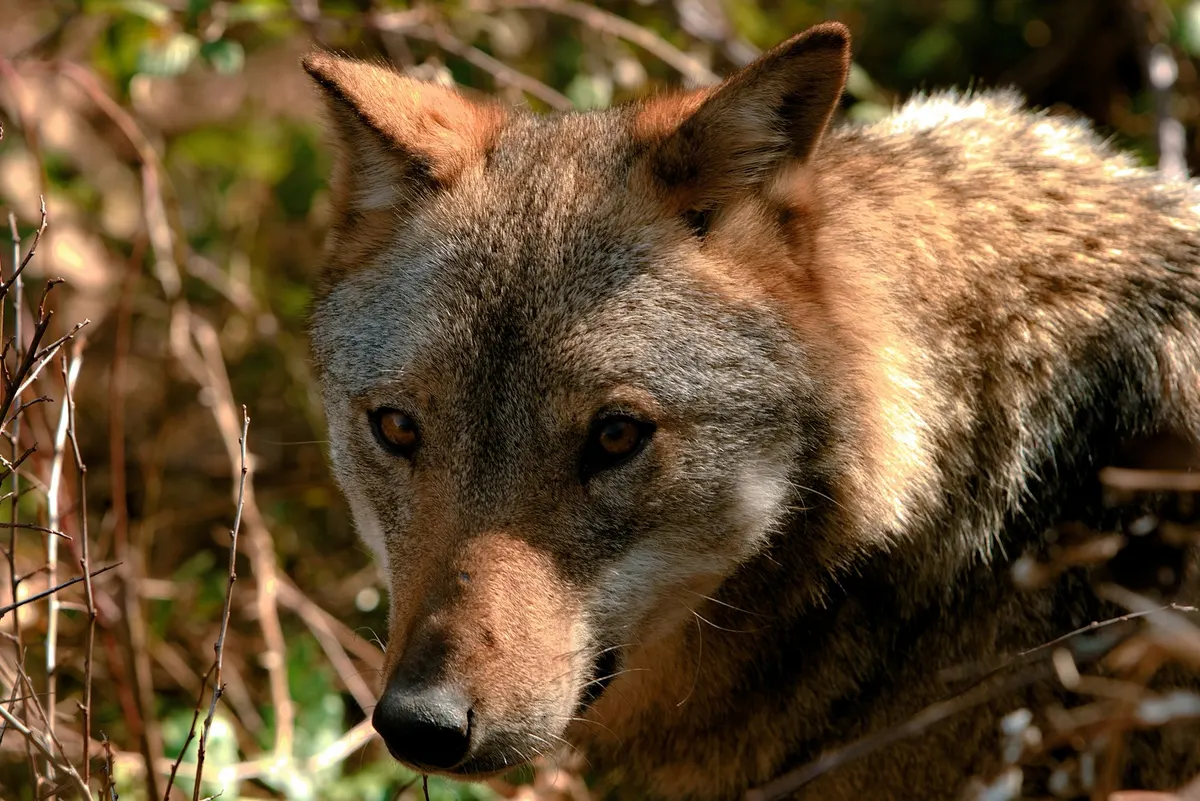
The Italian wolf is a population of the gray wolf, Canis lupus, that is often treated as its own subspecies, Canis lupus italicus. Scientists still debate how distinct it is. Italian wolves are fairly small for their species. Adults usually weigh about 25 to 40 kilograms and measure roughly 100 to 140 centimeters from the nose to the base of the tail, with females a little smaller than males.
Their coat is mostly grayish brown, often with a warmer reddish tone, and lighter on the cheeks, throat and belly. Many Italian wolves have a dark stripe running down the front of their forelegs, a feature often used to describe them.
Wolves live in family groups called packs, usually made up of a breeding pair and their young from the last year or two. A pack defends a territory and often hunts together. In Italy their main prey are wild hoofed animals such as wild boar, roe deer and red deer. In some areas they also kill sheep, goats or calves, which can lead to conflict with farmers.
Pups are born in spring in a den hidden in thick vegetation or among rocks. After a few weeks they move to meeting places in the forest, where they wait and play while the adults hunt. Young wolves often leave their family at one to two years old and can travel long distances to find a mate and a territory of their own.
Conservation
The gray wolf as a species is listed as Least Concern on the IUCN Red List. In Italy, however, wolves were hunted, trapped and poisoned for centuries. By the early 1970s only about 100 survived, mostly in the central and southern Apennines.
Protection began in 1971, when a ministerial decree banned wolf hunting across Italy, and the ban became law in 1976. With legal protection, fewer people living in the mountains and more deer and wild boar, wolves slowly spread north along the Apennines and back into the Alps. The first national survey, run by the Italian environment agency ISPRA in 2020 and 2021, estimated about 3,300 wolves in Italy: around 950 in the Alps and 2,400 in the rest of the peninsula.
Wolves still face threats. Many are killed by cars, and illegal killing, including poisoning and shooting, is still a problem. Wolves sometimes mate with free-roaming dogs, producing hybrids that can blur the wild population. Conservation work in Italy focuses on helping farmers protect their animals with fences and guard dogs and on reducing illegal killing.
Fun facts
- According to legend, a she-wolf fed the twins Romulus and Remus, and Romulus went on to found Rome.
- In the early 1970s only about 100 wolves were left in Italy; a 2020 to 2021 survey estimated about 3,300.
- Many Italian wolves have a dark stripe running down the front of their forelegs.
Frequently asked questions
What is the national animal of Italy?
The national animal of Italy is the Italian wolf (a widely recognized national symbol, not set by law). It is a population of the gray wolf, often treated as its own subspecies, that is fairly small for its species and lives in the mountain forests, hills and open countryside of the Apennines and the Alps.
Which country has the Italian wolf as its national animal?
The Italian wolf is the national animal of Italy. The same species is also the national animal of Estonia. The Italian wolf is also known as Apennine wolf.
Why is the Italian wolf the national animal of Italy?
Italy has no law naming a national animal, but the wolf is the animal most linked with the country because of Rome's founding legend: a she-wolf saved and fed the abandoned twins Romulus and Remus, and Romulus later founded Rome, traditionally in 753 BC. The best-known image of the story is the Capitoline Wolf, a bronze she-wolf kept in the Capitoline Museums in Rome.
Is the Italian wolf endangered?
The gray wolf as a species, which includes the Italian wolf, is listed as Least Concern on the IUCN Red List. In Italy only about 100 wolves survived by the early 1970s, but after hunting was banned in 1971 they recovered to an estimated 3,300 in the first national survey of 2020 and 2021.
Where does the Italian wolf live?
Mountain forests, hills and open countryside of the Apennines and the Alps.
See also: Most Popular Dog Breeds in Italy (2025)
Sources
- ISPRA (Italian Institute for Environmental Protection and Research). First national wolf population estimate, 2020–2021.
- Regione Emilia-Romagna. Aggiornamento tecnico su status e distribuzione del lupo in Emilia-Romagna.
- IUCN Red List of Threatened Species. Canis lupus (assessment 2018).
- Conservation status: IUCN Red List of Threatened Species.