Why it represents the country
The springbok is one of South Africa's national symbols, alongside the blue crane, the king protea and the yellowwood tree. The South African government lists it as the national animal.
The name comes from Afrikaans and Dutch words meaning to jump and a male antelope or goat, which suits an animal known for its leaps. The springbok is also closely linked to sport: the national rugby union team is known as the Springboks, and its emblem shows a leaping springbok.
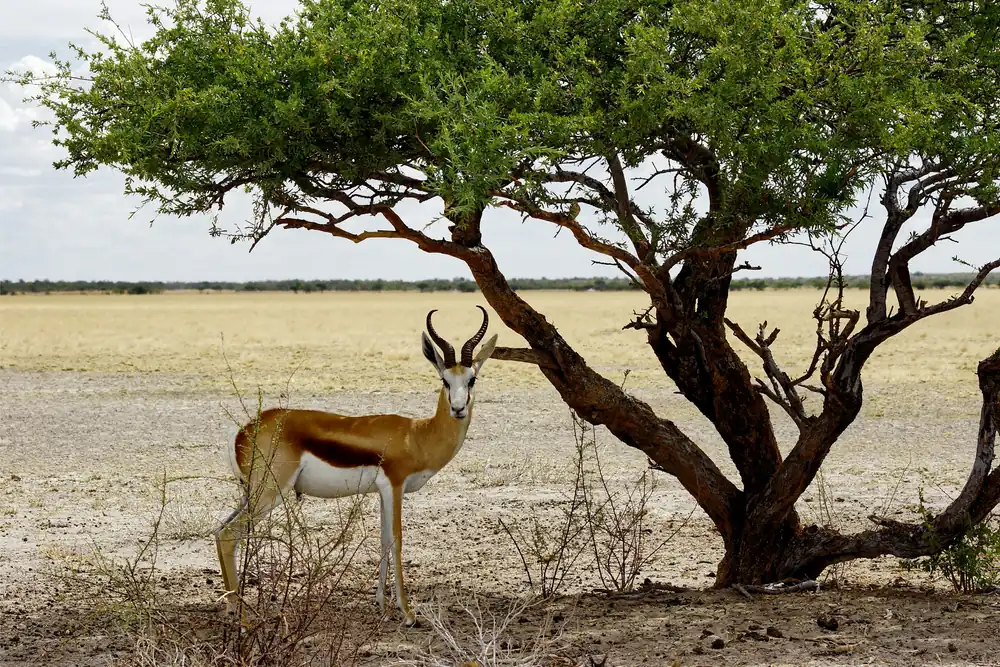
The antelope has appeared on many other national emblems over the years. According to the South African Presidency, it was used on the emblems of the South African Air Force and in the logo of South African Airways, whose radio call sign is still Springbok. The springbok also fits the landscape of much of the country. The springbok lives in the dry, open interior, where it survives heat and long periods without rain, and huge herds once moved across these plains.
About the animal
The springbok is a medium-sized, slender antelope that stands about 80 centimeters at the shoulder. It has a cinnamon-brown back, a white belly and a dark brown stripe along each side that separates the two colors. Its face is white, with a dark stripe running from each eye down toward the mouth. Both males and females have ridged, lyre-shaped horns, although those of males are thicker and longer.
Springbok are best known for pronking, also called stotting. The animal leaps straight up with a stiff-legged bounce, head down, back arched and hooves bunched together, sometimes several times in a row. When it pronks, a fold of skin along its back opens to show a fan of white hair. Scientists think pronking may signal to predators that the springbok is fit and hard to catch, and it is also seen in play. They are fast runners and are among the quickest antelopes in Africa. On the open plains, speed and a sharp lookout are their main defenses against cheetahs, lions, leopards and other hunters.
Springbok are very well adapted to dry country. They graze on grasses when these are green and switch to browsing on shrubs and succulent plants at other times. In the hot, dry season they also eat flowers, which hold about twice as much water as the grass they eat in wetter months. This lets them go for long periods without drinking, and it frees them from depending on water holes in a region where droughts are common.
Females live in herds with their young and a few dominant males, while younger, older and lower-ranking males often wander in separate groups. Mating usually takes place in the dry season. After a pregnancy of about five and a half months, a female gives birth to a single lamb, often at the start of the rains, when fresh food is easiest to find.
Conservation
The springbok is listed as Least Concern on the IUCN Red List and is common in parts of South Africa, Namibia and Botswana. Many live on private farms and game reserves as well as in national parks.
In the 1800s, travelers described vast migrations of springbok, known as trekbokke, in which herds moved across the land in huge numbers. The treks could ruin crops, and farmers hunted the antelope heavily. Hunting, fencing and farming brought those great movements to an end, and only small, occasional treks in remote areas have been reported since.
Today springbok populations are stable overall. Hunting them in South Africa requires a permit or license, and the antelope has been reintroduced to many reserves and farms. Well-managed land, protected areas and the value placed on wildlife by landowners and visitors all help to keep the national animal a familiar sight in the dry west of southern Africa.
Fun facts
- When a springbok pronks, a hidden fold of skin on its back opens to reveal a crest of white hair.
- Springbok can survive for long periods without drinking by getting water from the plants and flowers they eat.
- South Africa's national rugby team is named the Springboks after this antelope.
National bird of South Africa: Blue crane
Blue crane Anthropoides paradiseus Officially designated
Also known as: Stanley crane, paradise crane
The blue crane is South Africa's national bird, listed among the national symbols by the South African Government.
The blue crane is found almost only in South Africa, with a small breeding population in northern Namibia, and usually breeds in grassland at high elevations. After breeding, the cranes move to lower ground and gather in flocks of up to 1,000 birds, often roosting together at night in their hundreds or thousands. The IUCN Red List classes the species as Vulnerable, with roughly 17,000 to 30,000 mature birds.
Other national symbols of South Africa
- National flower
King protea Protea cynaroides Officially designated
The king protea is South Africa's national flower, listed among the national symbols by the South African Government.
Frequently asked questions
What is the national animal of South Africa?
The national animal of South Africa is the springbok (officially designated). The springbok is a slender, medium-sized antelope of the dry, open interior, famous for its stiff-legged leaps called pronking, and a leaping springbok is the emblem of the national rugby team, the Springboks.
Which country has the springbok as its national animal?
The springbok is the national animal of South Africa. The springbok is also known as springbuck.
Why is the springbok the national animal of South Africa?
The South African government lists the springbok as the national animal, alongside the blue crane, the king protea and the yellowwood tree among the national symbols. The leaping antelope has long stood for the country: it has appeared on the emblems of the South African Air Force and in the logo of South African Airways, and it fits the dry, open plains of much of South Africa, where huge herds once roamed.
Is the springbok endangered?
The springbok is listed as Least Concern on the IUCN Red List, and its populations are stable overall. Hunting, fencing and farming ended the vast migrations of the 1800s, but today hunting it in South Africa requires a permit and the antelope has been reintroduced to many reserves and farms.
Where does the springbok live?
Dry open grasslands, scrub and semi-desert in southwestern Africa.
What is the national bird of South Africa?
The national bird of South Africa is the blue crane (officially designated). The blue crane is South Africa's national bird, listed among the national symbols by the South African Government. The blue crane is also known as Stanley crane or paradise crane.
See also: Most Popular Dog Breeds in South Africa (2025)
Sources
- The Presidency, Republic of South Africa. National symbols.
- Encyclopaedia Britannica. Springbok.
- Animal Diversity Web, University of Michigan. Antidorcas marsupialis: springbok.
- IUCN Red List of Threatened Species. Antidorcas marsupialis (assessment 2016).
- South African Government - National bird.
- BirdLife DataZone: Blue Crane Anthropoides paradiseus Species Factsheet.
- South African Government - National flower.
- CIA World Factbook (2020 archive): South Africa - National symbol(s).
- Conservation status: IUCN Red List of Threatened Species.