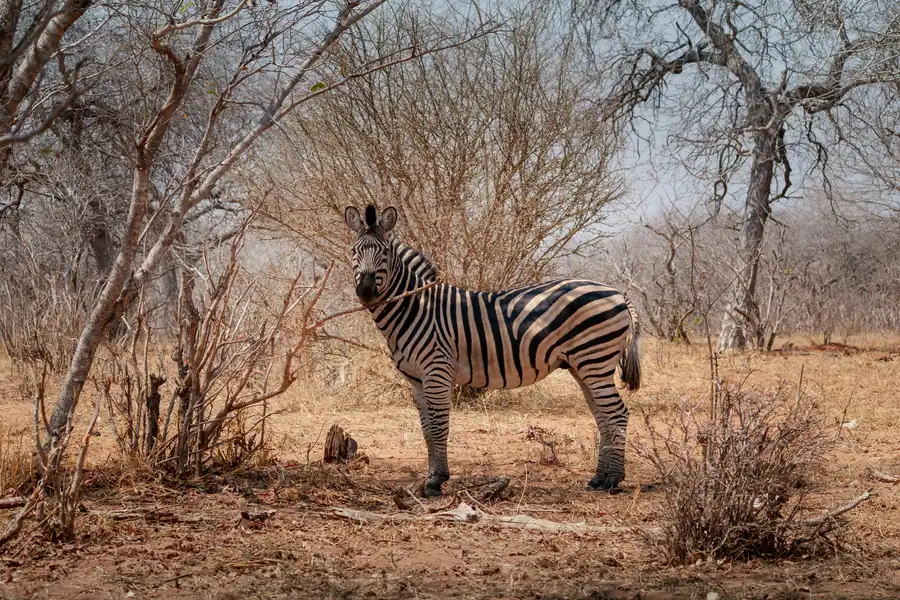
Why it represents the country
Two plains zebras support the national coat of arms of Botswana, which was adopted in January 1966, the year the country became independent. One zebra holds an elephant's tusk, a symbol of the country's elephants, and the other holds a stalk of sorghum, an important grain crop. Between them is a shield showing three cogwheels for industry, three wavy lines for water, and the head of a bull for cattle farming, with the motto Pula on a scroll below.
Because of this, the zebra is widely regarded as Botswana's national animal. The coat of arms appears on the country's money, which is also called the pula, and on the cover of the passport, so the zebras are seen in daily life. Pula means rain in Setswana, a reminder of how precious water is in a mostly dry country.
The zebra is a fitting choice. Its bold black and white coat is easy to recognize, and plains zebras are a familiar sight in many of Botswana's wild areas, from the Chobe River in the north to Nxai Pan National Park. Botswana is also the destination of one of the longest animal journeys recorded in Africa.
About the animal
The plains zebra is the most common and widespread of the three zebra species. It is a sturdy, horse-like animal with a short, upright mane and a tufted tail. Its stripes are broader than those of other zebras, running up and down on the front of the body and turning more sideways on the hindquarters. In southern populations, faint brownish shadow stripes often appear between the black ones. No two zebras have exactly the same pattern.
Plains zebras live in stable family groups called harems. Each harem has one stallion, several mares and their young, and its members can stay together for months or even years. Young males without a family form bachelor groups. Many harems and bachelor groups may join into large herds, especially when they migrate, but each family stays together within the crowd.
Zebras are grazers that eat many kinds of grass, including tall, tough grasses that other animals avoid. They are sometimes called pioneer grazers: by eating the tall grass first, they open up the plains for animals that prefer short, fresh growth. They also eat leaves and young shoots, which lets them range widely, even into woodland.
A mare gives birth to a single foal after a pregnancy of about a year. The foal's coat is brown and white at first, and the brown darkens as it grows. Lions and spotted hyenas are the zebra's main predators. When they spot danger, zebras bark or snort in alarm, and the stallion may charge to defend his family. An adult zebra can run at 60 kilometers per hour or more.
Conservation
The plains zebra is listed as Near Threatened on the IUCN Red List. It is still common in many parks and reserves, but its numbers have fallen sharply in many countries, and it has disappeared completely from Burundi and Lesotho.
The main threats are the loss of grassland to farming and settlements, competition with livestock for grazing, and hunting for meat and skins. Changes in land use can also cut the routes that migrating herds depend on, and large migrations of many animals are becoming rarer across Africa.
Botswana's zebras made scientific news in 2014. Researchers who fitted tracking collars to female zebras near the border between Namibia and Botswana found that the animals crossed the Chobe River and walked south to Nxai Pan National Park, stayed for about ten weeks, and then went back. The round trip covers about 500 kilometers in a straight line, the longest recorded migration of any large mammal in Africa. Protecting routes like this one helps keep Botswana's national animal on the move.
Fun facts
- No two zebras have exactly the same stripe pattern.
- Zebras from the Chobe River area make a round trip of about 500 kilometers to Nxai Pan, the longest recorded large mammal migration in Africa.
- On Botswana's coat of arms, one zebra holds an elephant tusk and the other holds a stalk of sorghum.
National bird of Botswana: Kori bustard
Kori bustard Ardeotis kori Officially designated
Botswana's government launched the kori bustard (kgori) as the national bird in May 2014, after consulting stakeholders.
The kori bustard lives across the dry savannas, grasslands and semi-deserts of eastern and southern Africa, keeping to open country and avoiding dense woodland. Males weigh 10 to 19 kilograms, which makes the kori the heaviest flying bird in Africa, yet the bustard prefers to walk with long strides and to shelter from the midday sun under trees. The kori eats almost anything, from insects to reptiles and small rodents, along with plants.
Other national symbols of Botswana
- National flower
Devil's claw (sengaparile) Harpagophytum procumbens Officially designated
Botswana's government launched devil's claw (sengaparile) as the national flower in May 2014, as a symbol of a strong nation.
Frequently asked questions
What is the national animal of Botswana?
The national animal of Botswana is the plains zebra (a widely recognized national symbol, not set by law). The plains zebra is a sturdy, horse-like animal with bold black and white stripes, and two of them support Botswana's coat of arms, which also appears on the country's money and on the cover of the passport.
Which country has the plains zebra as its national animal?
The plains zebra is the national animal of Botswana.
Why is the plains zebra the national animal of Botswana?
Two plains zebras support Botswana's coat of arms, adopted in January 1966, the year the country became independent: one holds an elephant's tusk and the other a stalk of sorghum. Because of this, and because the arms appear on the money and the passport, the zebra is widely regarded as the national animal, and plains zebras are a familiar sight in many of Botswana's wild areas.
Is the plains zebra endangered?
The plains zebra is listed as Near Threatened on the IUCN Red List; it is still common in many parks and reserves, but its numbers have fallen sharply in many countries. The main threats are the loss of grassland to farming and settlements, competition with livestock and hunting for meat and skins.
Where does the plains zebra live?
Grassland, savanna and open woodland in eastern and southern Africa.
What is the national bird of Botswana?
The national bird of Botswana is the kori bustard (officially designated). Botswana's government launched the kori bustard (kgori) as the national bird in May 2014, after consulting stakeholders.
Sources
- African Wildlife Foundation. Zebra.
- IUCN Red List of Threatened Species. Equus quagga (assessment 2016).
- Botswana Daily News (BOPA) - Department unveils national symbols, 13 May 2014.
- Animal Diversity Web: Ardeotis kori (kori bustard).
- Botswana Daily News (BOPA) - Department unveils national symbols, 13 May 2014.
- Conservation status: IUCN Red List of Threatened Species.