Why it represents the country
The okapi is the national animal of the Democratic Republic of the Congo by tradition, and it is one of the country's proudest symbols. It is fully protected under Congolese law, it appears on the country's money, and it is used on the emblem of the rangers of the Congolese Institute for Nature Conservation (ICCN), who protect the country's wildlife and plants.
For such a large animal, the okapi became known to science very late. In the 1880s the explorer Henry Morton Stanley wrote about a donkey-like animal that local people called the atti. A few years later, Sir Harry Johnston, then a British official in Uganda, obtained pieces of striped skin and a skull from the forest. The animal was formally described in 1901 and named Okapia johnstoni after him. The name okapi comes from a word used by local people of the Ituri Forest.
Because it lives in the DRC's forests, the okapi has become a flagship for protecting them. The Okapi Wildlife Reserve, which covers about one-fifth of the Ituri Forest, was named a UNESCO World Heritage Site in 1996, partly because of its large number of okapis.
About the animal
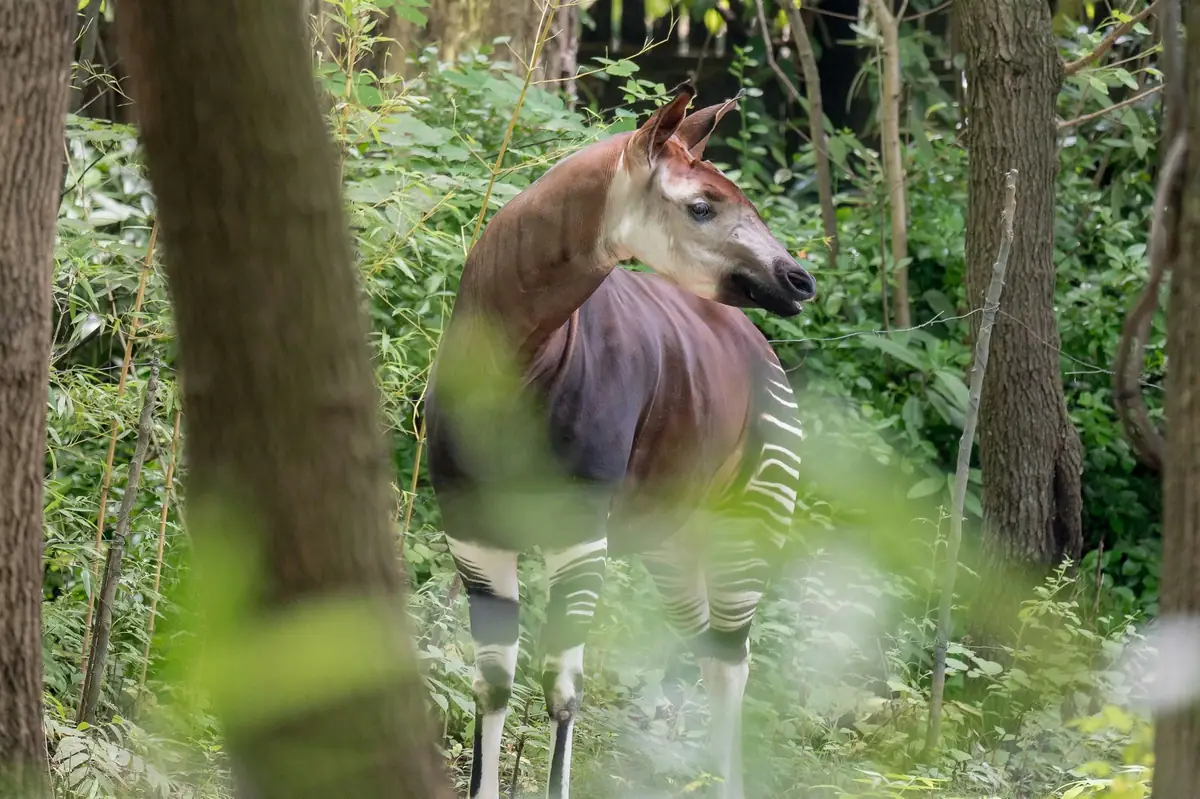
The okapi looks like a mix of several animals, but its closest relative is the giraffe. Its body is a deep reddish or chocolate brown with a soft, velvety coat. The coat is very oily, which helps rain run off in its wet forest home. Its legs and rump are marked with bold white and dark stripes, much like a zebra's, and its lower legs have white stockings.
Like the giraffe, the okapi has a long, dark, flexible tongue, which it uses to strip leaves from branches and even to clean its eyes and ears. Males have short, skin-covered horns called ossicones, while females have small whorls of hair instead. Okapis also walk with the same pacing gait as giraffes, moving both legs on one side of the body at the same time.
Okapis live in dense rainforest where little sunlight reaches the ground. They feed on the leaves, buds and twigs of plants growing under the tall trees, and they have been recorded eating more than 100 kinds of plants, including some that are poisonous to people. They also eat clay, which gives them minerals, and they have even been seen eating burnt charcoal. Okapis are shy, quiet and mostly solitary, and they are very hard to see in the wild.
A female gives birth to a single calf after a long pregnancy of about 14 to 15 months. The calf can stand within about half an hour, then spends much of its first two months hidden in a quiet spot in the forest while its mother guards it and returns to nurse. The young okapi is weaned at about six months, although it may nurse for up to a year.
Conservation
The okapi is listed as Endangered on the IUCN Red List. Because it is shy and lives in thick forest, it is hard to count, but its numbers have been falling. The main threats are the loss of forest to logging and human settlement, hunting for bushmeat and skins, and illegal mining in and around its habitat.
Important populations live in the Okapi Wildlife Reserve and Maiko National Park, where rangers work to protect the forest and its wildlife. The Okapi Conservation Project, founded in 1987, supports the protection of okapis and works with the Indigenous and local communities who share their forest.
Zoos around the world also keep okapis in carefully managed breeding programs, which act as a safety net and help people learn about this rarely seen animal. Antwerp Zoo in Belgium, the first zoo to show an okapi, in 1919, manages the international and European studbooks. Still, the okapi's future depends most of all on keeping the Congo's rainforests standing.
Where to see the okapi in the wild
Wild okapis live only in the rainforests of the Democratic Republic of the Congo, and the Okapi Wildlife Reserve in the Ituri forest is the best-known stronghold of the species.
Okapi Wildlife Reserve
The Okapi Wildlife Reserve covers about a fifth of the Ituri forest in northeastern DR Congo and was once estimated to hold about 5,000 okapis.
Official page ↗Maiko National Park
Maiko National Park, east of the Congo River, is one of the protected areas where the endangered okapi still occurs.
Official page ↗
Watch wild animals from a distance, never feed them, and follow the rules and rangers of each protected area.
Fun facts
- An okapi's tongue is long enough to clean its own eyes and ears.
- The okapi was formally described by scientists only in 1901.
- Okapis have been recorded eating more than 100 kinds of plants, including some that are poisonous to people.
Frequently asked questions
What is the national animal of the Democratic Republic of the Congo?
The national animal of the Democratic Republic of the Congo is the okapi (a widely recognized national symbol, not set by law). The okapi is a shy forest relative of the giraffe, with a chocolate-brown coat and zebra-like stripes on its legs and rump, and it appears on the country's money and on the emblem of the ICCN rangers.
Which country has the okapi as its national animal?
The okapi is the national animal of the Democratic Republic of the Congo. The okapi is also known as forest giraffe or zebra giraffe.
Why is the okapi the national animal of the Democratic Republic of the Congo?
The okapi lives in the wild only in the Democratic Republic of the Congo, and by tradition it is the national animal and one of the country's proudest symbols. It is fully protected under Congolese law, and it has become a flagship for protecting the forests where it lives, such as the Okapi Wildlife Reserve in the Ituri Forest.
Is the okapi endangered?
The okapi is listed as Endangered on the IUCN Red List, and although it is hard to count, its numbers have been falling. The main threats are the loss of forest to logging and human settlement, hunting for bushmeat and skins, and illegal mining in and around its habitat.
Where does the okapi live?
Dense tropical rainforest in the north and east of the Democratic Republic of the Congo.
Where can you see the okapi in the wild?
Wild okapis live only in the rainforests of the Democratic Republic of the Congo, and the Okapi Wildlife Reserve in the Ituri forest is the best-known stronghold of the species.
Sources
- Encyclopaedia Britannica. Okapi.
- IUCN Red List of Threatened Species. Okapia johnstoni (assessment 2015).
- IUCN World Heritage Outlook – Okapi Wildlife Reserve.
- IUCN – World Okapi Day.
- Key Biodiversity Areas – Maiko National Park (6067).
- Conservation status: IUCN Red List of Threatened Species.