Why it represents the country
Trinidad and Tobago has two national birds, one for each island, and both appear on the national coat of arms, one on each side of the shield. The scarlet ibis represents Trinidad. The cocrico, or rufous-vented chachalaca, a brown bird with a long tail that lives on Tobago but not naturally on Trinidad, represents Tobago.
The coat of arms was created in 1962, the year the country became independent, by a committee that included the artist Carlisle Chang and the Carnival designer George Bailey. Its pictures were chosen to show features of the islands themselves, and the two native birds were part of that. Until the ibis appeared on the coat of arms, it was still legal to hunt it.
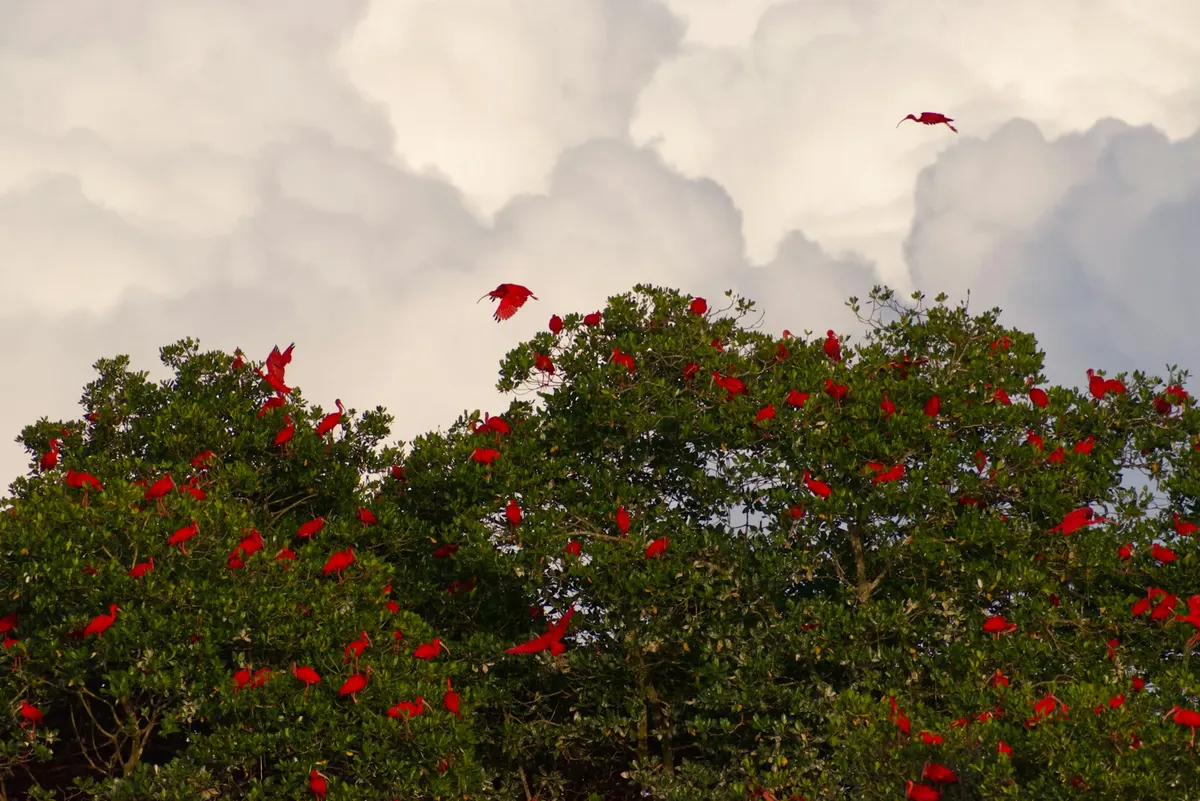
The ibis's best-known home is the Caroni Swamp, a large mangrove wetland in central Trinidad and the bird's main stronghold in the country. In the evening, flocks fly in from their feeding grounds to roost in the mangrove trees, and the sight of red birds settling into green trees has made the swamp one of Trinidad's most famous places to watch wildlife.
About the animal
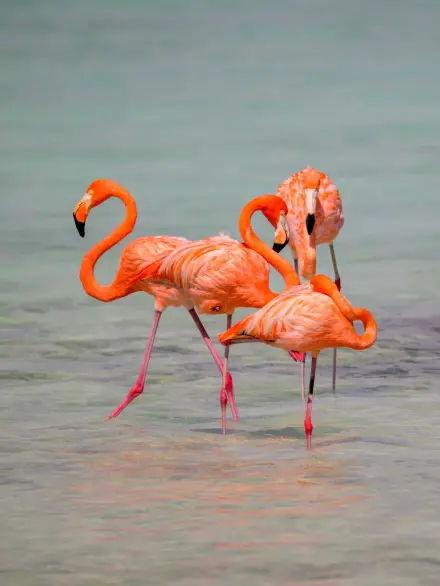
The scarlet ibis is a long-legged wading bird about 56 to 76 centimeters long, with a long, thin, down-curved bill. Adults are almost entirely bright scarlet, with glossy blue-black tips to the wings. Young birds are gray-brown with white bellies and turn red only as they grow up. Males and females look alike, but males are bigger and have longer bills.
The red color comes from the bird's food. Scarlet ibises eat lots of crabs, crayfish, shrimp and other small crustaceans, which contain red pigments. In zoos, their feathers fade to pink unless they are given a special diet.
The species lives along the northern coast of South America, from Colombia and Venezuela to eastern Brazil, and on Trinidad. It feeds by probing soft mud and shallow water with its bill and also catches aquatic insects, small fish, frogs and mollusks. Ibises are very social. They fly between feeding and roosting sites in large flocks and often feed alongside storks, spoonbills and other wading birds.
They nest in colonies, often in mangroves or on islands near river mouths, with several stick nests in a single tree. The female usually lays 3 to 5 eggs, and both parents take turns incubating them for 19 to 23 days. Both parents feed the chicks, which can fly well by about 40 days old and can look after themselves by about 75 days.
Conservation
The scarlet ibis is listed as Least Concern on the IUCN Red List because it has a very large range and population. BirdLife International notes, however, that its numbers appear to be falling, mainly because its wetland habitat is being destroyed.
In Trinidad, a major local threat has been illegal hunting, as some people still shoot the birds for meat. Local estimates put the number of ibises using the Caroni Swamp at between 8,000 and 30,000. In July 2018 the government named the scarlet ibis an environmentally sensitive species, and killing one can now bring a fine of 100,000 Trinidad and Tobago dollars and two years in prison.
Protecting the mangroves is just as important. Mangroves give ibises safe places to roost and nest, and the mudflats around them provide food. The Caroni Swamp is recognized as a wetland of international importance, and keeping it healthy is the key to keeping Trinidad's national bird coming home to roost each evening.
Fun facts
- Scarlet ibis chicks are gray-brown, and their bright red feathers come in only as they grow up.
- The ibis gets its red color from the crabs, shrimp and other crustaceans it eats.
- Tobago has its own national bird, the cocrico, which shares the coat of arms with the scarlet ibis.
Other national symbols of Trinidad and Tobago
- National flower
Double chaconia Warszewiczia coccinea 'David Auyong' Officially designated
A 2019 law made the double chaconia Trinidad and Tobago's national flower, replacing the single chaconia chosen at independence in 1962.
Frequently asked questions
What is the national bird of Trinidad and Tobago?
The national bird of Trinidad and Tobago is the scarlet ibis (a widely recognized national symbol, not set by law). It is a brilliant red, long-legged wading bird that appears on the national coat of arms as the bird of Trinidad, sharing the shield with Tobago's cocrico.
Which country has the scarlet ibis as its national bird?
The scarlet ibis is the national bird of Trinidad and Tobago. The scarlet ibis is also known as red ibis.
Why is the scarlet ibis the national bird of Trinidad and Tobago?
Trinidad and Tobago has two national birds, one for each island, and both appear on the coat of arms created in 1962, the year of independence: the scarlet ibis represents Trinidad and the cocrico represents Tobago. The committee that designed it chose pictures showing features of the islands themselves, including these two native birds. The ibis's best-known home, the Caroni Swamp in central Trinidad, is one of the country's most famous places to watch wildlife.
Is the scarlet ibis endangered?
The scarlet ibis is listed as Least Concern on the IUCN Red List because its range and population are very large, although BirdLife International notes its numbers appear to be falling as wetlands are destroyed. In Trinidad, where illegal hunting has been a major threat, it was named an environmentally sensitive species in July 2018.
Where does the scarlet ibis live?
Mangrove swamps, mudflats and coastal wetlands.
Sources
- Office of the Prime Minister, Trinidad and Tobago. The Coat of Arms.
- National Geographic. Trinidad's dazzling national bird is served up as bush meat (2018).
- Animal Diversity Web, University of Michigan. Eudocimus ruber: scarlet ibis.
- IUCN Red List of Threatened Species. Eudocimus ruber (assessment 2025).
- Office of the Prime Minister, Trinidad and Tobago — National Emblems.
- Caribbean Today — Double Chaconia is T&T's Official Flower (2019).
- Conservation status: IUCN Red List of Threatened Species.