Why it represents the country
The black crowned crane is widely described as Nigeria's national bird in conservation and media sources. A 2019 review published for the IUCN crane specialist group calls it Nigeria's National Bird. The cited sources do not identify a current Nigerian law or government act that designates it.
A 2018 report in the Nigerian newspaper Daily Trust says the black crowned crane was proposed as Nigeria's national bird around 1985. The report says the responsible government was unclear and that the eagle on Nigeria's coat of arms was later given the designation.
The black crowned crane has deep roots in northern Nigeria. The Hadejia-Nguru wetlands in Jigawa and Yobe states were once home to large numbers of the birds, which people in Hadejia call Borin Tunke.
About the animal
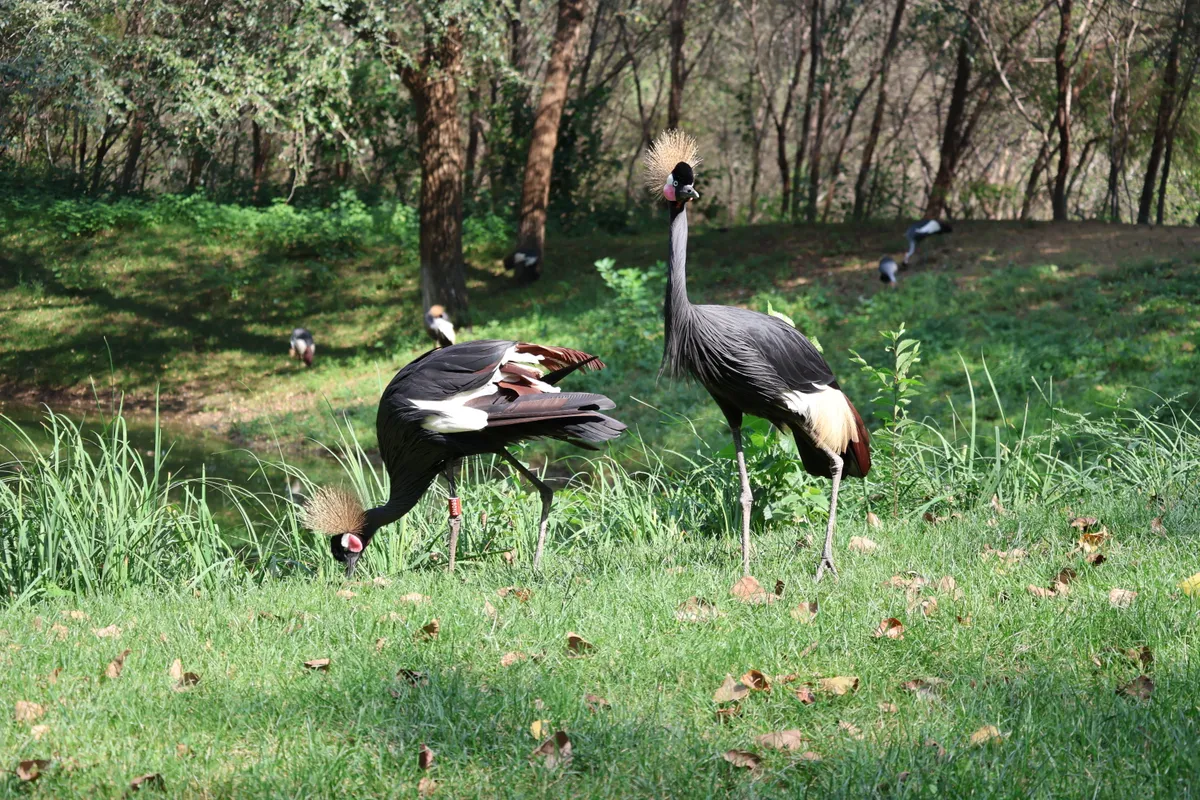
The black crowned crane is one of only two crowned cranes, both found in Africa. Its body is dark grey to black, its wings are white with brown and golden feathers, and its head carries a spray of stiff golden feathers. Red and white patches mark the cheeks, and a small red pouch hangs under the chin. Adults are about 1 meter long, stand about 104 centimeters tall and weigh about 3 to 4 kilograms.
The black crowned crane is the only kind of crane, together with its grey crowned cousin, that perches in trees. A long hind toe lets it grip branches, and the birds usually spend the night roosting in trees.
The black crowned crane eats almost anything it can find: grass tips, seeds and grain, insects such as grasshoppers, as well as snails, frogs, small reptiles and fish. Flocks often feed in rice fields and on harvested farmland.
Black crowned cranes breed in the rainy season. Pairs perform lively dances with bows, leaps and wing flapping, and build a platform of grasses and reeds in a wetland. The female usually lays two to five eggs, which hatch after 28 to 31 days, and the chicks fly at 60 to 100 days old.
Conservation
The 2019 IUCN SSC Crane Specialist Group review lists the black crowned crane as Vulnerable, with an estimated 43,000 to 70,000 birds and a decreasing trend. Its comparison of 15,000 to 20,000 birds in 1985 with about 15,000 in 2004 refers to the western subspecies, not Nigeria alone.
The same 2019 specialist-group review says black crowned cranes may have been extirpated from Nigeria and were essentially extirpated there, while birds were still sold in Nigerian markets into the 2000s. Wetland loss, droughts, dams upstream of the Hadejia-Nguru wetlands, hunting and egg collecting all contributed to the decline.
Black crowned cranes are also caught across their range to be kept as pets or ornamental birds, and many die in the process. Conservationists have called for wetland restoration, an end to hunting and egg taking, and captive breeding to help the species return.
Fun facts
- Crowned cranes are the only cranes that perch in trees, gripping branches with a long hind toe.
- In Hadejia, in northern Nigeria, the black crowned crane is known as Borin Tunke.
- Black crowned cranes dance all year round, and even young birds join in.
Other national symbols of Nigeria
- National flower
Yellow trumpet (Costus spectabilis) Costus spectabilis National symbol
The yellow trumpet is named as Nigeria's national flower on the website of the Nigerian Embassy in Israel, which notes that it appears on the coat of arms painted red; no designation act was found.
Frequently asked questions
What is the national bird of Nigeria?
The national bird of Nigeria is the black crowned crane (a widely recognized national symbol, not set by law). It is a tall, dark-bodied crane with a golden crest of stiff feathers, and it once lived in large numbers in the wetlands of northern Nigeria.
Which country has the black crowned crane as its national bird?
The black crowned crane is the national bird of Nigeria.
Why is the black crowned crane the national bird of Nigeria?
The black crowned crane is widely described as Nigeria's national bird in conservation and media sources. A 2018 Daily Trust report says it was proposed for the role around 1985, but the responsible government was unclear, the eagle on the coat of arms was later given the designation, and the cited sources do not identify a current law that designates the crane.
Is the black crowned crane endangered?
A 2019 IUCN SSC Crane Specialist Group review lists the black crowned crane as Vulnerable, with a decreasing trend. The same review says the species may have been extirpated from Nigeria; wetland loss, droughts, dams, hunting and egg collecting all contributed to the decline.
Where does the black crowned crane live?
Freshwater marshes, wet grasslands, floodplains and nearby farmland across the Sahel and Sudan savanna; in Nigeria, historically the Hadejia-Nguru wetlands.
Sources
- Daily Trust (Nigeria). Crowned Crane: The sad story of Nigeria's 'national' bird (3 February 2018).
- International Crane Foundation / IUCN SSC Crane Specialist Group. Crane Conservation Strategy (2019): Species Review, Black Crowned Crane.
- International Crane Foundation. Black Crowned Crane: species field guide.
- San Francisco Zoo docents. E & W African Crown Crane fact sheet.
- WorldAtlas. What is the National Bird of Nigeria?.
- IUCN Red List. Balearica pavonina (BirdLife International 2024, e.T22692039A240627334).
- Embassy of Nigeria, Tel Aviv: The National Flower of Nigeria: Costus Spectabilis.
- Conservation status: IUCN Red List of Threatened Species.