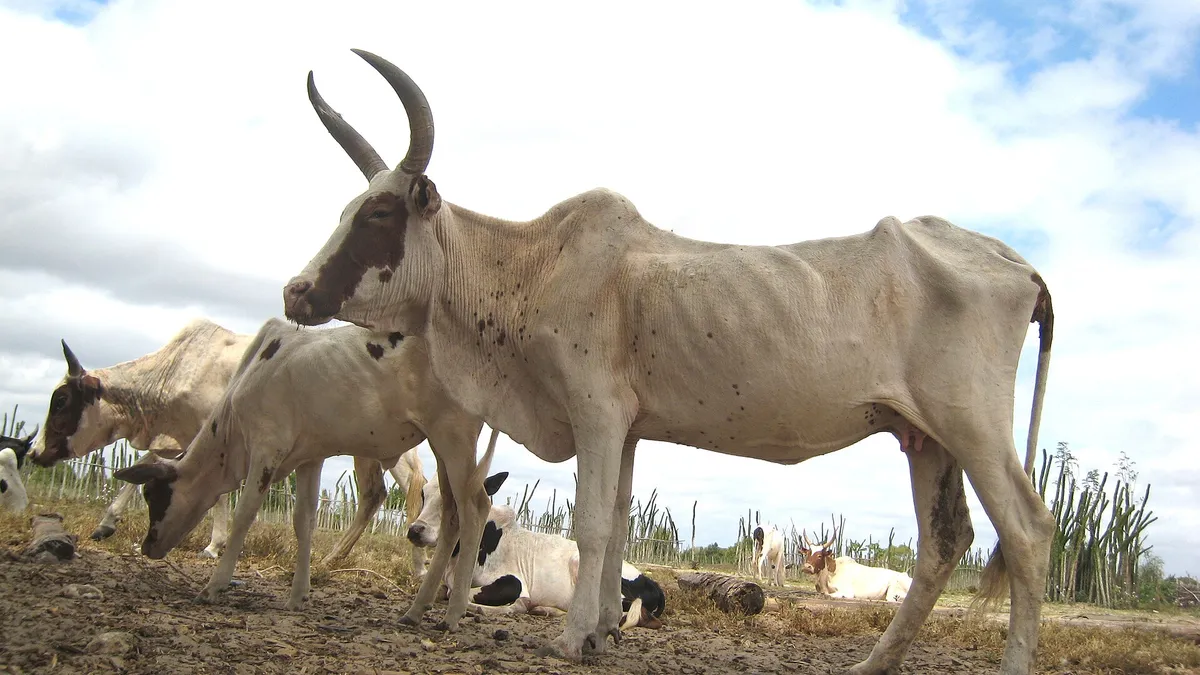
Why it represents the country
The zebu is not named as Madagascar's national animal in any law that could be found, but it is the animal on the Seal of the Republic, which is provided for by Article 4 of the Constitution. The golden seal shows the island's outline framed by the leaves of the traveller's tree, with a zebu head and a rice field just below it. The CIA World Factbook lists the traveller's palm and the zebu as Madagascar's national symbols. The ring-tailed lemur is often called the national animal in popular sources, and it is sometimes described as Madagascar's unofficial mascot, but no official source naming it was found.
The zebu has been on Madagascar's seal since the first one was introduced in 1958. After a period with a different design, it returned when the current seal was designed in 1993. On the seal, the zebu and the rice field stand for the two most important food and economic resources of the Malagasy people.
The zebu is also deeply woven into Malagasy culture. A man's wealth has traditionally been measured by the number of zebu he owns, and the most powerful families keep the largest herds. Zebu were long given as a gift when asking for a young woman's hand in marriage and to seal business deals, and they are slaughtered for festivities such as weddings and funerals.
About the animal
The zebu is a type of domestic cattle with a fatty hump over its shoulders and a loose flap of skin under the neck. The local breed, known as the Zebu of Madagascar, makes up about 85% of the island's cattle. An average Malagasy zebu weighs 300 to 400 kilograms and stands about 130 centimeters at the shoulder.
Cattle have been part of life in the Madagascar region for more than a thousand years. The oldest archaeological evidence of cattle in the region dates to the 9th to 10th centuries CE, and cattle bones become much more common from the 14th to 15th centuries. A 2022 genetic study found that the zebu of Madagascar and nearby Mayotte share mainly zebu ancestry from a mixing of cattle populations around the 12th century.
The zebu of Madagascar is well suited to the tropics. It is considered more resistant to heat stress and tick-borne diseases than imported European breeds, and its genome shows signs of selection in genes linked to skin structure, protection from UV light and the immune system.
Malagasy farmers use zebu to pull carts and plows and keep them for manure, milk and meat. A zebu cow gives about 1 to 2 liters of milk a day, and a study of Madagascar's extensive livestock systems gave the mean carcass weight of Malagasy zebu as 172 kilograms.
Conservation
The zebu is a domestic animal, so it does not have a category on the IUCN Red List. It was once said that Madagascar had as many zebu as people, but herd numbers have fallen sharply, from about 20 million animals in 2005 to 9 million in 2015. A 2022 study likewise reported about nine million cattle in Madagascar.
Because herds are kept as a family's savings and status, only about 5% of Madagascar's zebu are slaughtered each year. More than 60% of the country's land area is declared pasture.
The local zebu is valued for coping with heat and tick-borne diseases better than imported European cattle. A 2022 genome study of Malagasy zebu looked for the genes behind its adaptation to tropical conditions.
Fun facts
- A zebu appeared on Madagascar's first state seal in 1958, and a zebu head is still on the seal today.
- In the Mahafaly region of southern Madagascar, zebu skulls are placed on graves, and the more important the person was, the more skulls there are.
- The oldest archaeological evidence of cattle in the Madagascar region dates back to the 9th to 10th centuries CE.
Frequently asked questions
What is the national animal of Madagascar?
The national animal of Madagascar is the zebu (a widely recognized national symbol, not set by law). The zebu is a humped breed of domestic cattle whose head appears on Madagascar's Seal of the Republic.
Which country has the zebu as its national animal?
The zebu is the national animal of Madagascar. The zebu is also known as humped cattle.
Why is the zebu the national animal of Madagascar?
The zebu is Madagascar's best-known animal emblem: its head appears on the Seal of the Republic, where it stands with a rice field for the country's two most important food and economic resources, and the CIA World Factbook lists it as a national symbol. In Malagasy culture, the size of a family's zebu herd has long measured its wealth and status.
Where does the zebu live?
Domestic animal raised across Madagascar, mostly in large herds on open pasture, especially in the west and south.
Sources
- NewsMada. Landy Randriamanantenasoa: « Le Sceau de la République authentifie les documents d'investiture » (15 December 2023).
- Constitute Project. Madagascar's Constitution of 2010, Article 4.
- IndexMundi (CIA World Factbook data). Madagascar national symbol(s).
- MadaMagazine. The seal of Madagascar.
- MadaMagazine. Madagascar's secret emblem: the zebu.
- Détours Madagascar. Cultural emblems of Madagascar: Zebu and Rice.
- G3: Genes, Genomes, Genetics (Magnier et al. 2022). The genetic history of Mayotte and Madagascar cattle breeds mirrors the complex pattern of human exchanges in Western Indian Ocean.
- FAO. Production of the Malagasy extensive livestock (Rasambainarivo and Razafindratsita).
- Dimensions.com. Zebu (Bos taurus indicus).
- MadaMagazine. Madagascar's ring-tailed lemurs.
- Conservation status: IUCN Red List of Threatened Species.