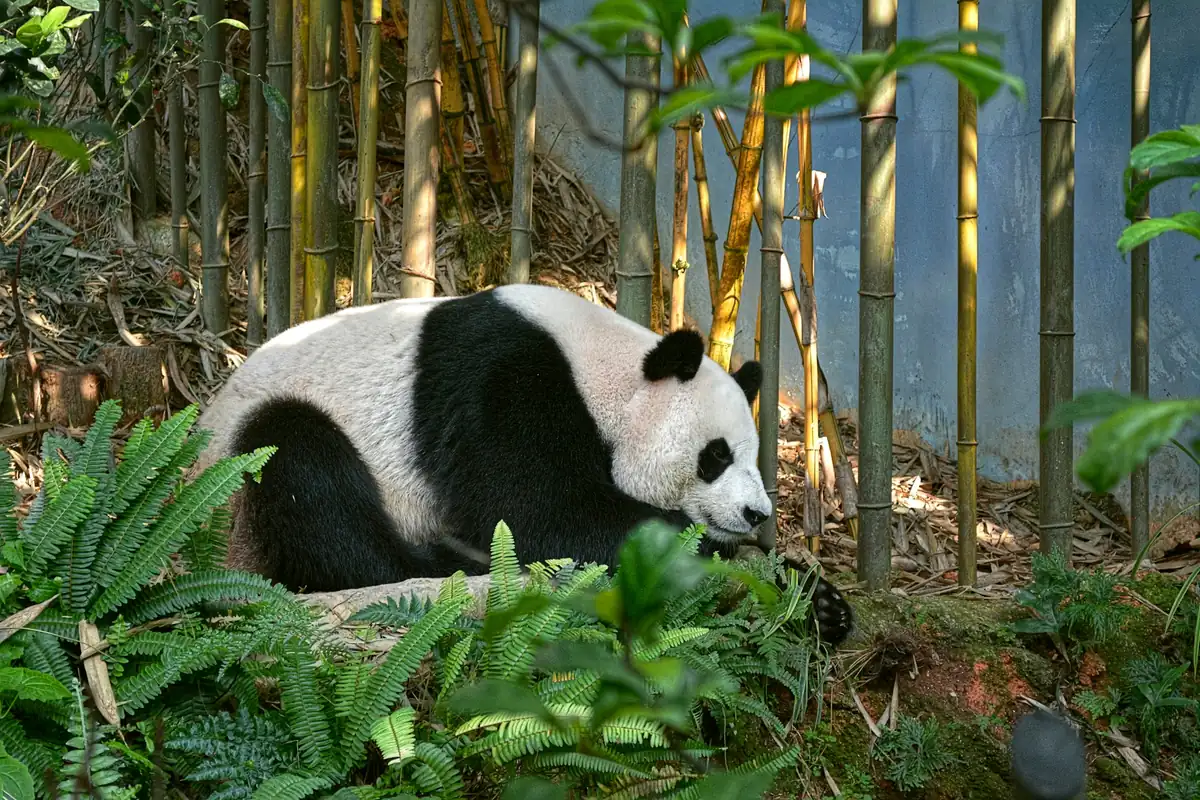
Why it represents the country
China has no law that names an official national animal, yet few symbols are as closely tied to one country as the giant panda. In Chinese it is often called a national treasure, and it is one of the country's most strictly protected species under national wildlife law. The panda appears on stamps, commemorative coins and the logos of sporting events, and it has been the face of conservation work in China for decades.
Part of the appeal is that the panda lives nowhere else in the wild. Every wild panda lives in a handful of mountain ranges in Sichuan, Shaanxi and Gansu provinces. Its gentle look, round face and slow, careful movements also make it easy to love, and that popularity has turned the panda into a powerful ambassador for protecting forests and the many other species that share them.
The panda is also a global conservation icon. When the World Wildlife Fund (now the World Wide Fund for Nature) was founded in 1961, it chose a panda for its logo, inspired by a panda named Chi Chi who lived at London Zoo. The same simple black and white design is still used today.
About the animal
The giant panda is a bear, even though it eats almost nothing but bamboo. Bamboo makes up about 99 percent of its diet. Because its digestive system is still built like a meat eater's, a panda gets little energy from each mouthful, so it spends much of the day eating, often somewhere between 10 and 16 hours. An adult can get through a large pile of stems, leaves and shoots every day and chooses different parts of the plant as the seasons change.
To grip bamboo, pandas use a so-called pseudo-thumb: an enlarged wrist bone that works a bit like an extra finger. They sit upright while feeding, holding stems in their front paws and stripping them with strong teeth and powerful jaw muscles, which give the head its round shape.
Pandas are mostly solitary. Each one keeps to its own area of forest and communicates with scent marks and calls. Females are ready to breed for only a few days each year, which is one reason pandas reproduce slowly. A newborn cub is pink, nearly hairless, blind and tiny, weighing only about 100 grams, around one nine-hundredth of its mother's weight. The cub stays with its mother for about a year and a half or more, learning where to find food and how to climb.
Despite their bulky look, pandas are good climbers and can also swim. They do not hibernate. In winter they move to lower, warmer slopes and keep eating bamboo.
Conservation
For many years the giant panda was listed as Endangered. In 2016 the IUCN Red List moved it to Vulnerable, after national surveys showed that the wild population had grown. China's fourth national survey, published in 2015, counted 1,864 wild giant pandas, up from the previous survey.
That recovery came from decades of work: protecting forests, creating a network of nature reserves, restoring bamboo habitat and breeding pandas in research centers. China has also set up the Giant Panda National Park, which links many separate reserves so that pandas can move between them more easily.
The panda is not out of danger. Wild pandas live in small, separated groups, and roads and farmland can cut them off from each other. Bamboo flowers and dies back in large areas every few decades, and a warming climate may shift where bamboo can grow. Protecting and reconnecting forests remains the key to the panda's future.
Where to see the giant panda in the wild
Wild giant pandas in China live in mountain bamboo forests of the southwest, and the Sichuan Giant Panda Sanctuaries and Foping National Nature Reserve in Shaanxi are among their best-protected strongholds.
Sichuan Giant Panda Sanctuaries
The Sichuan Giant Panda Sanctuaries, including Wolong, link reserves in the Qionglai and Jiajin Mountains that are home to more than 30 percent of the world's pandas.
Official page ↗Foping National Nature Reserve
Foping National Nature Reserve in the Qinling Mountains has 67 adult wild pandas, the highest wild panda density recorded in China.
Official page ↗
Watch wild animals from a distance, never feed them, and follow the rules and rangers of each protected area.
Fun facts
- A panda's eye patches, ears and legs are black, but its skin underneath the white fur is pale, and newborn cubs are pink.
- Giant pandas have a pseudo-thumb, an enlarged wrist bone that helps them grip bamboo stems.
- Relative to its mother, a newborn panda is one of the smallest babies of any mammal that is not a marsupial.
Frequently asked questions
What is the national animal of China?
The national animal of China is the giant panda (a widely recognized national symbol, not set by law). It is a bear with black eye patches that eats almost nothing but bamboo, and it appears on stamps, commemorative coins and the logos of sporting events.
Which country has the giant panda as its national animal?
The giant panda is the national animal of China. The giant panda is also known as panda bear.
Why is the giant panda the national animal of China?
No law names an official national animal, but the giant panda is often called a national treasure in Chinese and is one of the country's most strictly protected species. Part of its appeal is that wild pandas live nowhere else, only in a handful of mountain ranges in Sichuan, Shaanxi and Gansu provinces, and the panda has been the face of conservation work in China for decades.
Is the giant panda endangered?
The giant panda is listed as Vulnerable on the IUCN Red List; it was moved there from Endangered in 2016, after national surveys showed that the wild population had grown. China's fourth national survey, published in 2015, counted 1,864 wild giant pandas.
Where does the giant panda live?
Cool, misty bamboo forests in the mountains of central China.
Where can you see the giant panda in the wild?
Wild giant pandas in China live in mountain bamboo forests of the southwest, and the Sichuan Giant Panda Sanctuaries and Foping National Nature Reserve in Shaanxi are among their best-protected strongholds.
Sources
- Smithsonian's National Zoo and Conservation Biology Institute. Giant panda.
- WWF. Giant Panda.
- Encyclopaedia Britannica. Giant panda.
- IUCN Red List of Threatened Species. Ailuropoda melanoleuca (assessment 2016).
- IUCN World Heritage Outlook – Sichuan Giant Panda Sanctuaries.
- Shaanxi Provincial Government – Foping giant panda report (Nov 2025).
- WWF – Giant Panda.
- Conservation status: IUCN Red List of Threatened Species.