Why it represents the country
The kouprey was declared a national symbol of Cambodia in the 1960s; Animal Diversity Web says Prince Norodom Sihanouk named it the national animal in 1964. On 21 March 2005, a royal decree signed by King Norodom Sihamoni chose the animals and plants that serve as emblems of the kingdom, and it named the kouprey the national mammal, one of seven national symbols alongside a national bird, flower, tree, fruit, fish and reptile.
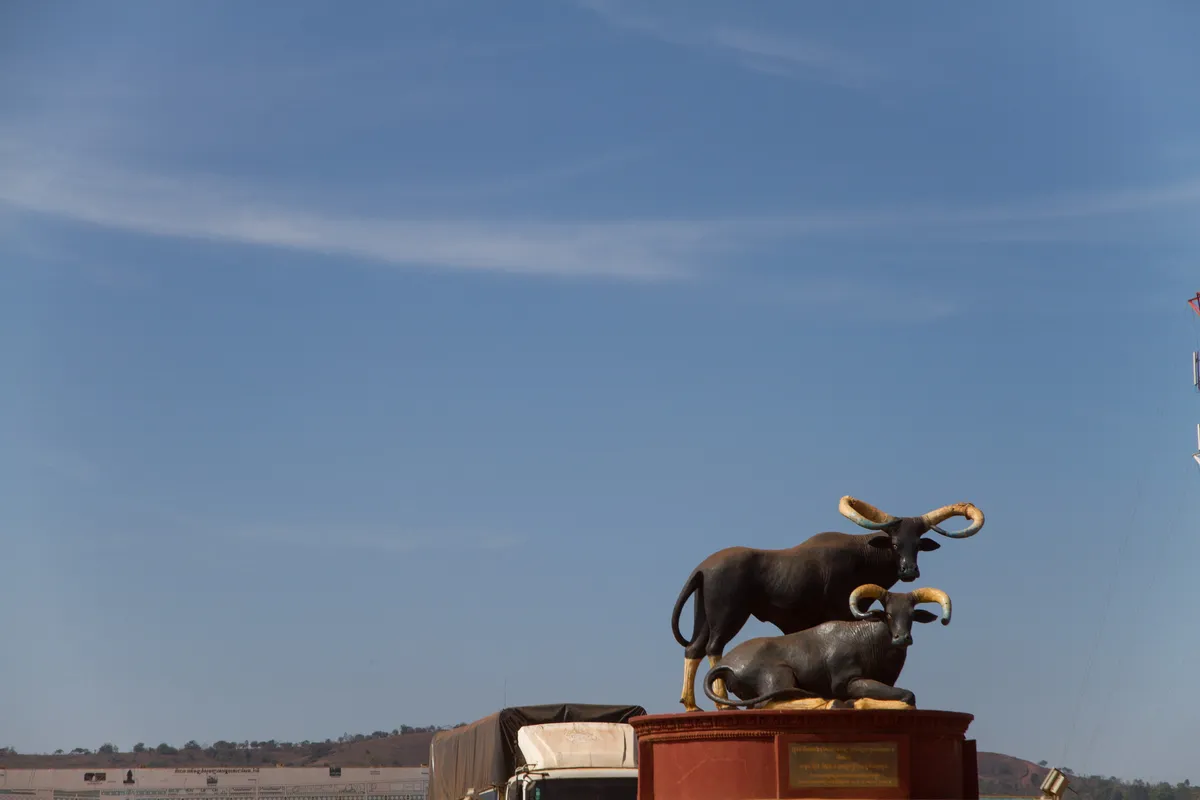
The kouprey is a familiar sight in Cambodia even though the animal itself has not been confirmed in the wild since 1969. A kouprey statue stands at the roundabout by Wat Phnom, the historic pagoda in Phnom Penh, kouprey statues line the driveway of the national zoo, and another stands in the town of Senmonorom. The animal's likeness appears on official stamps and company logos, and Kouprey is even the nickname of Cambodia's national football team.
The kouprey was only described by scientists in 1937, and most of what is known about it comes from expeditions in Cambodia in the 1950s and early 1960s. That makes it both a proud emblem of the country's forests and a reminder of how quickly a large animal can slip away.
About the animal
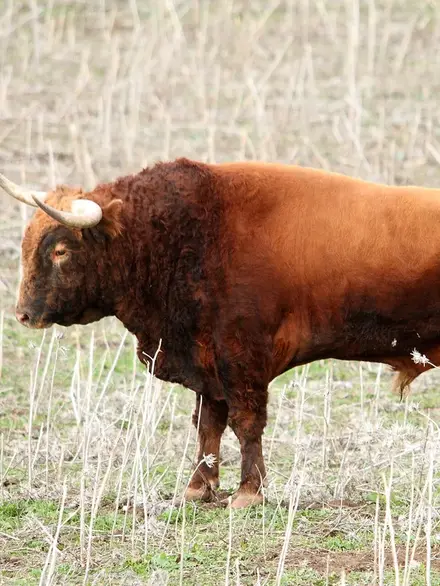
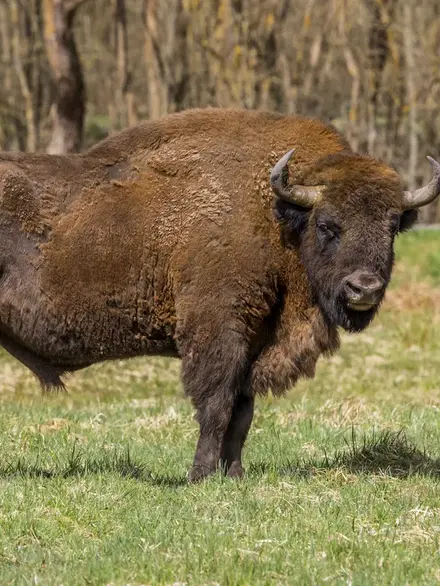
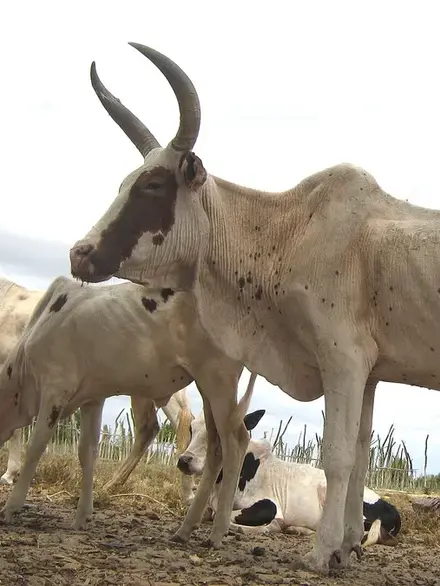
The kouprey is a wild ox, a close relative of the banteng. Adults stand about 170 to 190 centimeters at the shoulder, measure roughly 2.1 to 2.2 meters from head to rump, plus a tail of up to about one meter, and weigh around 680 to 910 kilograms. Compared with its relatives it has an unusually large dewlap, the loose fold of skin hanging from the neck, and a long tail.
Calves are reddish and turn grayer by the age of five or six months. Adult bulls are dark brown or black, and both sexes have pale lower legs that look like white socks. A bull's horns can reach about 80 centimeters and, from around three years of age, their tips split and fray. Cows also have horns, about half as long, which curve and twist upward.
The kouprey lived in open forest and grassland, often near thicker monsoon forest, and liked areas with water pools and mineral licks. It was mostly active at night and grazed on grasses and other plants. Herds were led by females, and in the dry season bulls joined them, forming groups of up to about 20 animals.
Kouprey mated in spring, and a cow usually gave birth to a single calf after a pregnancy of about eight to nine months, typically in December or January.
Conservation
The kouprey is listed as Critically Endangered (Possibly Extinct) on the IUCN Red List. The assessment estimates a decline of more than 80 percent over 30 years, mainly from hunting for meat and for horns and skulls, and says that if any survive there are almost certainly fewer than 50 mature animals. Estimates of 100 to 300 kouprey made in the late 1980s are now thought to have been too optimistic.
The last confirmed sighting of a kouprey was in 1969, in northern Cambodia. Later reports from the 1980s were never confirmed, and when the IUCN Asian Wild Cattle Specialist Group checked about 90 percent of the region's camera-trap photos in 2011, it found no images of the animal. The IUCN has not declared the kouprey extinct because some possible habitat has never been searched well enough to rule it out.
The kouprey is listed on CITES Appendix I and is legally protected in every country where it once lived. There are no kouprey in captivity, so any hope rests on wild animals. Conservationists point to the protected forests of eastern Cambodia as the most likely places for any survivors, and researchers have been reviewing old expedition records and camera-trap data to decide where to look next.
Fun facts
- The animal used to describe the kouprey as a species in 1937 was an animal living at the Vincennes Zoo in Paris, one of only two kouprey ever known in captivity.
- A kouprey bull's horn tips split and fray as it grows older, giving them a shaggy, tasseled look.
- In 2006 scientists asked whether the kouprey might be a feral hybrid rather than a true species; a 2007 study answered that it is a real species.
National bird of Cambodia: Giant ibis
Giant ibis Thaumatibis gigantea National symbol
The giant ibis is called Cambodia's national bird by the Wildlife Conservation Society and Mongabay, and is reportedly one of the national symbols designated by royal decree in 2005, but no opened source ties it to the decree text.
The giant ibis now lives mostly in northern and eastern Cambodia, with a few birds in the far south of Laos, and has vanished from its former range in Thailand. The ibis feeds in marshes, pools and seasonal water meadows inside open lowland forest, taking invertebrates, eels, small amphibians and reptiles from soft mud, and nests in large dipterocarp trees. With an estimated 194 mature birds left, the species is classed as Critically Endangered.
Other national symbols of Cambodia
- National flower
Romduol Sphaerocoryne affinis (named Mitrella mesnyi in the decree) Officially designated
The romduol was designated Cambodia's national flower by the royal decree of 21 March 2005 signed by King Norodom Sihamoni, which gave its scientific name as Mitrella mesnyi; botanists more commonly call it Sphaerocoryne affinis.
Frequently asked questions
What is the national animal of Cambodia?
The national animal of Cambodia is the kouprey (officially designated). It is a large wild ox with white legs and long curved horns, and its likeness appears on statues in Phnom Penh, on official stamps and in the nickname of the national football team.
Which country has the kouprey as its national animal?
The kouprey is the national animal of Cambodia. The kouprey is also known as forest ox or grey ox.
Why is the kouprey the national animal of Cambodia?
The kouprey was declared a national symbol of Cambodia in the 1960s, and Animal Diversity Web says Prince Norodom Sihanouk named it the national animal in 1964. On 21 March 2005, a royal decree signed by King Norodom Sihamoni named the kouprey the national mammal, one of seven national symbols alongside a national bird, flower, tree, fruit, fish and reptile.
Is the kouprey extinct?
The kouprey is listed as Critically Endangered (Possibly Extinct) on the IUCN Red List: there has been no reliable sighting since 1969, and it is most likely extinct. The IUCN has not declared it extinct because some possible habitat has never been searched well enough to rule it out, and if any survive there are almost certainly fewer than 50 mature animals.
What is the national bird of Cambodia?
The national bird of Cambodia is the giant ibis (a widely recognized national symbol, not set by law). The giant ibis is called Cambodia's national bird by the Wildlife Conservation Society and Mongabay, and is reportedly one of the national symbols designated by royal decree in 2005, but no opened source ties it to the decree text.
Sources
- Animal Diversity Web (University of Michigan Museum of Zoology). Bos sauveli (kouprey).
- Biodiversity Center of Japan, Ministry of the Environment (ESABII). Threatened Mammal Species Database: Bos sauveli (reproduces the IUCN Red List assessment).
- Eco-Business / China Dialogue. The kouprey: on the trail of Cambodia's elusive wild cattle (Anton L Delgado, 2022).
- Scroll.in / China Dialogue. The kouprey: Does Cambodia's national mammal and cultural symbol even exist anymore? (2022).
- Le Petit Journal Cambodge. Romduol, l'emblème floral du royaume du Cambodge (Pascal Médeville, 2021).
- IntoCambodia.org. Kouprey (Bos sauveli): The National Mammal of Cambodia.
- IUCN SSC Asian Wild Cattle Specialist Group. Kouprey.
- Recently Extinct Species. Bos sauveli.
- Store norske leksikon. Kouprey.
- WCS Cambodia: Nineteen Critically Endangered Giant Ibis Nests Located in Northern Plains of Cambodia (2017).
- Mongabay: Cambodia protects forest for giant ibis (2014).
- IntoCambodia.org: Tror Yorng (Giant Ibis): The National Bird of Cambodia.
- BirdLife DataZone: Giant Ibis Thaumatibis gigantea Species Factsheet.
- Le Petit Journal Cambodge: Romduol, l'emblème floral du royaume du Cambodge (2021).
- CambodgeMag: Cambodia & Nature: The Rumduol, Cambodia's national flower (2024).
- IntoCambodia.org: Romduol Flower (Mitralla mesnyi): The National Flower of Cambodia.
- Conservation status: IUCN Red List of Threatened Species.