Why it represents the country
The snow leopard is called an official symbol of Kazakhstan in the country's national snow leopard plan, which credits the idea to President Nursultan Nazarbayev, and the news site Tengrinews describes it the same way. No law or decree naming a national animal has been found: Kazakhstan's 2007 law on state symbols covers the flag, emblem and anthem, and the flag shows a soaring steppe eagle. The golden eagle, famous from Kazakh eagle hunting, is also often called the national animal, but no reliable source for that title was found.
The snow leopard is the most visible animal symbol of Almaty, Kazakhstan's biggest city. A snow leopard appears on the coat of arms of Almaty, and when a snow leopard mural in the city was painted over, residents asked for it to be painted back.
The snow leopard's image is used by many organizations, sports and tourism clubs, products and brands in Kazakhstan. A snow leopard named Irby was the official mascot of the 2011 Asian Winter Games, held in Almaty and Astana. Conservationists in Kazakhstan call it the "Lord of the Celestial Mountains" and use its symbolic status to encourage people to protect it.
About the animal
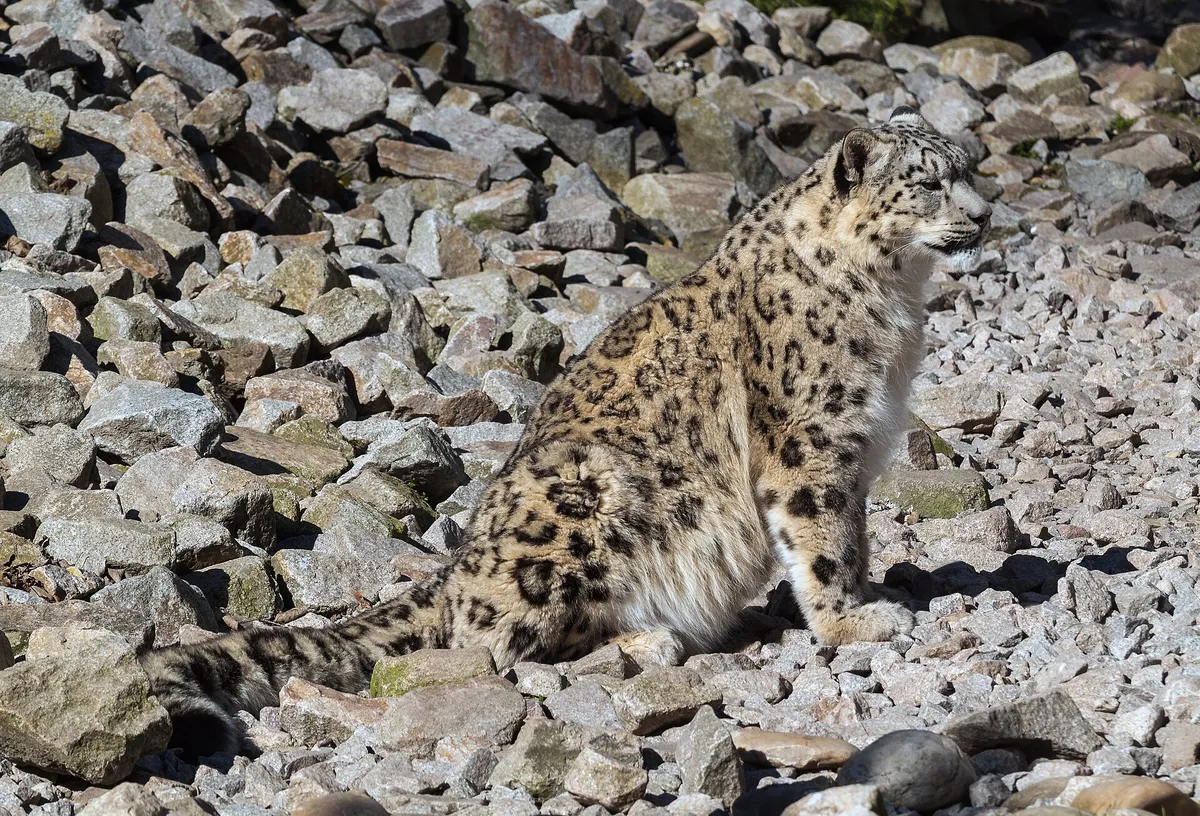
The snow leopard is a medium-sized big cat with a long, thick coat that ranges from light gray to smoky gray or creamy yellow, paler on the belly. Adults measure about 100 to 130 centimeters from nose to the base of the tail, and the tail adds another 80 to 100 centimeters. Most adults weigh about 35 to 45 kilograms.
The snow leopard is built for cold, steep terrain. Its very large paws work like snowshoes, its long tail helps it balance and can be wrapped around the body for warmth, and its large nasal cavities help it breathe cold mountain air. It lives at elevations from about 900 to 5,500 meters, most often between 3,000 and 4,500 meters.
The snow leopard hunts wild sheep and goats such as blue sheep, ibex and argali, along with smaller animals like marmots and pikas. It ranges over a large area, and some snow leopards have home ranges of up to 1,000 square kilometers.
A female snow leopard gives birth after a pregnancy of about 90 to 105 days, usually to 2 or 3 cubs. Snow leopards in captivity have lived to 21 years of age.
Conservation
The snow leopard is listed as Vulnerable on the IUCN Red List as a species. It had been listed as Endangered since 1986 and was moved to Vulnerable in the 2017 update, although the population is still thought to be declining. Between 3,920 and 6,390 snow leopards may be left in the wild across 12 countries of Central and South Asia, threatened by habitat loss, declining prey, conflict with herders and poaching.
Kazakhstan lies at the northwestern edge of the snow leopard's range and holds only about 2.7% of its world range. The country's national snow leopard plan estimated no more than 100 to 110 animals on about 50,000 square kilometers of habitat, split into five groups: Altai, Saur-Tarbagatai, Dzungarian Alatau, northern Tien Shan and western Tien Shan.
Kazakhstan's snow leopards have since increased. In 2025 the country's Red Book update estimated 152 to 189 animals, more than 20% higher than in 2019, and eleven snow leopards have been fitted with satellite collars. Also in 2025, Vice Minister of Ecology Nurken Sharbiyev said the population had more than doubled from its critical level of the 1990s to around 189.
Fun facts
- A snow leopard named Irby was the official mascot of the 2011 Asian Winter Games in Almaty and Astana.
- Snow leopards cannot roar; instead they make a high-pitched yowl.
- A snow leopard's tail can be 80 to 100 centimeters long, nearly as long as its body.
Frequently asked questions
What is the national animal of Kazakhstan?
The national animal of Kazakhstan is the snow leopard (a widely recognized national symbol, not set by law). The snow leopard is a pale, thick-furred big cat of Kazakhstan's high mountains, and it appears on the coat of arms of Almaty.
Which country has the snow leopard as its national animal?
The snow leopard is the national animal of Kazakhstan.
Why is the snow leopard the national animal of Kazakhstan?
The snow leopard is described as an official symbol of Kazakhstan in the country's national snow leopard plan, which credits the idea to President Nursultan Nazarbayev. It also appears on the emblem of Almaty, but no law naming a national animal has been found.
Is the snow leopard endangered?
The snow leopard is listed as Vulnerable on the IUCN Red List as a species. In Kazakhstan its numbers have grown to an estimated 152 to 189 animals in 2025.
Where does the snow leopard live?
Rugged high mountains; in Kazakhstan, the Altai, Saur-Tarbagatai, Dzungarian Alatau and the northern and western Tien Shan.
Sources
- Global Snow Leopard and Ecosystem Protection Program (GSLEP). National Snow Leopard Ecosystem Protection Priority in Kazakhstan (NSLEP).
- Tengrinews. Rare animal recorded on camera in Kazakhstan (2014).
- Caspian Post. Snow Leopards: How a Symbol of Kazakhstan Turned into a Vulnerable Species (2023).
- The Astana Times. Kazakhstan Updates Red Book List: Who's In, Who's Out in 2025.
- Kazakhstan Today (via Kazinform). Kazakhstan's snow leopard population more than doubles (2025).
- Mongabay. Snow leopards no longer Endangered, but still in decline and in need of urgent conservation measures (2017).
- Animal Diversity Web (University of Michigan). Uncia uncia (snow leopard).
- Snow Leopard Trust. Snow leopard facts.
- Adilet (Republic of Kazakhstan legal database), unofficial translation via zakon.uchet.kz. Constitutional Law On State Symbols of the Republic of Kazakhstan, 4 June 2007, No. 258.
- Conservation status: IUCN Red List of Threatened Species.