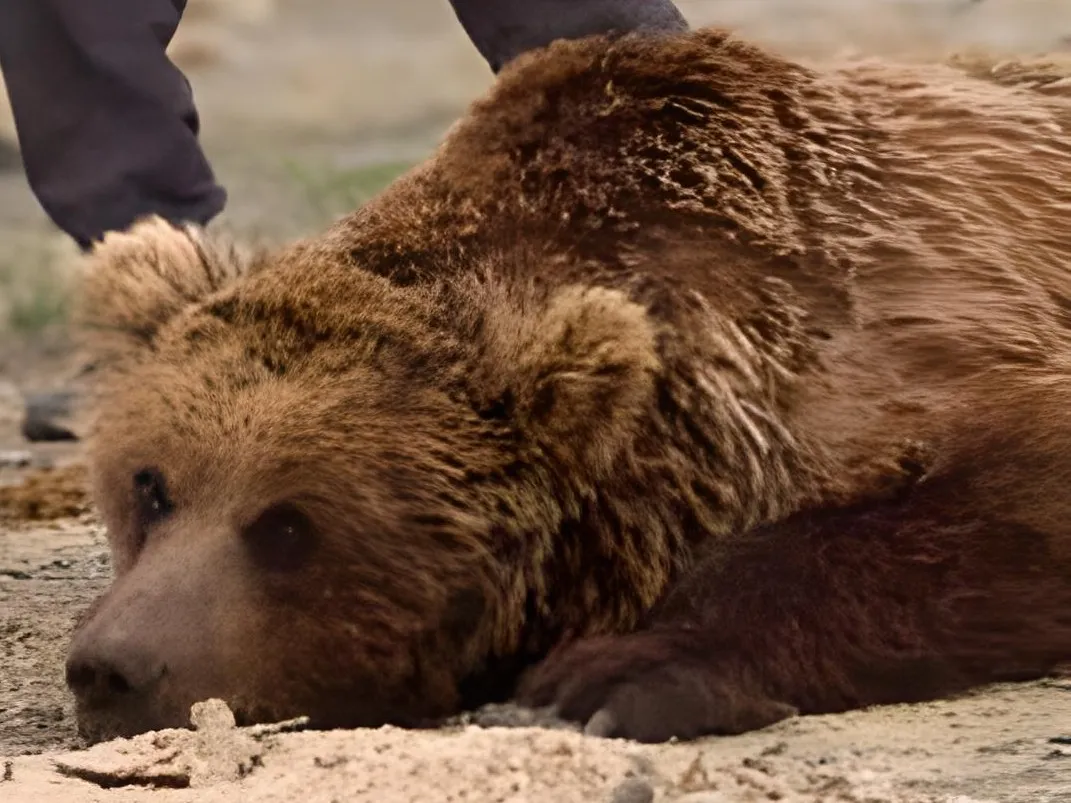
Why it represents the country
The Gobi bear was declared Mongolia's national pride animal by Government Resolution No. 437 of 13 December 2023. The resolution, signed by Prime Minister L. Oyun-Erdene and Environment and Tourism Minister B. Bat-Erdene, links the decision to the 2023–2025 "Visit Mongolia" years and tells three ministries to make the bear known at home and abroad. The idea came from President U. Khurelsukh and was first announced by the environment minister in September 2023.
The Gobi bear, called mazaalai in Mongolian, has long been regarded as a national treasure. A decree banned hunting it in 1953, its whole range was placed under state protection in 1975, and the President declared 2013 the Year of the Gobi Bear, the first time a country had made such a decree for any bear. The government later declared 2024 a year for protecting the mazaalai.
The Gobi bear is not Mongolia's only animal emblem. A 2012 government resolution named the saker falcon the national pride bird, and the takhi, or Przewalski's horse, which has been returned to the Mongolian steppe since 1992, is called Mongolia's national symbol by the Dutch foundation that brought it back to Hustai.
About the animal
The Gobi bear is a small, desert-dwelling brown bear. Adult males weigh about 96 to 138 kilograms and females about 51 to 78 kilograms, much less than most other brown bears; a large, healthy male caught in spring 2023 weighed only 135 kilograms. Mongolian sources give an average body length of about 150 centimeters and a height of 80 to 92 centimeters.
Scientists still debate whether the Gobi bear is a separate subspecies or a distinct population of the brown bear. Mongolian sources call it Ursus arctos gobiensis, while the Convention on Migratory Species lists it as Ursus arctos isabellinus. Its tracks were recorded at the Shar Khuls oasis by the Russian botanist V. F. Ladygin as early as 1899.
The Gobi bear lives in one of the harshest places any bear calls home, where temperatures range from about 46°C in summer to −34°C in winter. The bears keep to three oasis areas in the Great Gobi A Strictly Protected Area, each with seven or more springs, about 70 to 100 kilometers apart. One GPS-tracked female used a home range of 514 square kilometers, while two males that moved between oases each ranged over nearly 2,500 square kilometers.
The Gobi bear eats mostly plants, such as wild rhubarb, roots and the berries of Nitraria shrubs, along with insects such as grasshoppers and the occasional rodent; it eats little meat. It hibernates through the winter, and females give birth in their dens. Zoologists say Gobi bears do not live in pairs or groups and are rarely seen together.
Conservation
As a species, the brown bear is listed as Least Concern on the IUCN Red List, but the Gobi bear has no separate global IUCN assessment. Mongolia's Red Book lists the Gobi bear as Critically Endangered, and it is included in Appendix I of CITES and, since 2017 at Mongolia's request, in Appendix I of the Convention on Migratory Species.
The Gobi bear population is tiny. DNA studies of hair estimated 22 to 31 bears in 2008–2009 and 27 to 40 in 2013, with far more males than females. A later genetic study counted 52 bears, and in 2025 about 50 were thought to remain. The bear's range has also shrunk: bears disappeared from the northern part of it between 1940 and 1970.
The Gobi bear faces scarce water and food, which climate change may worsen, as well as livestock grazing in the reserve's buffer zone, mining and coal trucks, and illegal small-scale gold mining near water points. Rangers restore water sources and put out extra food for a short time in spring, after hibernation, and in autumn, and a China-aided project from 2018 to 2024 supported research and training in the reserve.
Fun facts
- No Gobi bears are known to live in captivity anywhere in the world.
- In 2016, a GPS-collared Gobi bear travelled more than 140 kilometers west into China's Tian Shan mountains, stayed about a month and then came back.
- Gobi bears are so hard to catch that in 12 years of research, only 21 were captured.
National bird of Mongolia: Saker falcon
Saker falcon Falco cherrug Officially designated
Government of Mongolia Resolution No. 101 of 20 October 2012 declared the saker falcon (shonkhor) Mongolia's national pride bird, as a symbol of the Mongolian people's vigor, freedom and unity, to mark the 850th anniversary of the birth of Chinggis Khaan.
The saker falcon breeds across the Palearctic from eastern Europe to western China, including Mongolia, and hunts close to the ground over steppe, semi-desert and other open grassy country. Built for rapid acceleration and sharp turns, the saker specialises in mid-sized rodents, especially ground squirrels. Rather than building its own, the falcon takes over the old nests of other birds on cliffs or in copses, and the IUCN Red List classes it as Endangered.
Frequently asked questions
What is the national animal of Mongolia?
The national animal of Mongolia is the Gobi bear (officially designated). The Gobi bear, or mazaalai, is a small brown bear that survives around the desert oases of the Great Gobi A Strictly Protected Area in south-western Mongolia.
Which country has the Gobi bear as its national animal?
The Gobi bear is the national animal of Mongolia. The same species is also the national animal of Finland and Russia.
Why is the Gobi bear the national animal of Mongolia?
The Gobi bear was declared Mongolia's national pride animal by Government Resolution No. 437 of 13 December 2023, on the initiative of President U. Khurelsukh. Mongolians have long regarded this rare desert bear as a national treasure, and hunting it has been banned since 1953.
Is the Gobi bear endangered?
As a species, the brown bear is listed as Least Concern on the IUCN Red List, but the Gobi bear has no separate global assessment and is listed as Critically Endangered in Mongolia's Red Book. Only about 50 Gobi bears are thought to remain.
Where does the Gobi bear live?
Desert mountains and oases; in Mongolia, the Atas Bogd, Shar Khuls and Tsagaan Bogd oasis areas of the Great Gobi A Strictly Protected Area.
What is the national bird of Mongolia?
The national bird of Mongolia is the saker falcon (officially designated). Government of Mongolia Resolution No. 101 of 20 October 2012 declared the saker falcon (shonkhor) Mongolia's national pride bird, as a symbol of the Mongolian people's vigor, freedom and unity, to mark the 850th anniversary of the birth of Chinggis Khaan.
Sources
- Legal Info of Mongolia (legalinfo.mn). Government Resolution No. 437 of 13 December 2023: On declaring the Mazaalai bear a national pride animal.
- MONTSAME. Campaign to Promote the National Animal of Mongolia Mazaalai Bear Held at the National Garden Park (2025).
- Asia News Network. Mazaalai bear to be "Mongolian National Pride Animal" (2023).
- News.MN. Mazaalai named as a "Mongolian National Pride Animal" (2023).
- Convention on Migratory Species (UNEP/CMS/COP12/Doc.25.1.5). Proposal for the inclusion of the Gobi bear (Ursus arctos isabellinus) on Appendix I of the Convention (submitted by Mongolia, 2017).
- Convention on Migratory Species. Species page: Ursus arctos isabellinus (Gobi bear).
- Conservation Frontlines (Jerrold Belant). To Save the World's Rarest Bear (2023).
- Mongolian Economy. "Үндэсний бахархалт амьтан" мазаалай баавгай / Gobi bear (2025).
- Xinhua. Feature: Guardians of Gobi bear -- China's role in Mazaalai conservation in Mongolia (2025).
- GoGo Mongolia. Why we need to save the Gobi bear, Mazaalai (2016).
- Embassy of Mongolia in the United States. Taxonomy proves Mazaalai bear to be independent subspecies (2014).
- International Association for Bear Research and Management (IBA). Ursus arctos (Brown bear).
- San Diego Zoo Wildlife Alliance Library. Brown bear fact sheet: population & conservation status.
- Legal Info of Mongolia (legalinfo.mn). Government Resolution No. 101 of 20 October 2012: On declaring the national pride bird.
- Foundation for the Preservation and Protection of the Przewalski Horse (FPPPH). Back to the wild.
- Legal Info of Mongolia: Government Resolution No. 101 (20 October 2012), On declaring the national pride bird.
- National Geographic (Costas Christ, 14 November 2012): Happy 850th, Genghis (saker falcon proclaimed Mongolia's first national bird).
- Mongolian National Broadcaster (2015): Saker Falcon identified as the national bird of Mongolia in 2012.
- BirdLife DataZone: Saker Falcon Falco cherrug Species Factsheet.
- Conservation status: IUCN Red List of Threatened Species.