Why it represents the country
The steppe eagle is named as Egypt's national animal by BBC Wildlife and by Egyptian media. No law naming a national animal has been found, so the title rests on tradition and on the eagle's place in Egypt's national emblem. The steppe eagle is also the national bird of Kazakhstan.
The steppe eagle is often called the Saladin eagle, after Saladin, the first Sultan of Egypt, for whom it was a prized bird. Accounts differ on whether the eagle he used as his personal standard was a steppe eagle or a golden eagle. A prominent eagle on the western wall of the Cairo Citadel, built in his time, is seen as a sign of his emblem.
The Eagle of Saladin has been Egypt's coat of arms since the mid-1980s. The eagle is usually shown in gold, and the ribbon it holds bears the country's name, Arab Republic of Egypt. The same emblem appears in the middle of the white stripe of the national flag.
About the animal
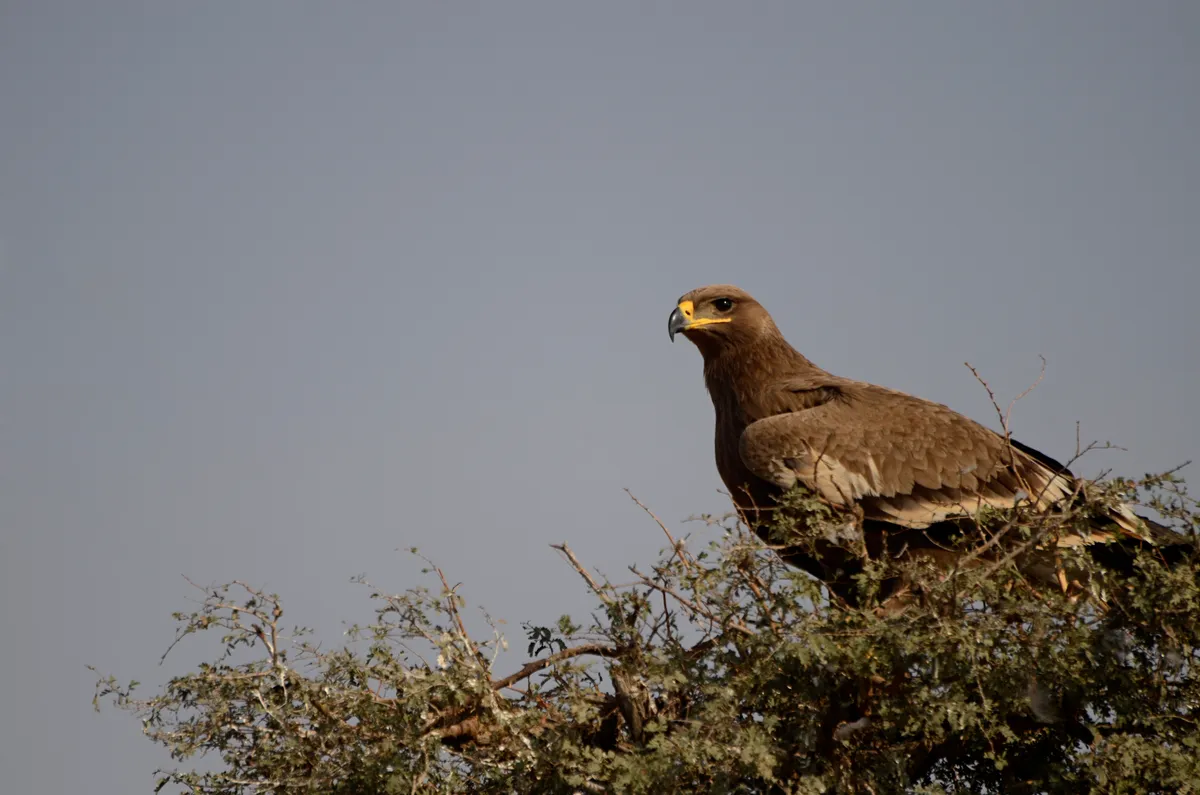
The steppe eagle is a large, mostly dark-brown eagle. Adults measure about 60 to 81 centimeters from bill to tail, have a wingspan of about 165 to 214 centimeters and weigh about 2 to 4.9 kilograms. Two subspecies are recognized.
The steppe eagle eats mainly small mammals such as ground squirrels and voles, along with birds, reptiles and insects such as termites and locusts. It often hunts on the ground, sometimes waiting beside a rodent burrow, and it also feeds on carrion and will steal prey from other birds of prey. In winter, flocks of more than 100 birds can gather.
The steppe eagle is unusual among eagles because it often nests on the ground, since much of its breeding habitat has no trees. The nest is a fairly flat pile of sticks, sometimes placed on a slight rise. The female lays one to three eggs, which are incubated for about 45 days, and the young leave the nest at about 55 to 65 days old.
The steppe eagle lives across parts of Europe, Asia, the Middle East and Africa, and many travel long distances between their breeding grounds and wintering areas. It is a visitor rather than a resident in Egypt: steppe eagles are a common sight in Egyptian skies from about October to January.
Conservation
The steppe eagle is listed as Endangered on the IUCN Red List. Its population is estimated to have fallen by more than 50 percent over three generations, and the decline is expected to continue unless threats are reduced. In 2017 the species was added to Appendix I of the Convention on Migratory Species.
The main threats to the steppe eagle are the loss of steppe grassland to farming and overgrazing, electrocution and collisions on power lines, poisoning and illegal killing. Because many nests are on the ground, eggs and chicks are also exposed to grass fires, predators and trampling by livestock.
Egypt lies on a major flyway for migrating birds of prey. On 13 and 14 March 1985, birdwatchers counting from a rooftop in Suez recorded 5,721 steppe eagles in a single day and estimated that more than 7,500 passed that day. Egypt has no program dedicated only to the steppe eagle, but it runs a wider program to protect migratory birds that includes training for monitors and tourism workers and a bird observation point in Sharm El Sheikh.
Fun facts
- Unlike many eagles, the steppe eagle often nests right on the ground, because much of its home has no trees.
- In a single day in March 1985, more than 7,500 steppe eagles were estimated to have flown past Suez.
- In Mongolia, some steppe eagle nests have been built mostly from the bones of large mammals instead of sticks.
Other national symbols of Egypt
- National flower
Lotus (Egyptian white water lily) Nymphaea lotus National symbol
The lotus is described as Egypt's national flower by Egyptian Streets, owing to its long importance in Egyptian history and modern culture; no official designation was found.
Frequently asked questions
What is the national bird of Egypt?
The national bird of Egypt is the steppe eagle (a widely recognized national symbol, not set by law). It is a large dark-brown eagle of open country, linked to the Eagle of Saladin that appears on Egypt's coat of arms and in the middle of the national flag, and thousands pass over Egypt on migration each year.
Which country has the steppe eagle as its national bird?
The steppe eagle is the national bird of Egypt.
Why is the steppe eagle the national bird of Egypt?
The steppe eagle is named as Egypt's national animal by BBC Wildlife and Egyptian media, and with no law naming a national animal, the title rests on tradition and on the eagle's place in the national emblem. It is often called the Saladin eagle, after Saladin, the first Sultan of Egypt, for whom it was a prized bird, and the Eagle of Saladin has been Egypt's coat of arms since the mid-1980s. Accounts differ, however, on whether the eagle Saladin used as his standard was a steppe eagle or a golden eagle.
Is the steppe eagle endangered?
The steppe eagle is listed as Endangered on the IUCN Red List, and its population is estimated to have fallen by more than 50 percent over three generations. The main threats are the loss of steppe grassland, power lines, poisoning and illegal killing.
Where does the steppe eagle live?
Open steppe, grassland, desert and savanna; in Egypt a migrant and winter visitor.
Sources
- BBC Wildlife (Discover Wildlife). What is Egypt's national animal?.
- Egyptian Streets. Egypt's national animal is under threat of extinction.
- The Peregrine Fund. Steppe Eagle.
- Ornithological Society of the Middle East (Sandgrouse 39, 2017). High day count of migrating Steppe Eagles Aquila nipalensis in Suez, Egypt, March 1985.
- Flags of the World (CRW Flags). Egypt.
- CMS Raptors MOU. Aquila nipalensis.
- Egyptian Streets: Beyond simple blooms – discovering the meanings behind Egyptian flowers (17 Aug 2023).
- Conservation status: IUCN Red List of Threatened Species.