Why it represents the country
Guatemala has placed the resplendent quetzal at the heart of its national symbols. Decree No. 33 of 18 November 1871 created the country's coat of arms, and a quetzal stands at its top, above a scroll with the date 15 September 1821. The coat of arms sits in the center of the blue and white national flag, so the quetzal appears on every Guatemalan flag. On the coat of arms the bird stands for independence and freedom.
The bird also gave its name to the country's money. Guatemala's currency has been called the quetzal since 1925.
The quetzal was prized long before the modern country existed. The Maya and other peoples of the region valued the male's long, shining green feathers, and in those societies only people of high rank were allowed to wear them. That long history helps explain why the quetzal is still the first bird many people link with Guatemala.
About the animal
The resplendent quetzal belongs to the trogon family. It lives in the mountain cloud forests of Central America, from southern Mexico to western Panama, usually at elevations of about 900 to 3,200 meters. These forests are cool and damp and often wrapped in cloud, and their trees are covered in moss and ferns.
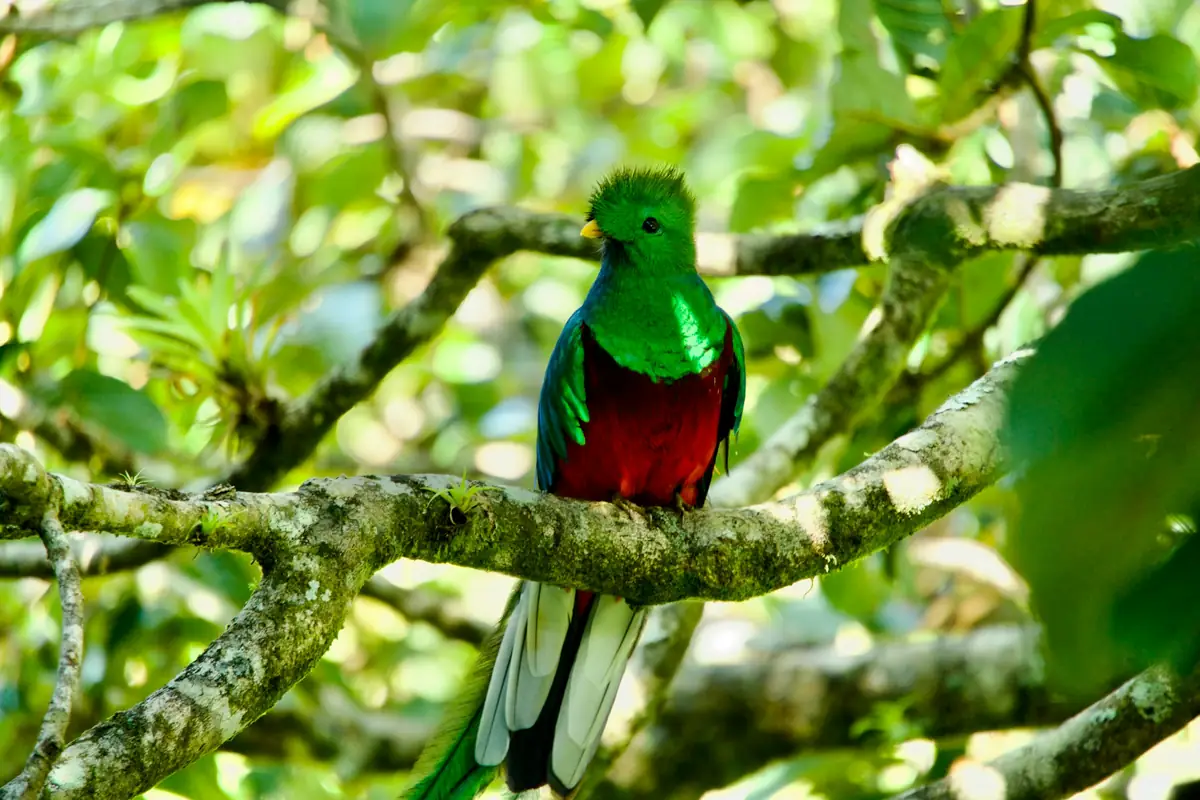
The male is one of the most striking birds in the Americas. His head, back and wings are a shining green that can look blue or gold as the light changes, and his breast and belly are bright red. For the breeding season he grows two long, trailing feathers above the tail that can add up to about 65 centimeters to his length. The female is duller, with a bronze-green head, less red below and no long streamers.
Quetzals eat mostly fruit, especially small wild avocados and other fruits of the laurel family. They swallow the fruit whole and later bring up the large seed, which drops far from the parent tree. In this way quetzals help spread the seeds of dozens of kinds of forest trees. They also eat insects, frogs, lizards and snails.
Pairs nest in holes in rotting tree trunks, which they dig out or enlarge themselves. The female lays one to three pale blue eggs, and both parents take turns sitting on them for about 17 to 19 days. The male usually incubates during the day and the female at night. The chicks leave the nest about three weeks after hatching.
Conservation
The resplendent quetzal is listed as Near Threatened on the IUCN Red List. The world population is estimated at roughly 20,000 to 50,000 birds, and numbers are thought to be falling.
The main threat is the loss and breaking up of cloud forest. Forests are cleared for farms, pasture and settlements, and the quetzal depends on large areas of forest. It needs old, decaying trees for nest holes and many kinds of fruiting trees for food, so small, isolated patches of forest are not enough.
Guatemala and its neighbors protect cloud forests in national parks and reserves where quetzals live, and birdwatching visitors give local people another reason to keep these forests standing. Protecting the national bird also protects the many other plants and animals that share its mountain forests.
Where to see the resplendent quetzal in the wild
Wild resplendent quetzals in Guatemala live in highland cloud forest, including the Sierra de las Minas Biosphere Reserve and the Biotopo del Quetzal in Baja Verapaz.
Biotopo del Quetzal (Mario Dary Rivera)
The Biotopo del Quetzal is a university reserve created in 1976 in the cloud forest of the Sierra de las Minas, Baja Verapaz, to conserve the quetzal.
Sierra de las Minas Biosphere Reserve
Sierra de las Minas Biosphere Reserve holds an estimated 60 percent of Guatemala's remaining cloud forest, and UNESCO names the quetzal among the wildlife observed there.
Official page ↗
Watch wild animals from a distance, never feed them, and follow the rules and rangers of each protected area.
Fun facts
- Guatemala's currency, the quetzal, is named after the national bird.
- The male's long green streamers are not true tail feathers but covert feathers that grow over the tail and can add about 65 centimeters to his length.
- Quetzals swallow small wild avocados whole and later bring up the seed, helping forest trees spread.
Other national symbols of Guatemala
- National flower
White nun orchid (monja blanca) Lycaste skinneri var. alba Officially designated
Guatemala's government declared the monja blanca, a white orchid, the national flower by presidential decree on 11 February 1934.
Frequently asked questions
What is the national bird of Guatemala?
The national bird of Guatemala is the resplendent quetzal (officially designated). The resplendent quetzal is a cloud-forest bird of the trogon family whose male has shining green plumage, a red breast and long tail streamers, and it stands on the coat of arms in the center of Guatemala's flag and gives the currency, the quetzal, its name.
Which country has the resplendent quetzal as its national bird?
The resplendent quetzal is the national bird of Guatemala.
Why is the resplendent quetzal the national bird of Guatemala?
Decree No. 33 of 18 November 1871 created Guatemala's coat of arms with a quetzal at its top, where the bird stands for independence and freedom, and because the coat of arms sits in the center of the flag, the quetzal appears on every Guatemalan flag. The bird was prized long before the modern country existed: the Maya and other peoples of the region valued the male's shining green feathers, which only people of high rank could wear.
Is the resplendent quetzal endangered?
The resplendent quetzal is listed as Near Threatened on the IUCN Red List, with a world population estimated at roughly 20,000 to 50,000 birds that is thought to be falling. The main threat is the loss and breaking up of the cloud forests it depends on.
Where does the resplendent quetzal live?
Cool, misty cloud forests in the mountains of Central America.
Where can you see the resplendent quetzal in the wild?
Wild resplendent quetzals in Guatemala live in highland cloud forest, including the Sierra de las Minas Biosphere Reserve and the Biotopo del Quetzal in Baja Verapaz.
Sources
- Encyclopaedia Britannica. Quetzal.
- IUCN Red List of Threatened Species. Pharomachrus mocinno (assessment 2023).
- Agencia Guatemalteca de Noticias – ¿Cuáles son los símbolos patrios de Guatemala?.
- UNESCO Man and the Biosphere Programme – Sierra de las Minas.
- INGUAT – Biotopo Universitario para la Conservación del Quetzal Mario Dary Rivera.
- Conservation status: IUCN Red List of Threatened Species.