Why it represents the country
Chile's coat of arms, adopted in 1834, is held up by two animals of the Andes: a huemul on one side and an Andean condor on the other. Each of them wears a golden naval crown on its head.
The huemul lives only in the southern Andes of Chile and Argentina, so it is a truly local choice. Its name comes from Mapudungun, the language of the Mapuche people. It is a quiet, sturdy deer of cold forests and mountain valleys, and for many Chileans it stands for the wild south of the country.
Chile has also given the huemul strong legal protection. On 30 June 2006 a decree declared it a natural monument (monumento natural) of Chile. The deer on the coat of arms is therefore also one of the country's most carefully protected wild animals.
About the animal
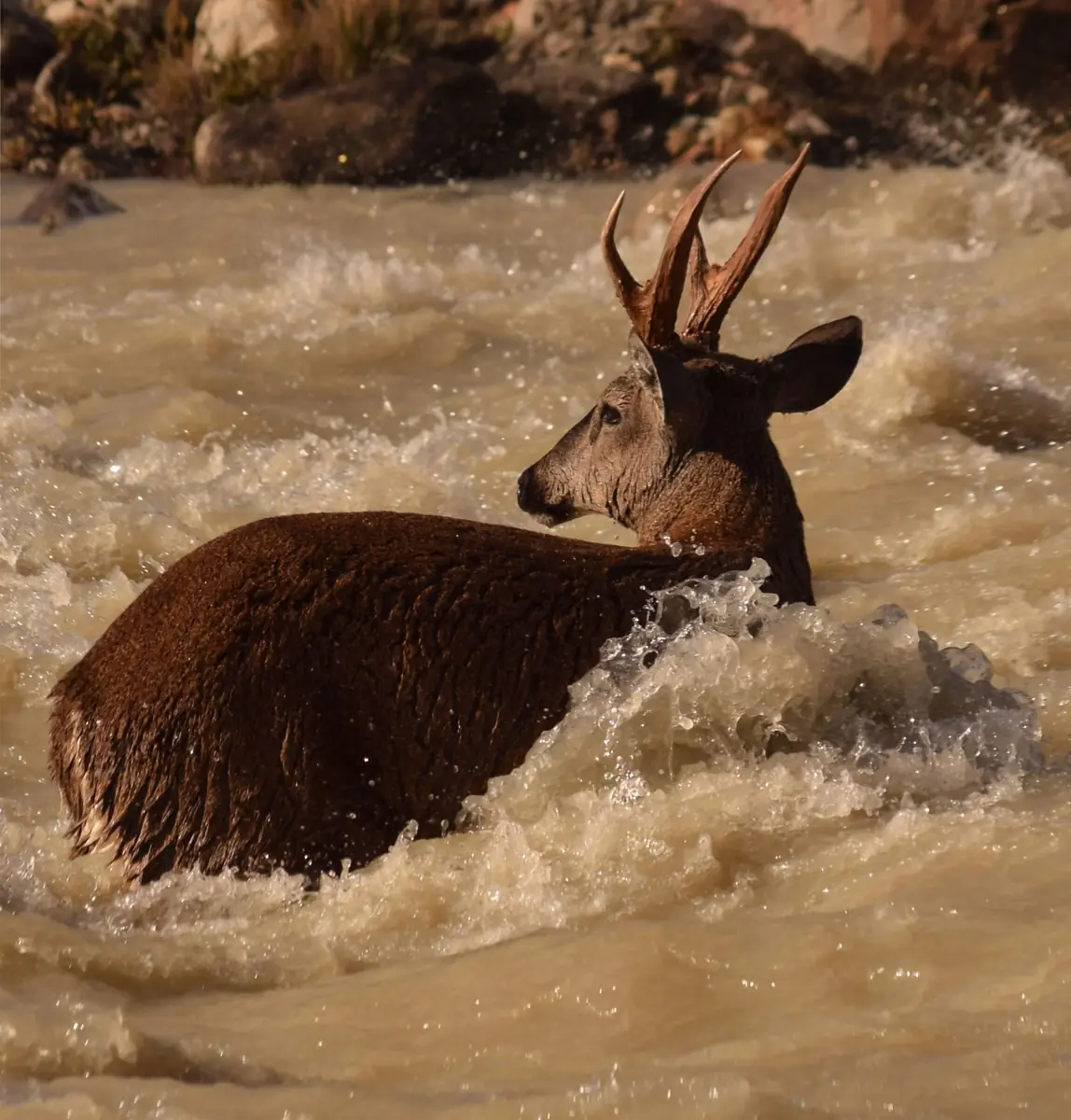
The huemul is a medium-sized deer with a thick, sturdy body and fairly short legs, well suited to steep and rough ground. Adults usually weigh about 40 to 100 kilograms, and males are a little larger than females. The dense coat is light brown, with white on the underside of the tail, on parts of the legs and around the eyes. Males have dark markings on the face and grow antlers that fork once, into a Y shape.
Huemules live in the mountains and forests of southern Chile and Argentina, from sea level up to about 3,000 meters. Many spend the summer higher on the slopes and move down to lower, sheltered areas in winter, usually traveling only a few kilometers.
They are plant eaters that feed on the leaves, twigs, fruits and flowers of shrubs and small plants, and they are most active around dawn and dusk. In spring and summer they usually live alone or in very small groups of two or three, and in winter the groups can be larger.
Mating takes place in late summer and autumn. After a pregnancy of about seven months, the female gives birth to a single fawn in late spring, around November or December. In the wild, huemules live for about 10 years on average.
Conservation
The huemul is listed as Endangered on the IUCN Red List. Estimates suggest that only about 1,500 remain in the wild, roughly 1,000 in Chile and 500 in Argentina, split into many small and separate groups. A 2022 report from Argentina's national research council, CONICET, counted fewer than 500 huemules in that country, spread in about 60 small groups over some 1,800 kilometers of the Andes.
Its decline has several causes. Forests have been cleared and broken up, and roads now cross its range. Cattle and other livestock compete for food and can pass on parasites, and introduced red deer also compete with it. Poaching still kills some animals.
Chile protects the huemul as a natural monument and in more than ten national parks, and Argentina protects it in its own parks. Researchers monitor the remaining groups, and captive breeding has been used to try to support wild numbers. Saving the deer on the coat of arms depends on keeping large, connected areas of wild land in the south.
Where to see the huemul in the wild
Wild huemul in Chile survive in small, scattered populations in the southern Andes, and Cerro Castillo National Park in the Aysén Region is the place in the country where huemul are easiest to see.
Cerro Castillo National Park
Cerro Castillo National Park holds roughly 120 huemul, about a tenth of Chile's population, and huemul are often seen crossing the roads near the park.
Official page ↗
Watch wild animals from a distance, never feed them, and follow the rules and rangers of each protected area.
Fun facts
- On Chile's coat of arms, both the huemul and the condor wear a golden naval crown.
- Male huemules grow simple antlers that fork once into a Y shape.
- Huemules often move only a few kilometers between their summer and winter areas, going up the mountains in summer and down in winter.
National bird of Chile: Andean condor
Andean condor Vultur gryphus National symbol
The Andean condor stands beside the huemul on Chile's coat of arms, adopted by law in 1834, and is regarded as Chile's national bird.
The Andean condor ranges along western South America from western Venezuela to Tierra del Fuego, favouring wide open country where food is easy to spot from the air. With a wingspan of about 3.2 metres, the longest of any land bird, and a weight of up to 15 kilograms, the condor rides warm air rising off cliff faces and can soar for hours with little effort. Andean condors feed mainly on carrion.
Other national symbols of Chile
- National flower
Chilean bellflower (copihue) Lapageria rosea Officially designated
Chile declared the copihue, long seen as the symbolic flower of the nation, its national flower by Decree No. 62 of 1977.
Frequently asked questions
What is the national animal of Chile?
The national animal of Chile is the huemul (a widely recognized national symbol, not set by law). It is a stocky, medium-sized deer of the steep, forested mountain slopes of the southern Andes, and it stands on Chile's coat of arms beside the Andean condor.
Which country has the huemul as its national animal?
The huemul is the national animal of Chile. The huemul is also known as south Andean deer, southern guemal or Chilean huemul.
Why is the huemul the national animal of Chile?
The huemul holds up Chile's coat of arms, adopted in 1834, together with the Andean condor. It lives only in the southern Andes of Chile and Argentina, so it is a truly local choice, and for many Chileans it stands for the wild south of the country. In 2006 a decree also declared it a natural monument of Chile.
Is the huemul endangered?
The huemul is listed as Endangered on the IUCN Red List, and only about 1,500 are thought to remain in the wild, roughly 1,000 in Chile and 500 in Argentina, split into many small, separate groups. Forest clearing, roads, competition from livestock and introduced red deer, and poaching have all driven its decline.
Where does the huemul live?
Steep, forested mountain slopes and valleys of the southern Andes.
What is the national bird of Chile?
The national bird of Chile is the Andean condor (a widely recognized national symbol, not set by law). The Andean condor stands beside the huemul on Chile's coat of arms, adopted by law in 1834, and is regarded as Chile's national bird.
Where can you see the huemul in the wild?
Wild huemul in Chile survive in small, scattered populations in the southern Andes, and Cerro Castillo National Park in the Aysén Region is the place in the country where huemul are easiest to see.
Sources
- Animal Diversity Web, University of Michigan. Hippocamelus bisulcus: Chilean huemul.
- IUCN Red List of Threatened Species. Hippocamelus bisulcus (assessment 2016).
- Ley Chile (BCN) – Ley S/N de 26-JUN-1834 (escudo de armas).
- Ministerio de Relaciones Exteriores de Chile – Emblemas nacionales.
- Animal Diversity Web: Vultur gryphus (Andean condor).
- Ley Chile (BCN) – Decreto 62, Ministerio del Interior, 24-FEB-1977.
- CONAF – Parque Nacional Cerro Castillo.
- Mongabay Latam – Huemul hospital in Chile (Feb 2026).
- Conservation status: IUCN Red List of Threatened Species.