Why it represents the country
Germany's national emblem is the Bundesadler, or federal eagle: a black, single-headed eagle with a red beak, tongue and claws on a gold shield. It was officially set out in an announcement by Federal President Theodor Heuss on 20 January 1950, which closely followed the wording and design used by the Weimar Republic after 1919. The rules fix only a few things, such as one head turned to the eagle's right and no crown.
The eagle has stood for German rulers since the early Holy Roman Empire, about a thousand years ago. Heraldic eagles are drawn in a stylized way, and the official rules describe only the emblem, not a kind of bird. Even federal institutions draw it differently. The eagle in the Bundestag's plenary hall, based on one made by the sculptor Ludwig Gies for the parliament in Bonn, is so plump that Germans nicknamed it the fat hen.
Of the real birds, the golden eagle is the one most often connected with the Bundesadler. The Bavarian State Office for the Environment notes that many countries, including the Federal Republic of Germany, have chosen it as their heraldic animal. Some writers argue for the white-tailed eagle instead, so the golden eagle is best seen as a traditional choice rather than an official one.
About the animal
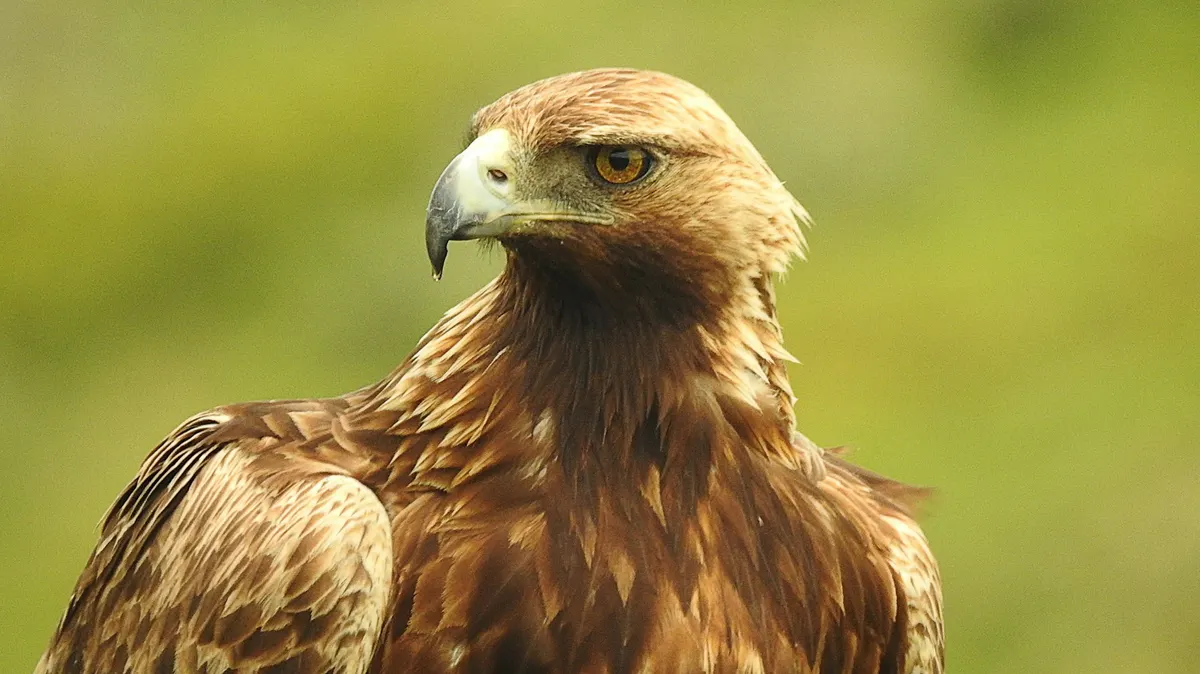
The golden eagle is a large, dark brown eagle with golden feathers on the back of its head and neck, which give it its name. Its wings can span up to about 2.3 meters. Females are clearly bigger than males and can weigh around 6 kilograms. Unlike sea eagles, golden eagles have legs feathered all the way down to the toes, and their huge yellow feet carry powerful talons.
Golden eagles hunt over open ground, often gliding low along slopes to surprise their prey. In the Alps they catch marmots, mountain hares and birds such as grouse and ptarmigan, and sometimes the young of chamois. They also eat carrion, especially in winter. When diving after prey they can reach very high speeds.
The species lives across much of the Northern Hemisphere, from North America through Europe and North Africa to Russia, Central Asia and Japan. Germany's golden eagles are part of the population that lives along the Alps.
Pairs hold large territories and nest on cliff ledges or sometimes in tall trees, often keeping several nests and using them in turn. The female lays one to four eggs, usually two, and both parents incubate them for about 40 to 45 days. Usually only one or two chicks survive, and they leave the nest at about three months old.
Conservation
The golden eagle is listed as Least Concern on the IUCN Red List. BirdLife International estimates there are 85,000 to 160,000 mature golden eagles in the world, and the overall population is considered stable.
In Germany the picture is very different. Systematic persecution brought the golden eagle close to extinction by the end of the 19th century. Today the country's only golden eagles live in the Bavarian Alps. Between 2000 and 2020 their numbers stayed at about 38 to 42 occupied territories, according to the Bavarian State Office for the Environment, which has monitored them closely since 1998.
Bavarian golden eagles raise few young. On average a pair produces only about 0.3 fledged chicks a year, about half the average of 0.6 found elsewhere in Central Europe. Experts think competition between eagles for territories and changes in alpine habitat may be part of the reason, but the causes are not well understood. Disturbance from aircraft near nests can also make pairs give up breeding.
Fun facts
- Germans nicknamed the plump eagle in the Bonn parliament the fat hen, and its shape lives on in the Bundestag in Berlin.
- Golden eagles have feathers all the way down their legs to their toes.
- The golden eagle is also the national bird of Mexico.
Frequently asked questions
What is the national bird of Germany?
The national bird of Germany is the golden eagle (a widely recognized national symbol, not set by law). It is a large, dark brown eagle named for the golden feathers on the back of its head and neck, and in Germany it lives only in the Bavarian Alps.
Which country has the golden eagle as its national bird?
The golden eagle is the national bird of Germany. The same species is also the national bird of Mexico.
Why is the golden eagle the national bird of Germany?
Germany's emblem, the Bundesadler or federal eagle, is a heraldic eagle, and the official rules of 1950 describe only the emblem, not a kind of bird. Of the real birds, the golden eagle is the one most often connected with it: the Bavarian State Office for the Environment notes that many countries, including Germany, have chosen it as their heraldic animal, although some writers argue for the white-tailed eagle instead.
Is the golden eagle endangered?
The golden eagle is listed as Least Concern on the IUCN Red List, with an estimated 85,000 to 160,000 mature birds worldwide and a stable overall population. In Germany, where persecution brought it close to extinction by the end of the 19th century, it now survives only in the Bavarian Alps, at about 38 to 42 occupied territories between 2000 and 2020.
Where does the golden eagle live?
High mountains, cliffs and open alpine country; in Germany only the Bavarian Alps.
See also: Most Popular Dog Breeds in Germany (2025)
Sources
- Deutscher Bundestag. Der Bundesadler.
- Bayerisches Landesamt für Umwelt. Artenhilfsprogramm Steinadler.
- Encyclopaedia Britannica. Golden eagle.
- IUCN Red List of Threatened Species. Aquila chrysaetos (assessment 2021).
- Conservation status: IUCN Red List of Threatened Species.