Why it represents the country
Ireland has never officially chosen a national animal. Its official emblem is the harp, and many Irish symbols come from custom rather than from law. When people do name a national animal, the one most often chosen is the Irish hare, which wildlife writers describe as Ireland's unofficial national animal.
The hare has a strong claim. It is a subspecies of the mountain hare that lives nowhere else in the world, and it is the only member of the hare and rabbit family that is native to Ireland. Fossil remains show that it has been on the island since the end of the last ice age, about 12,900 years ago, so it is one of Ireland's oldest surviving mammals.
The hare also has a place in Irish culture. When the new Irish state planned its first coins, a committee led by the poet W. B. Yeats chose native animals as the designs. The threepence coin, first issued in 1928, showed a hare designed by the artist Percy Metcalfe, and it stayed in use until decimal coins replaced it in 1971.
About the animal
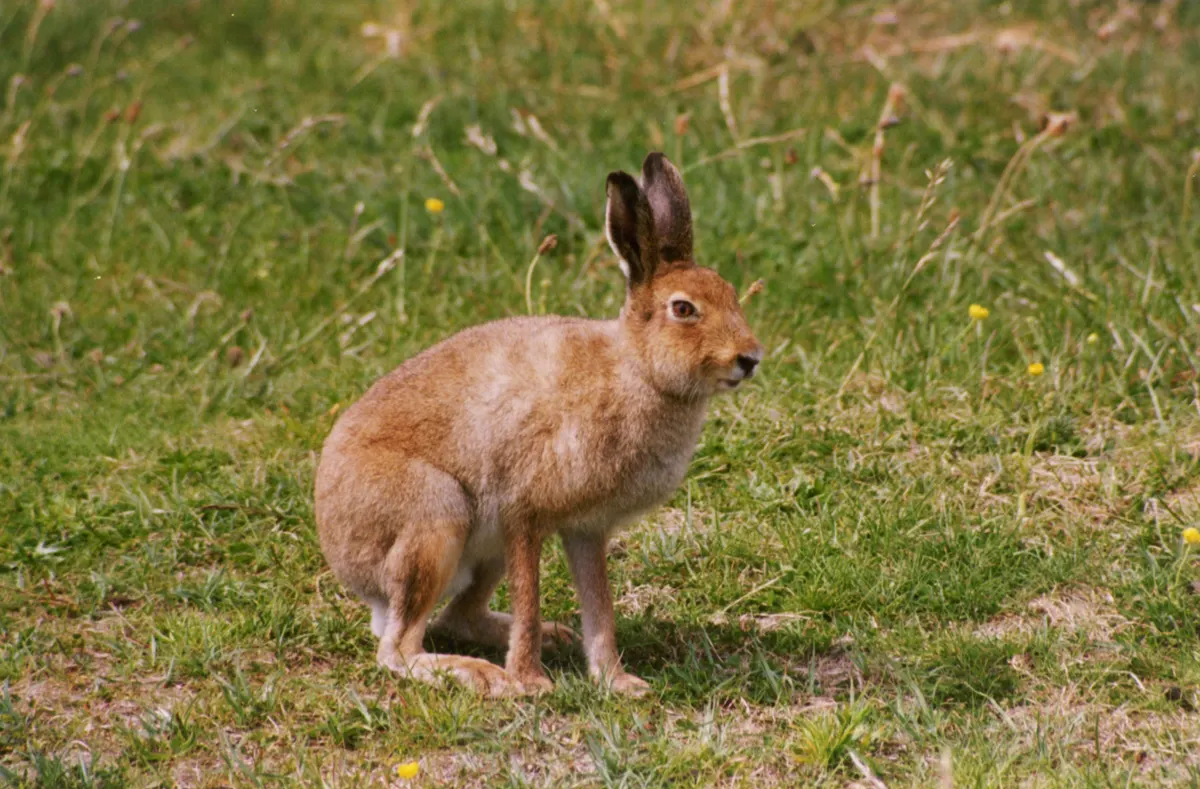
The Irish hare is about 52 to 62 centimeters long and weighs about 3 to 3.6 kilograms, and females are often a little larger than males. Its coat is usually russet brown, with a white tail and a white underside. Unlike most other mountain hares, it rarely turns white in winter, although some Irish hares grow large white patches.
Irish hares live in many kinds of open country, from coastal dunes to farmland, bogs and mountaintops. A national survey found that much of the population lives on pasture farmland. Hares do not dig burrows. They rest in a shallow hollow in the ground called a form, usually hidden in rushes, heather or a hedge.
They feed mainly on grasses, along with heather and sedges where those grow, and they are most active at night. Females are dominant over males all year round. The famous "boxing" matches seen in fields in spring are usually a female fending off a male that is following her too closely.
A female can have two or three litters a year, with one to four young, called leverets, in each. After a pregnancy of about 50 days, the leverets are born above ground, fully furred and with their eyes open. Their mother visits to feed them only once a day, around dusk, and they are weaned at about three weeks. Only about one in five survives its first year.
Conservation
The mountain hare as a whole is listed as Least Concern on the IUCN Red List, and the Irish hare has also been assessed as Least Concern in Ireland. Hare numbers can swing a lot from year to year. A survey for the National Parks and Wildlife Service estimated about 233,000 hares in the Republic of Ireland in 2006 and about 535,000 in 2007, and old hunting records suggest hares were more common in the 19th and early 20th centuries than they are now.
The main threats are changes in farming, such as heavier machinery, more livestock and fields with fewer kinds of grasses, and the introduced brown hare. Brown hares compete with Irish hares for food and space, can carry a disease called European brown hare syndrome, and sometimes interbreed with them, which threatens the Irish hare's unique genetic identity.
The Irish hare has been legally protected in the Republic of Ireland since 1930 and is covered by the Wildlife Acts and the EU Habitats Directive, although hunting and coursing are still allowed under license. Keeping varied grassland, hedges and rough corners on farms gives hares the food and cover they need.
Fun facts
- The Irish hare is the only member of the hare and rabbit family that is native to Ireland.
- Hare "boxing" is usually a female fending off an over-eager male.
- One of Ireland's first coins, the 1928 threepence, had a hare on it.
Frequently asked questions
What is the national animal of Ireland?
The national animal of Ireland is the Irish hare (a widely recognized national symbol, not set by law). It is a russet-brown hare with a white tail and underside, a subspecies of the mountain hare found only on the island of Ireland, and it once appeared on the Irish threepence coin.
Which country has the Irish hare as its national animal?
The Irish hare is the national animal of Ireland.
Why is the Irish hare the national animal of Ireland?
Ireland has never officially chosen a national animal (its official emblem is the harp), but when people name one, the Irish hare is the most common choice. It lives nowhere else in the world, it is the only member of the hare and rabbit family native to Ireland, and it has been on the island for about 12,900 years. It also has a place in Irish culture: a committee led by W. B. Yeats chose native animals for the new state's first coins, and the threepence first issued in 1928 showed a hare.
Is the Irish hare endangered?
The mountain hare as a whole, the species the Irish hare belongs to, is listed as Least Concern on the IUCN Red List, and the Irish hare has also been assessed as Least Concern in Ireland. Its main threats are changes in farming and the introduced brown hare, which competes with it and sometimes interbreeds with it.
Where does the Irish hare live?
Farmland, grassland, bogs, coastal dunes and mountains.
Sources
- BBC Wildlife (Discover Wildlife). What's the national animal of Ireland?.
- Vincent Wildlife Trust. Irish hare.
- National Parks and Wildlife Service (Ireland). Status of hares in Ireland (Irish Wildlife Manuals No. 30, 2007).
- IUCN Red List of Threatened Species. Lepus timidus (assessment 2025).
- Conservation status: IUCN Red List of Threatened Species.