Why it represents the country
Denmark has changed its national bird once. In 1960 the Ministry of Education named the skylark as the national bird. Then in 1984 viewers of the Danish television program Dus med dyrene voted for a new one, and the mute swan, called knopsvane in Danish, took the title. It is a popular choice rather than one set by law.
The swan has deep roots in Danish culture. Hans Christian Andersen's fairy tale The Ugly Duckling, published in 1843, tells of a grey chick who is mocked by the other birds but grows up to be a beautiful swan. The story is known around the world, and many people link the swan with Andersen and with Denmark.
Swans are also easy to see across the country. Denmark has many shallow bays, fjords and lakes, and in these waters mute swans are a familiar sight all year. For many Danes the calm white bird gliding across the water is a natural symbol of their country.
About the animal
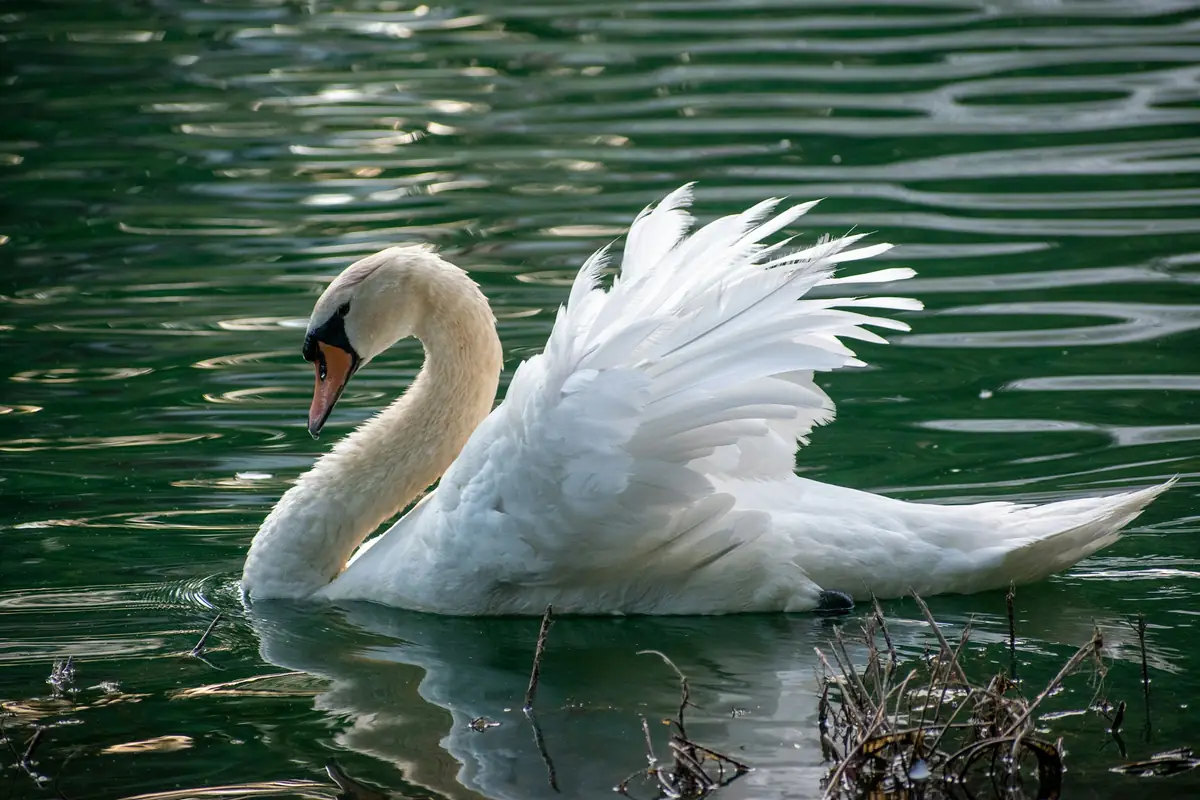
The mute swan is one of the heaviest flying birds. It measures about 145 to 160 centimeters from bill to tail, and it is the heaviest bird in Denmark, with some large males weighing up to about 16 kilograms. Adults are pure white with an orange bill and a black knob at the base of the bill, which is larger in males. The knob gives the bird its Danish name, knopsvane, meaning knob swan.
Despite its English name, the mute swan is not silent. It is quieter than other swans, but it hisses when threatened and makes soft grunting and snorting sounds. In flight its wings make a loud, rhythmic humming that can be heard from far away.
Mute swans feed mainly on water plants. They dip their long necks under the surface, or tip up with their tails in the air, to reach plants growing on the bottom, so they need shallow water with plenty of underwater vegetation.
Pairs usually stay together for many years. They build a large nest of reeds and other plants near the water's edge, and both parents defend it fiercely. The chicks, called cygnets, are covered in grey-brown down, and young birds keep brownish feathers for their first year. This grey youth is exactly what inspired Andersen's story.
Conservation
The mute swan is listed as Least Concern on the IUCN Red List. It is common across much of Europe and has also been introduced to other parts of the world.
In Denmark the swan's recovery is a good example of how protection works. By the time it was protected from hunting in 1926, only three or four breeding pairs were left in the country, according to the Danish national encyclopedia. After protection the population grew quickly, reaching about 4,000 pairs by the late 1970s and about 4,500 pairs in 2019.
Today the swan's main needs are clean, shallow waters with healthy plant growth. Pollution that clouds the water can kill the underwater plants swans eat, and swans can be hurt by collisions with power lines, by lead fishing weights and by bird flu outbreaks. Clean water and healthy lakes and fjords help swans and many other water birds.
Fun facts
- Before the mute swan, Denmark's national bird was the skylark, chosen in 1960.
- The mute swan is the heaviest bird in Denmark, and large males can weigh up to about 16 kilograms.
- Mute swans are not really mute: they hiss and snort, and their wingbeats make a loud humming sound in flight.
Frequently asked questions
What is the national bird of Denmark?
The national bird of Denmark is the mute swan (a widely recognized national symbol, not set by law). It is one of the heaviest flying birds and the heaviest bird in Denmark, pure white with an orange bill and a black knob at its base.
Which country has the mute swan as its national bird?
The mute swan is the national bird of Denmark.
Why is the mute swan the national bird of Denmark?
In 1984 viewers of the Danish television program Dus med dyrene voted for the mute swan, called knopsvane in Danish, replacing the skylark that the Ministry of Education had named in 1960. The swan has deep roots in Danish culture through Hans Christian Andersen's fairy tale The Ugly Duckling, and it is a familiar sight all year on Denmark's shallow bays, fjords and lakes.
Is the mute swan endangered?
The mute swan is listed as Least Concern on the IUCN Red List. In Denmark only three or four breeding pairs were left when it was protected from hunting in 1926, and the population has since grown to about 4,500 pairs in 2019.
Where does the mute swan live?
Lakes, fjords, coastal bays and slow rivers with shallow water.
See also: Most Popular Dog Breeds in Denmark (2025)
Sources
- Lex.dk (Den Store Danske). Nationalfugl.
- Lex.dk (Den Store Danske). Knopsvane.
- IUCN Red List of Threatened Species. Cygnus olor (assessment 2025).
- Conservation status: IUCN Red List of Threatened Species.