Why it represents the country
Norway chose its national bird through a radio poll. In 1963 listeners of the national broadcaster NRK voted, and the white-throated dipper, called fossekall in Norwegian, won. The choice is a popular tradition rather than a law. The dipper was seen as a bird that captured the character of Norway's varied nature.
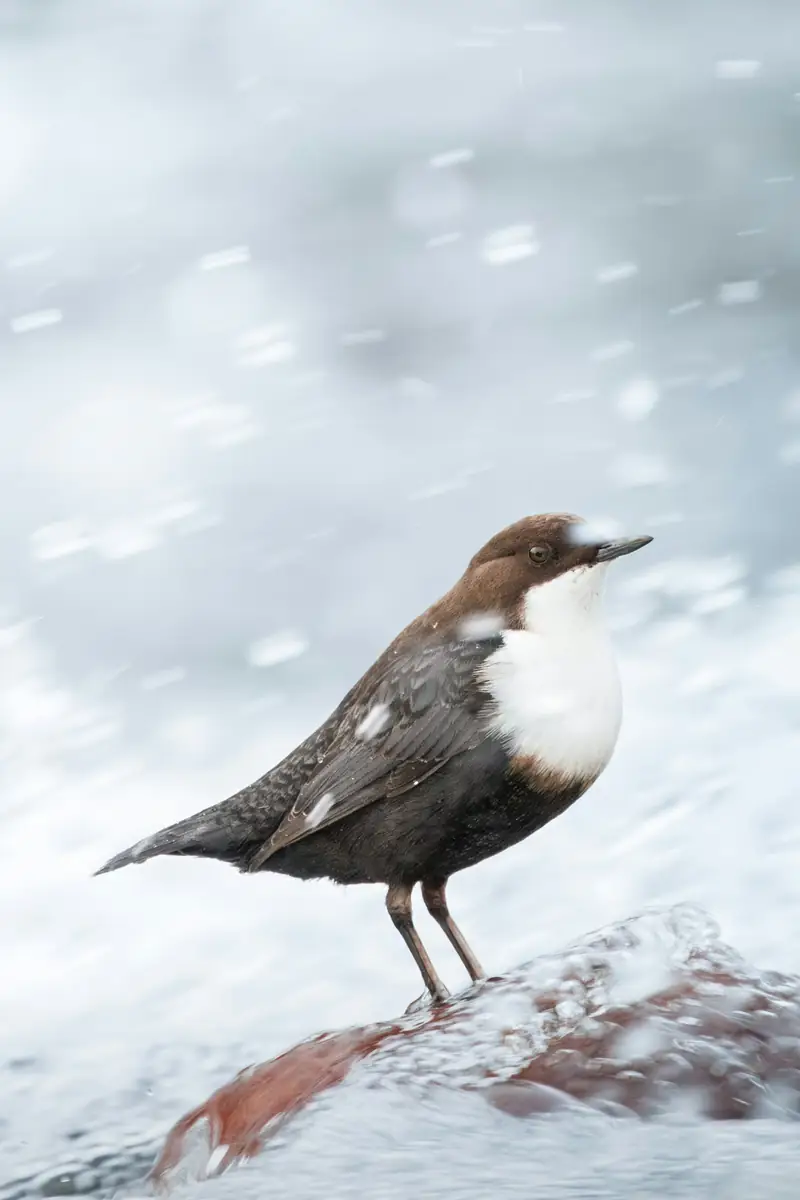
The Norwegian name fossekall means something like waterfall fellow, and it fits. Norway is a country of steep valleys, rushing streams and waterfalls, and the dipper lives right beside them, often standing on a wet rock in the spray. It breeds across the whole country, from the coast up into the bare mountains.
The dipper is also a bird of all seasons. Many stay in Norway through the winter, feeding in stretches of river that do not freeze, and dippers can be heard singing even on cold winter days. For a country with long winters, a small bird that keeps going in icy water is an easy one to admire.
About the animal
The white-throated dipper is a plump, short-tailed bird about the size of a starling, around 17 to 20 centimeters long and weighing roughly 45 to 75 grams. It is dark brown and blackish, with a bright white throat and breast. When it stands on a rock it bobs up and down, and this constant dipping movement gives it its English name.
The dipper is the only songbird in Europe that feeds underwater. It wades into fast water or dives in, then uses its wings to swim, almost as if flying under the surface. It can also grip the stream bed and walk along the bottom with its head down, searching for food. Dense, oily feathers keep it waterproof, and it can stay underwater for up to about half a minute or more.
Its food is mostly the larvae of aquatic insects, such as caddisflies and mayflies, along with small snails, crustaceans and sometimes tiny fish. Because it needs so many water insects, a dipper is a good sign that a stream is clean.
Pairs build a round nest of moss and dry leaves with an entrance on the side, often in a crack in a rock, under a bridge or behind a waterfall, where the spray keeps it damp. The female lays about 3 to 6 white eggs. The chicks leave the nest about three weeks after hatching.
Conservation
The white-throated dipper is listed as Least Concern on the IUCN Red List. It is widespread in the mountains and hills of Europe, North Africa and Asia, and Norway has a large breeding population, estimated at around 10,000 to 40,000 pairs according to the Norwegian national encyclopedia.
The dipper depends on clean, fast-flowing water. Pollution and acid rain can kill the insects it feeds on, and dams, water pipes and straightened rivers can change or remove the rushing stretches it needs. In very hard winters, when rivers freeze over, some Norwegian dippers move to Sweden, Denmark or Germany to find open water.
Because it is so sensitive to water quality, the dipper is useful to scientists. Where dippers thrive, the river is usually healthy. Protecting clean rivers and waterfalls in Norway helps both the national bird and the many other animals that share these waters.
Where to see the white-throated dipper in the wild
Wild white-throated dippers in Norway occur throughout the country along clear, fast-flowing streams and rivers, where they dive for aquatic insects and often nest in the spray of waterfalls.
Watch wild animals from a distance, never feed them, and follow the rules and rangers of each protected area.
Fun facts
- The dipper is the only European songbird that regularly swims and feeds underwater.
- Its Norwegian name, fossekall, can be translated as waterfall fellow.
- Dippers sometimes build their nests behind waterfalls, flying in and out through the falling water.
Frequently asked questions
What is the national bird of Norway?
The national bird of Norway is the white-throated dipper (a widely recognized national symbol, not set by law). It is a small, plump bird of fast streams, called fossekall in Norwegian, and it is the only songbird in Europe that feeds underwater.
Which country has the white-throated dipper as its national bird?
The white-throated dipper is the national bird of Norway. The white-throated dipper is also known as European dipper.
Why is the white-throated dipper the national bird of Norway?
In 1963 listeners of the national broadcaster NRK voted for the white-throated dipper, which was seen as a bird that captured the character of Norway's varied nature. It lives right beside the country's rushing streams and waterfalls, breeds from the coast up into the mountains, and keeps going in icy water through the long winters.
Is the white-throated dipper endangered?
The white-throated dipper is listed as Least Concern on the IUCN Red List, and Norway has a large breeding population of around 10,000 to 40,000 pairs. It depends on clean, fast-flowing water, so pollution, acid rain and dams can harm it.
Where does the white-throated dipper live?
Clear, fast-flowing streams and rivers, from the coast to the mountains.
Where can you see the white-throated dipper in the wild?
Wild white-throated dippers in Norway occur throughout the country along clear, fast-flowing streams and rivers, where they dive for aquatic insects and often nest in the spray of waterfalls.
See also: Most Popular Dog Breeds in Norway (2025)
Sources
- Store norske leksikon. Nasjonalfugl.
- Store norske leksikon. Fossekall.
- IUCN Red List of Threatened Species. Cinclus cinclus (assessment 2018).
- Store norske leksikon – fossekall.
- Conservation status: IUCN Red List of Threatened Species.