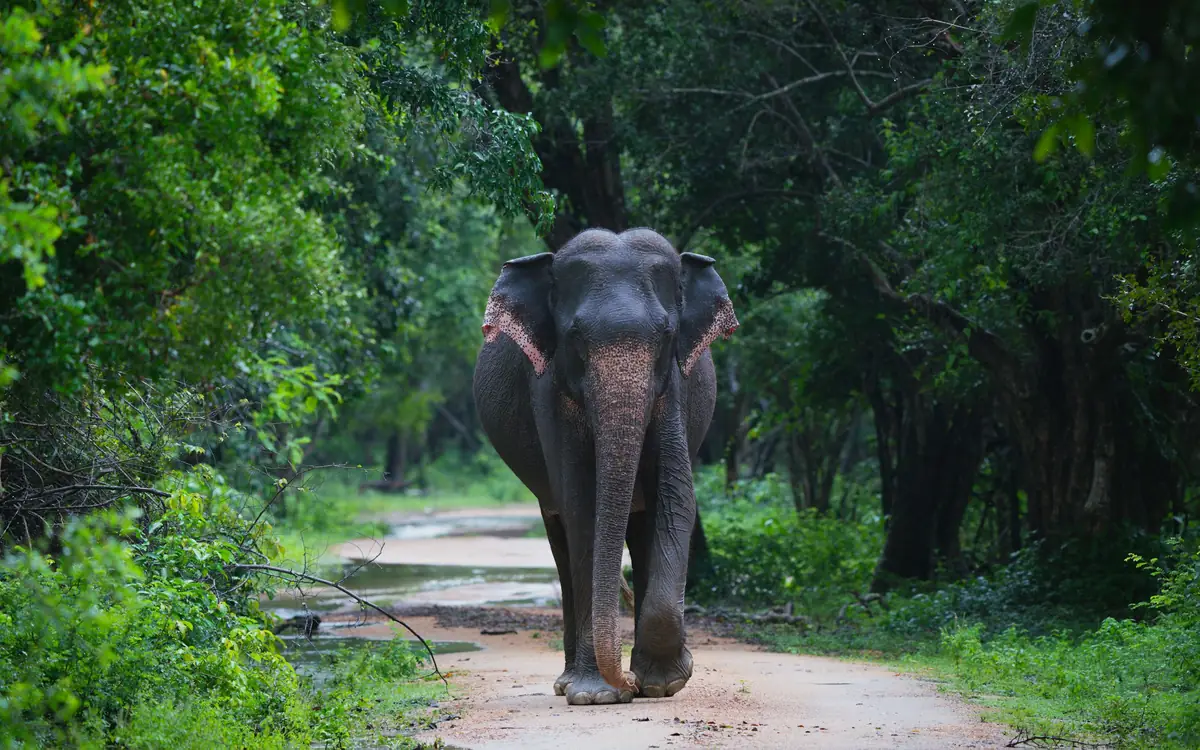
The grass at the edge of the forest is still warm from the afternoon sun when the first grey back appears above it. A large female steps out slowly, testing the ground, and behind her come two younger elephants and a calf that keeps close to her legs.
Nobody in the vehicle speaks. The elephants pull up grass, shake the soil from the roots against their knees and eat, as if the people watching from the track were simply part of the evening.
Wild Asian elephants in Thailand are best seen in protected forests, and Kui Buri National Park in Prachuap Khiri Khan Province is the place most often singled out for elephant viewing. Khao Yai National Park, Thailand’s first national park, is the other well documented option, because research links where its elephants appear to the park’s roads and salt licks. Kaeng Krachan National Park, in the same forest complex as Kui Buri, also holds elephants, though encounters there are less predictable. This guide covers wild elephants in protected areas only, not captive-elephant venues.
- Thailand has several thousand wild elephants. The national parks department estimated between 4,013 and 4,422 in its 2024 fiscal-year report.
- Kui Buri is the recognised viewing park. IUCN singles out Kui Buri National Park for well-managed elephant viewing.
- Khao Yai’s elephants follow roads and salt licks. Research found these were the main factors shaping where elephants appeared.
- Kaeng Krachan holds elephants too. Sightings in Kaeng Krachan National Park are a matter of chance.
- Distance keeps everyone safe. Visitor advice for Khao Yai National Park says to stop at least 30 metres away and stay in the vehicle.
Why Thailand still has wild elephants to see
Thailand still has several thousand wild elephants, and they live in national parks, wildlife sanctuaries and other protected forests. The Asian elephant is Thailand’s national animal and is listed as Endangered on the IUCN Red List, so every herd that survives in these forests matters.
The national picture comes from Thailand’s Department of National Parks, Wildlife and Plant Conservation. A report for the 2024 fiscal year, described by the Nation newspaper, put the wild population at between 4,013 and 4,422 elephants in 94 conservation areas. The IUCN SSC Asian Elephant Specialist Group, which worked with the Thai government on mapping elephant distribution, cites the same range and names the Western Forest Complex, Kaeng Krachan and Dong Phayayen-Khao Yai as major forest complexes for elephants.
Wild elephants in Thailand also leave the forest, which is why their story is not only one of good news. The same 2024 report named the Eastern Forest Complex, Kaeng Krachan and Dong Phayayen-Khao Yai among the complexes where elephants most often moved into farmland and villages. The parks below are places where people meet elephants on the elephants’ terms.
Kui Buri National Park: the best documented place for viewing
Kui Buri National Park is the protected area most clearly recognised for elephant viewing in Thailand. In its conservation assessment of the Kaeng Krachan Forest Complex, IUCN’s World Heritage Outlook describes Kui Buri as an area known for well-managed wildlife tourism, particularly elephant viewing, run with zoning and controlled access.
Kui Buri lies in the Tenasserim Hills of Prachuap Khiri Khan Province. Since 2021 it has been one of the four protected areas that make up the Kaeng Krachan Forest Complex World Heritage site, together with Kaeng Krachan and Chaloem Phrakiat Thai Prachan national parks and Mae Nam Phachi Wildlife Sanctuary.
Kui Buri’s elephant habitat has been the focus of years of careful work. WWF Thailand reports that it works with the Department of National Parks to create grass plots, salt licks and waterholes and to look after them regularly, and that wildlife numbers in the Kui Buri forest, including elephants and gaur, have increased. Villagers around the park now earn income as local guides for visitors.
How Kui Buri's elephants became a conservation story
Kui Buri’s elephants were once known mainly for conflict. A 2006 paper by WWF and Kasetsart University researchers described about 140 elephants living within the park, surrounded by 34 villages and more than 39,000 hectares of pineapple farms that strongly attracted the animals. Conflict had been recorded since 1995, and in 1997 a herd of 70 elephants destroyed a large pineapple farm, after which two elephants were killed.
Elephants in Kui Buri crossed into farmland 905 times in one year of that study, about two and a half times a day, and more often in the dry season, when the forest held less food. A management project started in 2004 brought together park staff, WWF, local officials and villagers.
A count in November 2025 by WWF Thailand, the park and local partners recorded up to 104 elephants at 20 points in the central Payang zone, and the overall estimate for all areas was around 400. WWF describes these figures as preliminary and still being verified.
Khao Yai National Park: elephants on the road
Khao Yai National Park is the second place where visitors have a realistic chance of meeting wild elephants, and the visitor advice published for the park expects that meeting to happen on the road. A camera-trap study from 2017 to 2020 found that roads and salt lick sites were the main factors influencing where elephants and five hoofed species occurred in the park.
Khao Yai is Thailand’s first national park, and since 2005 it has been part of the Dong Phayayen-Khao Yai Forest Complex World Heritage site, a chain of five protected areas. IUCN’s World Heritage Outlook lists the Asian elephant among the complex’s important species and reports that elephant numbers there appear stable or increasing.
Elephants in Khao Yai do not spread evenly across the forest. A 2024 study of patrol records rated only about a third of the park as moderately or highly suitable for elephants, with climate, water and salt the strongest influences, and the camera-trap study found the park’s boundary zone to be the most suitable habitat.
Kaeng Krachan National Park: wilder and less predictable
Kaeng Krachan National Park holds wild elephants, but a sighting there is a chance encounter rather than an expectation. The Kaeng Krachan Forest Complex lists the Asian elephant among its wildlife, yet IUCN’s assessment highlights Kui Buri, not Kaeng Krachan, for elephant viewing.
Kaeng Krachan National Park covers a large area of forest in the Tenasserim range. Its forests connect with Kui Buri through the Kui Buri Forest Reserve, which IUCN describes as an ecological corridor between the two parks.
Kaeng Krachan rewards patience more than a fixed plan, and visitors who do meet elephants there should follow the same safety rules as in Kui Buri or Khao Yai.
Wild elephants can be dangerous. Visitor advice for Khao Yai National Park warns that an agitated elephant, such as a mother with a calf, may attack something that bothers it even from a distance. Stay in your vehicle, keep well back, and follow park rangers’ instructions at all times.
Watching wild elephants safely
The safest way to watch wild elephants is from inside a vehicle, at a generous distance, with the engine running. Visitor advice published for Khao Yai National Park covers anyone who meets an elephant on the road, and the main points are simple enough to remember:
- Stop at least 30 metres from the elephant, and if it comes towards you, reverse carefully and wait for it to leave the road.
- Keep the engine running so you can move away; elephants are used to the steady sound of engines.
- Do not sound the horn, shout or try to drive the elephant away, and do not use flash photography.
- Do not park or get out of the car to take close-up photos, because elephants travel in family groups and you may not reach the car in time.
- Never feed wild animals; the advice explains that feeding changes their behaviour and can spread disease between people and animals.
Elephant body language gives useful warning. The same advice describes a relaxed elephant as one that flaps its ears, swings its tail and trunk or keeps feeding with little interest in people. An elephant that spreads its ears, holds its tail and trunk still and stares is upset, and that is the moment to give it more room.
Park rules and visitor arrangements change, so check the park’s official information, or ask at the visitor centre, before you go. In Kui Buri, the park’s zoning and controlled access are part of what keeps both elephants and visitors safe, so the evening herd at the forest edge can keep grazing undisturbed.
Frequently asked questions
Where is the best place to see wild elephants in Thailand?
Kui Buri National Park in Prachuap Khiri Khan Province is the protected area most clearly recognised for elephant viewing; IUCN’s World Heritage Outlook describes its wildlife tourism as well managed, with zoning and controlled access. Khao Yai National Park is another good option, where research has found roads and salt licks strongly shape where elephants appear.
How many wild elephants are there in Thailand?
Thailand’s Department of National Parks, Wildlife and Plant Conservation estimated in its 2024 fiscal-year report that between 4,013 and 4,422 wild elephants live in the country. The figure is an estimate spread across 94 conservation areas.
Can you see wild elephants in Khao Yai National Park?
Wild elephants live in Khao Yai National Park, and research has found that roads and salt licks strongly influence where they appear. Visitors who meet one on the road should stop at least 30 metres away and stay in the vehicle, as the park’s visitor advice says.
Sources
- IUCN World Heritage Outlook – Kaeng Krachan Forest Complex, conservation outlook assessment (2025)
- IUCN World Heritage Outlook – Dong Phayayen-Khao Yai Forest Complex, conservation outlook assessment (2025)
- IUCN SSC Asian Elephant Specialist Group – Thailand government collaboration on wild elephant distribution mapping (2024)
- The Nation (Thailand) – Wild elephants caused 227 deaths in 12 years; efforts to address this intensify (2024)
- WWF Thailand – Integrated Monitoring of Wild Elephant Populations in Kuiburi National Park (2025)
- WWF Thailand – Insights from Kuiburi: Managing Human-Elephant Conflict Through Collaboration (2024)
- Saranet S. and Tanakanjana N. – Conflict between Local Villagers and Elephants (Elephas maximus) at Kuiburi National Park, Thailand, in Exploring the Nature of Management (2006)
- Pla-ard M. et al. – Population characteristics and habitat suitability of Khao Yai National Park, Thailand for Asian elephant and five ungulate species, Biodiversitas 23 (2022)
- Nanla Y. et al. – Factors influencing appearance and suitable habitat for wild elephants in the Khao Yai National Park, Thailand, Biodiversitas 25 (2024)
- Khao Yai National Park visitor information – What to do if you see an elephant on the road?